On October 4, 2020, we packed up and moved to Zion Wright Family Ranch Campground about ten miles northeast of Virgin, Utah. The Wright Family has owned the ranch and eco-camp for six generations.
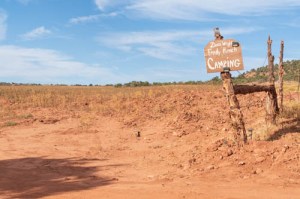
Zion Wright Family Ranch Camping
Don’t expect a staffed office for check-in or restrooms. Just drive through the fence opening, find a spot near a campfire ring that’s not already occupied, and set up. Oh, and pick a site away from the road and position your unit to avoid drifting sand from vehicles roaring down the dusty road.
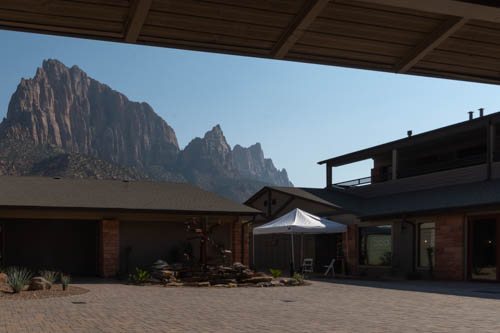
Sunrise at Zion Wright Family Ranch
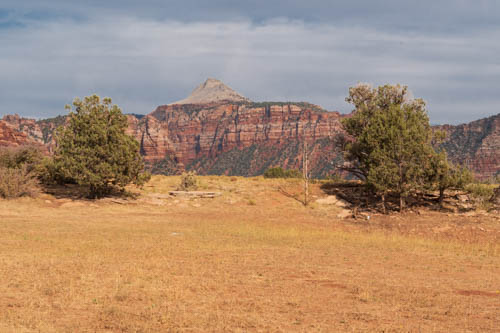
Afternoon view of Zion Wright Family Ranch
Porta-Potties are the only other amenity available. We can’t vouch for their cleanliness since we preferred our onboard facilities. Be prepared like a Scout with plenty of water, food, and fuel. It’s a long way back to town.
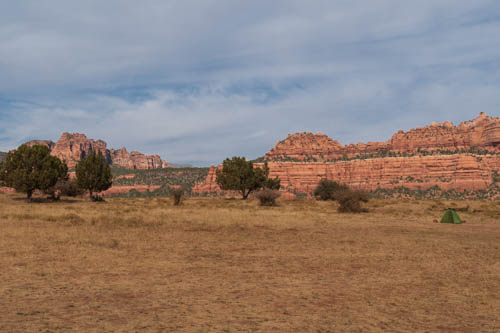
View from campsite at Zion Wright Family Ranch
Amenities were not what attracted us to the place. Our goal was to enjoy the clear star-gazing skies and find a hike or two. We were not disappointed on either account.
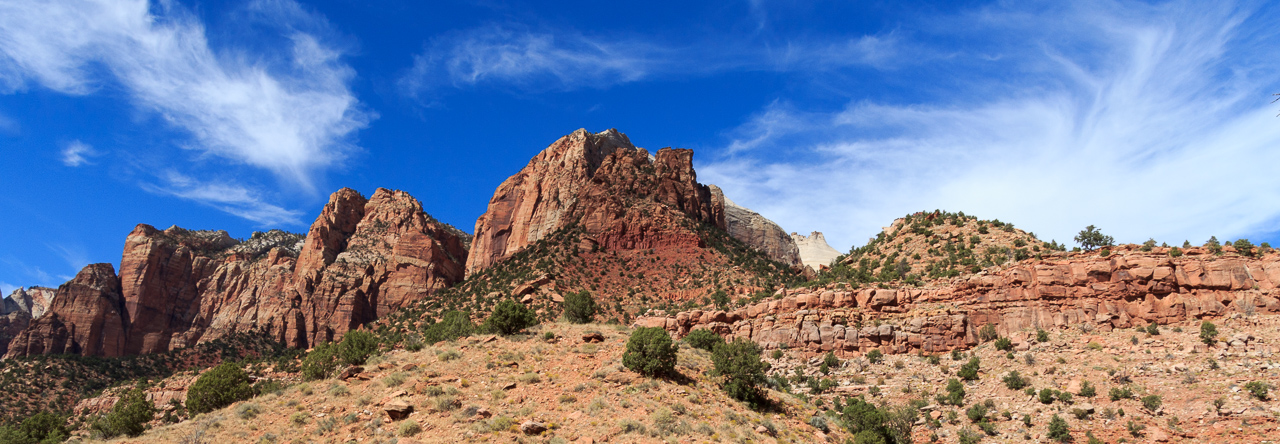
View of Zion NP peak from Zion Wright Family Ranch
The sky our first night was amazing. It had been decades since I’d seen the Milky Way so full of stars. It looked as though I could reach out and touch it. The big dipper hung above the horizon while we munched s’mores, dripping chocolate and marshmallow all over our hands. I can still picture in my mind all the stars, constellations, and Milky Way when I think of that night.
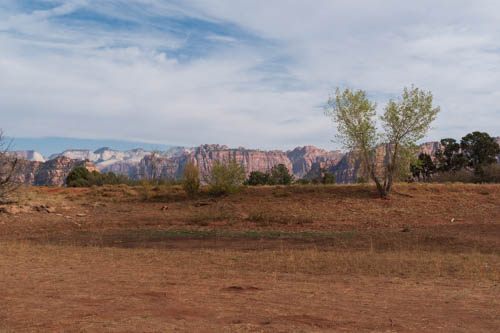
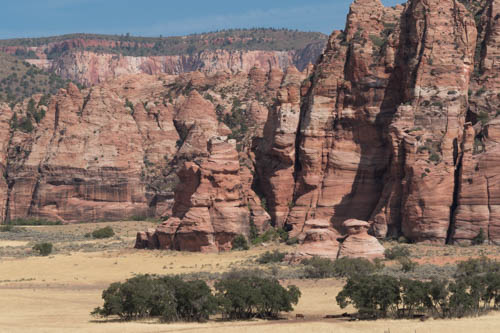
View of Zion NP peaks from campsite
The next day we found two hikes to keep us busy. The first was Lamb’s Knoll, a popular cayoneering site in the Kolob Terrace area of Zion National Park.
On the Lamb’s Knoll Trail
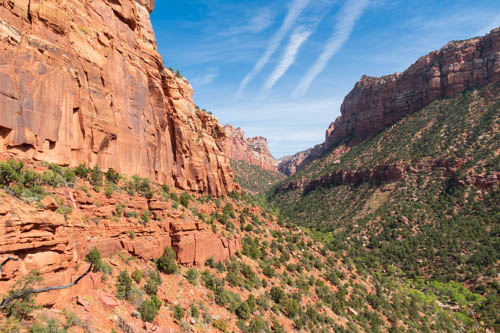
We lacked the gear and knowledge to scale any of the boulders and cliffs, so we hiked around them and through slot canyons. On the backside of the knoll, we found a beautiful view of the valley below.
Peek A Boo
On the Lamb’s Knoll trail
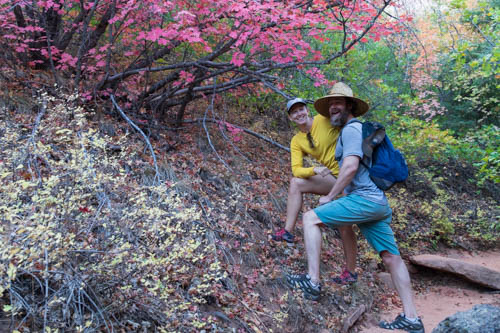
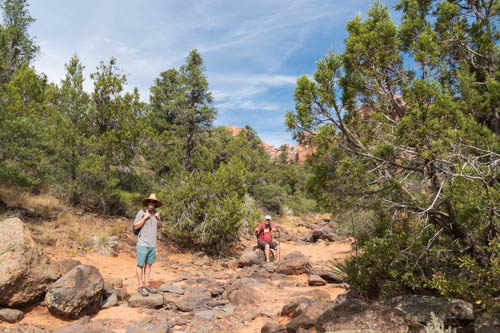
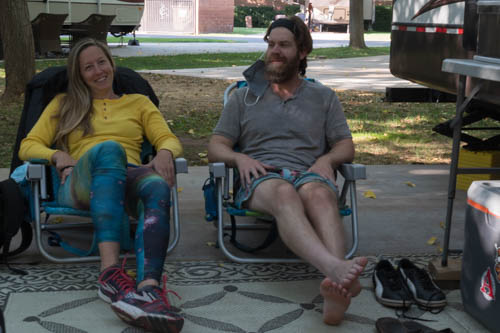
Kevin and Bailey strike a pose
View from Lamb’s Knoll parking lot
View from Lamb’s Knoll parking lot
Closer view from Lamb’s Knoll parking lot
View from backside of Lamb’s Knoll
The second hike was the Left Fork Trailhead that leads to the Subway. The entire trail to the Subway and back is nine miles, which was too strenuous and long for us after our time at Lamb’s Knoll.
Site along the Left Fork trailhead
The Subway is rated a semi-technical slot canyon hike that requires hikers to wade and swim through the river, scramble over boulders, and climb down waterfalls. For hikers wanting to go all the way to The Subway, they must pick up permits at one of the Zion NP visitor centers.
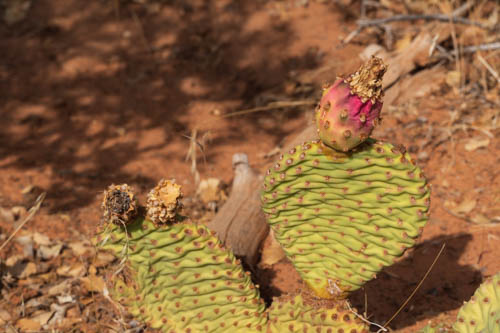
Prickly pear at end of blooming season
We stayed on the well-maintained trail that passed through pine trees, shrubs, and prickly pear until we reached the technical part, which was a steep descent into the valley. We stopped to take in the views and watch a couple navigate up the cliff.
View into canyon that leads to the Subway
On our way back to the parking lot, a wrong turn led us on a half-mile or so detour down a dry riverbed between canyon walls, then back again until we found the correct turnoff.
Taking a break along our riverbed detour
No one was interested in cooking dinner after our hard work of hiking, so we drove into Hurricane for a Mexican dinner at Las Lupitas Mexican Grill. We’re always on the lookout for good Mexican food, and Lupitas fit the bill.
Las Lupitas Mexican Grill in Hurricane, Utah
A layer of thin clouds foiled our expectation for a repeat of the celestial skies of the previous night. That was okay with us. We enjoyed another night around the campfire before it was time for bed.
The morning we left, I woke up early enough to capture this colorful sunrise.
Sunrise over Zion peaks
Coming up, we pull into Hitch-N-Post Campground in Panguitch, Utah, our base camp for Bryce National Park and Red Canyon State Park.
Yikes! One step forward and two steps back. This week California sent our county back to start in the game of “Open Up the Economy.” The current virus surge triggered feelings of sadness, despair, and grief for the many people suffering under the weight of COVID-19.
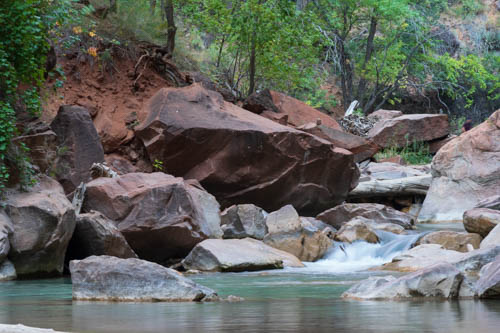
Virgin River
Then, while preparing the photos and narrative for this post, sadness turned to thankfulness. How lucky are we that so far our family has escaped infection and illness? How lucky are we that we have a home to keep us safe? And how lucky were we for the opportunity to visit Utah before the virus worsened across the nation? Pretty dang lucky, I’d say, and for that, we’re very thankful.
Balancing Rock on the Riverwalk Trail
While traveling we thought we had found a way to “live with the virus” that was safe for the people we encountered and for us. Unfortunately, it looks like we won’t be able to put our newly learned skills to the test anytime soon.
Virgin River
Instead, we will abide by the new restrictions the health department has placed on us and look back on our trip to Utah while reminding ourselves that someday we will again travel the roads and continue exploring the United States. We can wait a few more months. Hope it won’t be a year. If only we had a crystal ball to tell the future.
Zion National Park’s Swamp along the Virgin River
So, join us as we look back at our second day trip into Zion National Park.
Zion National Park adopted a reservation system for their shuttle into the canyon where many of the hikes and sites are located. The reservations are required for two reasons. The first is to reduce the number of people on the shuttles, and the second is to avoid the crowded long lines of people waiting to board them. Our attempt to snag four tickets the day before was unsuccessful, so we signed up for a private shuttle, costing $30.00 per person rather than the $1.00 the parked charged.
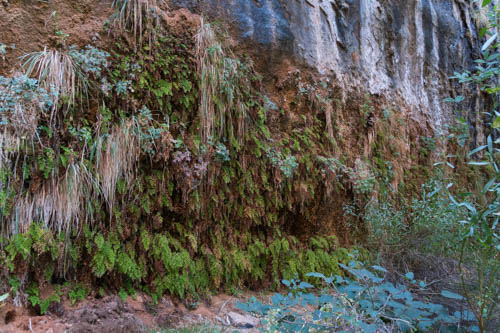
I call this Fern Wall. The Weeping Rock is 100 times more impressive, but it was closed.
We parked in the South Entrance visitor center parking lot and took the short walk across the bridge to Springdale. The gear store and our shuttle stop were in the shopping center close to the park entrance. I wasn’t too happy about sitting behind, in front of, and next to strangers in the van. The concept of social distancing was not adhered to on this shuttle as it was on the one the park ran. Everyone did wear a mask, though. I hoped it would be enough protection.
Virgin River
Our first stop was the Temple of Sinawava, which leads to the Riverside Walk and the Narrows trails. We took the Riverside Walk to the Narrows (photos above), and waved goodbye as Kevin and Bailey, wearing their special boots and grasping their hiking staff, continued their trek in the Narrows.
Random visitors at entrance to the Narrows Walk
Jon and I decided keeping the virus at bay was enough to deal with. No need to add the toxic cyanobacteria bloom in the Virgin River to our risk of possible illnesses. So we hopped back on the shuttle and got off at The Grotto. From there we took the Kayenta and Emerald Trails to Zion Lodge.
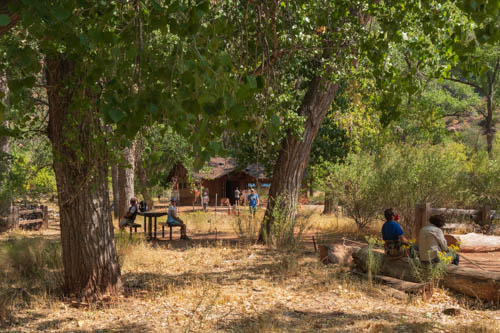
Visitors will find picnic tables and restrooms at The Grotto
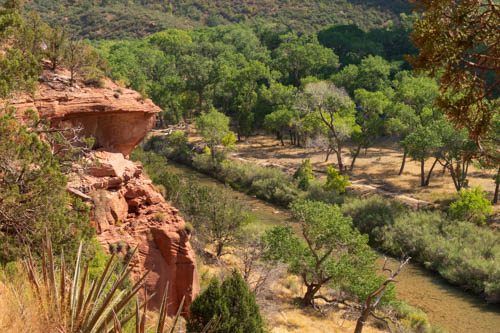
Virgin River and canyon cliffs from Kayenta Trail
Virgin River from Kayenta Trail
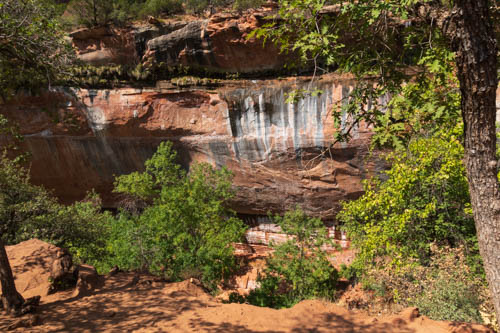
Lower Falls from the falls trail
Hard to see the waterfall from this spot
Zion National Park did not receive the normal amount of snow and rain this past year, so Lower Falls was more of a trickle than waterfall.
October 2020 the fall was like a trickle
This is a photo from October 2017 when the park received more precipitation.
October 2017 there was more water flowing
The trail under the waterfall’s overhang is slippery. Use the fencing to prevent falls.
Lower Falls trail
When we reached the lodge, Jon’s attitude turned grumpy when he realized our shuttle didn’t stop there.
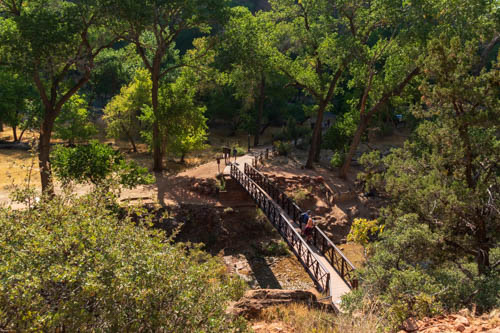
Bridge across the Virgin River from trail to the Lodge
We had another mile to go on The Grotto trail. The trails we took made a loop, normally our favorite. This time, it subjected me to bouts of grumbling as Jon trailed behind me.
I think the mesa on the left is the Sinawava Temple
We went back to where we picked up the shuttle that morning. A mocha frappuccino and protein bar perked us up as we recovered and waited for Kevin and Bailey to return from the Narrows hike.
So how was it hiking under the threat of COVID-19? Mostly I felt safe. The majority of hikers on the Riverside Trail wore masks. There were a few groups with college-aged people who walked around like, “Virus? What virus?” And other groups where there was one, maybe two, holdouts in a family of seven or eight were like, “No mask for me. Don’t tread on my rights.”
Back at the Grotto
That was okay because the trail was fairly wide, and it was easy to keep our distance. The Kayenta and Emerald Pools Trails was another story. The narrower path made it difficult to keep our distance from the “mask-less” folks.
Sitting under the overhang, drinking our shakes and enjoying the view
Our hike took us much longer than it should have since we had to step off the trail and let people without masks pass before we continued. We thought for sure one of us would end up infected. We’re happy to report our fear did not materialize. After that experience, we only hiked in places where there weren’t a bunch of people.
Kevin and Bailey relaxing after their walk through the Virgin River
So was it worth the $30.00 shuttle ride? We have to say yes. Hiking the narrows was an item on Kevin and Bailey’s bucket list, and we got to see a few sites in a different light than we did before. Besides, with our Lifetime Senior Pass, we entered the park for free.
The next day, we moved to Zion Wright Family Ranch for a couple of nights of dispersed camping to see a different side of Zion.
We counted the trip to the California coast a success, so it was time to map out our next adventure. Initially, we planned on a week or two in San Diego to visit our son, Kevin, and his better half, Bailey. They had other ideas in store for us. When they mentioned Zion and Bryce, we said, “Sure. Let’s go.”
With the trailer loaded with food and clothes, we made our first leg of the trip to Barstow, California, on October 3, 2020. Smoke from the California fires filled the skies until we reached the Tehachapi Summit. I switched the AC from recycle to fresh air and we took big deep breaths as we descended into the Mojave Desert.
The next morning we left Barstow at sunrise, which wasn’t all that early, only 6:50 a.m. It sure looked like smoke or dust or something had shaded the sky with orange and yellow hues. The iPhone 8 captured a surreal image.
Desert Sunrise
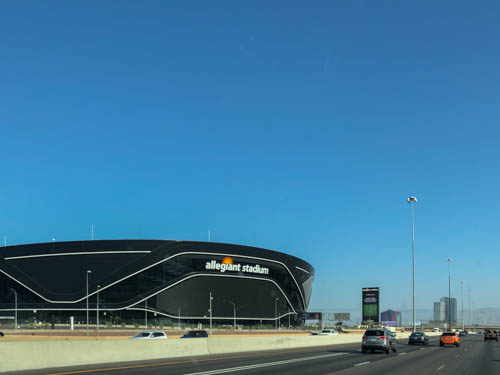
In Las Vegas, Nevada, we caught our first glimpse of the new Raider’s Allegiant Stadium from the freeway. Bitterness that the team left Oakland, again, still exists in the Bay Area, although I’m sure fans in Las Vegas are happy about the move. The stadium should be a boom to the City of Las Vegas once we come out of the pandemic, and fans are let back into the sports arenas.
Raider’s New Nation
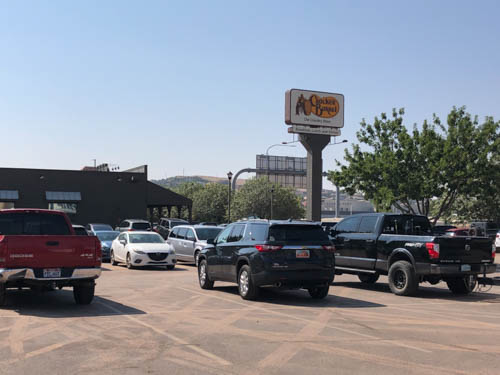
The quick breakfast we ate that morning had long worn off when we hit Las Vegas, which would have been a good place to stop and have a bite to eat. We try to avoid the big cities for our stops because it’s too difficult to maneuver through traffic and find a place to park with the rig. So, we sucked it up and drove the next two hours to St. George. That Cracker Barrel sign never looked so good by the time we arrived.
Breakfast, here we come.
In the Bay Area, dining options were limited to takeout and outdoor seating. In Southwestern Utah, they offered inside dining or takeout. Since we hadn’t been inside a restaurant for seven months, we chose the takeout. Cracker Barrel isn’t usually my first choice for a restaurant. I much prefer to buy food from an independent store or a local chain. Jon, on the other hand, loves their pecan pancakes. We put on our masks, locked up the trailer, and set out to order our meals.
We were leery about all the people waiting outside, rocking in the chairs on the porch or standing next to the railing and ignoring the six feet of distance we had practiced since March. Only half of them wore masks. At the time, wearing face coverings was only a suggestion, not a state mandate. The state now requires masks in all state-owned buildings and individual counties may have their own requirements.
We kept our distance the best we could, stepped up to the podium, and ordered our meals. A few minutes later, we were inside the trailer, chowing down on the best Cracker Barrel breakfast and cup of coffee I had ever had. Either the cooks do a better job at the Cracker Barrel in St. George, or I was so hungry, a dog bone would have tasted good to me.
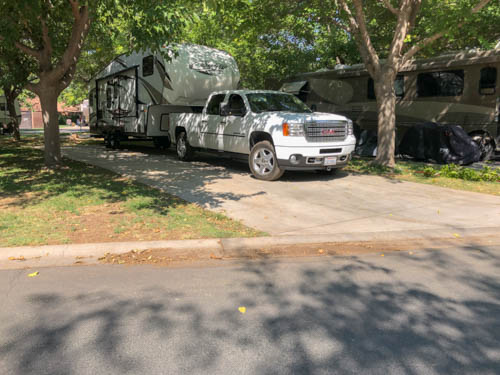
With our bellies filled, we drove the remaining thirty minutes to WillowWind RV Park in Hurricane, Utah, where we had booked three nights. Kevin and Bailey arrived a few hours later.
Campsite at WillowWind RV Park
On our first day in Zion National Park, we checked out the situation for catching the shuttle (we couldn’t get tickets for the park shuttle, so paid for a private one) and renting equipment Kevin and Bailey would need for their river walk the next day. Then we drove to the east end to see other sections of the park and find a place to eat our lunch.
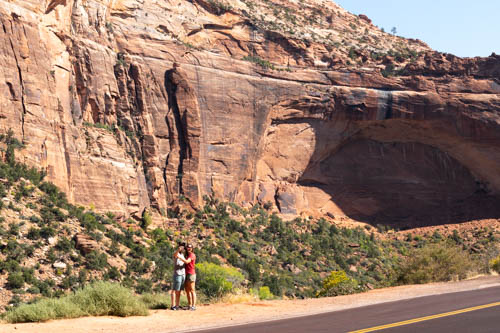
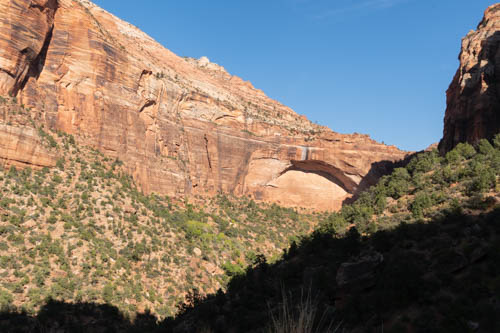
An arch in the making
Reverse view from Arch in the making
Look at that view
We passed the Canyon Overlook Trail on our way to the tunnel, and there were no parking spots. So we kept driving and found a place with a bit of fall color to eat our lunch and take a break.
Shootin’ the breeze
Navajo sandstone
Fall is near
View from picnic site
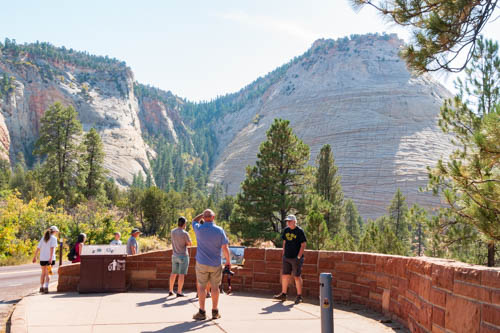
Checkerboard Mesa is a good place to stop for views. There is plenty of parking, information signs, and plenty of sites to see. Unfortunately, the position of the sun made it difficult to capture the checkerboard feature on the mesa. Earlier in the day would have been better.
Checkerboard Mesa
The sun was coming from a better angle, so the colors pop in the photo of East Temple.
East Temple
And here are two more views along the road.
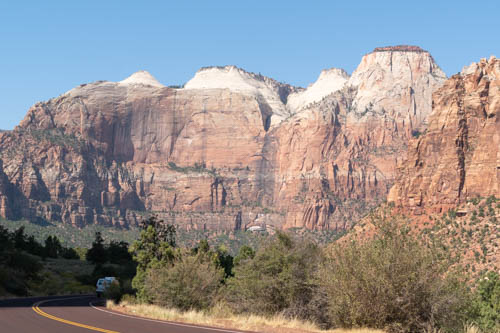
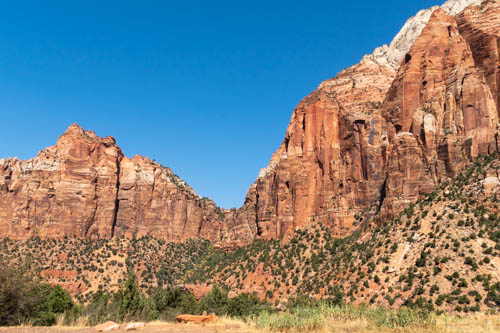
View of mountains and cliffs
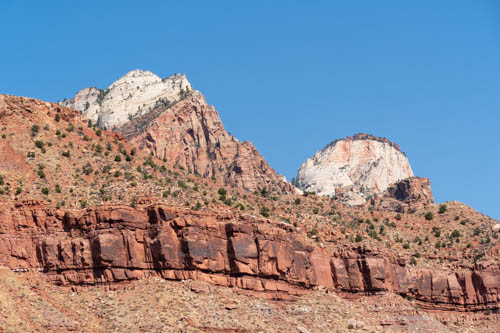
View of geological formations
Outside of the park on the east side is The Get and across the street is an RV and tent campground and cabins to rent.
The Get sells a bit of groceries, sandwiches, gifts, and souvenirs.
On our way back to the west side of the park, we scouted around for a parking space at the Canyon Overlook and ended up having to stop and wait for one-way traffic to clear. When the west-bound vehicles started flowing, a car just ahead of us pulled out, and we slipped right in as if it was all planned perfectly.
View from Canyon Overlook Trail
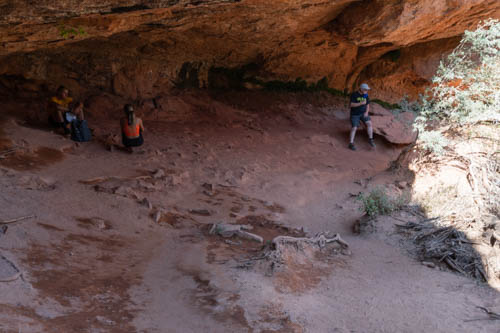
At first we thought the overlook was close by. It turned out further than we thought. I brought my water bottle with me, but no one else did. We hoofed it most of the way, at least to the section where the cave was and we could peek down into the canyon. So, word of caution: come prepared for a hike, not a short walk.
View from Canyon Overlook Trail
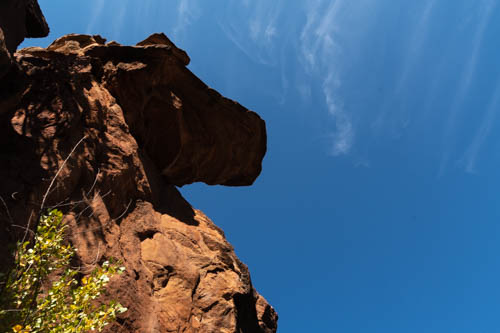
Anyone else see a horse’s head?
View of cave from Canyon Overlook Trail
A place to rest
View from cave into canyon
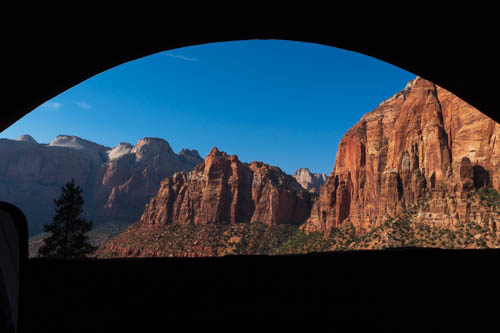
Heading west through the tunnel gives a person a good view out the windows. Luckily, no one was behind us, so Jon stopped the truck for a couple of seconds so we could capture the view with our cameras.
View from one of the tunnel windows
After the tunnel there are a few places to stop and take in the views and spot the windows in the rock walls.
Another arch in the making
Zion-Mt. Carmel Tunnel window
Next up we have another day of more fun and games in Zion.
Before we continue our exploration of the California Coast and our visit to Año Nuevo Point and Island, Pigeon Point Light Station State Historic Park, and the Town of Pescadero, a brief update about our absence from WordPress.
As I write this, it is November 4, 2020, the day after the quadrennial presidential election, and the results of the election are still up in the air. Are we all biting our fingernails? We spent the past month in Utah, Arizona, on the eastern side of the California Sierras, and Nevada. Often we lacked reliable cell and WiFi service that hampered our ability to publish posts. The lack of connectivity was not always a bad thing. It kept us unaware of the pandemic marching across the nation and away from the bickering political campaigns for large chunks of time. We’re back in the real world now, and will publish future articles on our October 2020 COVID-19 Adventure.
Until then, here’s a look at what else we encountered along the California Coast in September. To see the first article, click here.
Año Nuevo Point and Island
We had visited Año Nuevo State Park several years ago and were excited about seeing this unique location again. The park includes the Año Nuevo Coast Natural Preserve, which protects the breeding colonies of northern elephant seals. The seals are year-round residents that peepers like me can normally view by permit or guided walk.
Trail to and from elephant seal viewing area
We took the trail to the preserve, walking through walls of poison oak trimmed back from the trail. Little blue daisies dotted the path along the way.
Poison oak and blue daisies
At the end of the trail, a ranger told us that guided walks were canceled because of COVID-19. The sound from the other side of the hill made me think the seals were having a party and enjoying their secluded cove without the prying eyes of tourists. I so wanted to watch them in action. I’ll be keeping tabs on the website for when the viewing area reopens. These eyes want to pry.
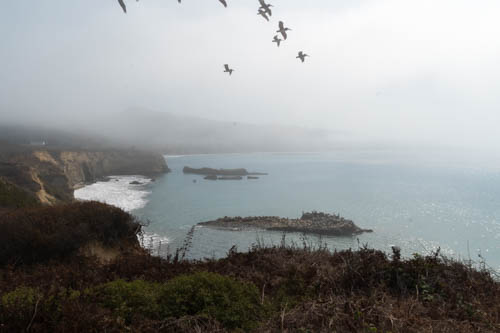
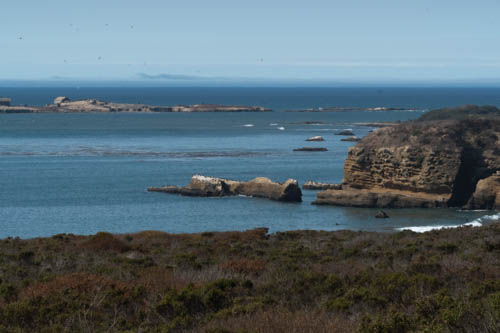
We walked around the short trail while fog hung close to the shoreline, partially obscuring the view of the nearby hills and pelican colonies that breed on the little islands.
Foggy skiesA touch of blue
Along the way, several species of birds enjoyed splashing in a freshwater wetland, cleaning their feathers.
Wetland attracts birds of all types
Other features at Año Nuevo are the historic buildings of the Cypress Dairy. Edwin and Effie Dickerman built the farm in 1881 to make butter and cream. In the 1930s, the family switched to growing artichokes and Brussels sprouts, crops which still grow in the area today.
Cypress Dairy house
The State of California added the farm to Año Nuevo State Park in 1968 when they purchased the ranch. We enjoyed being the only ones walking around the buildings and taking photos. Had the buildings been open and docents nearby, I’m sure we would have heard interesting stories about the Dickerman family.
Cypress Dairy farm equipment on display
Pigeon Point Light Station State Historic Park
A short distance from where we stayed at Costanoa stands Pigeon Point Lighthouse, one of the tallest lighthouses in America at 115 feet. The lighthouse began service on November 15, 1872, when the five-wick oil lamp was first lit. An automated LED beacon replaced the original Fresnel lens and is still an active U.S. Coast Guard navigation aid.
Pigeon Point lighthouse across the bay
The lighthouse has been closed for repairs since December 2001 when the iron belt course fell off of the exterior. In August 2019, California State Parks announced funding for the stabilization and restoration project to begin the spring of 2020. In mid-2020 a request for proposals was to be released for the $9 million projects. Maybe next year they can start the project.
Pigeon Point lighthouseA whole lotta rust up there
We missed out on seeing the elephant seals at Año Nuevo, but the harbor seals sunbathing on the little island near the lighthouse did not escape our notice.
Soakin’ up the rays
Next to the lighthouse are three rental houses for up to 10 people at a nightly rate of $350 to $500, depending on the time of year.
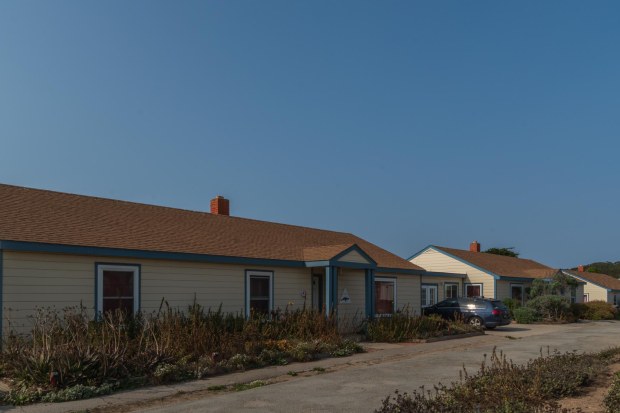
Hostel houses for rent
Twelve ships wrecked along the shore between Año Nuevo and Pigeon Point, between 1853 and 1953. The Point Arena, a steam schooner built in 1887, carrying cargo along California’s central coast, was one of the twelve ships that succumbed to the power of the sea.
Remains of the Port Arena schooner
While loading tanbark at Pigeon Point, rough seas forced her on the rocks and tore a hole in the hull. The sailors watched in horror as the waves ripped her apart. They burned the remains to prevent danger to other ships, and everyone thought there was nothing left. Eighty years later in 1983, a five-ton section of the hull washed ashore at Año Nuevo as a testament to the power of storms and oceans. They hid from view a five-ton hunk of a hull for eighty years and then spit it out one day.
Pescadero, California
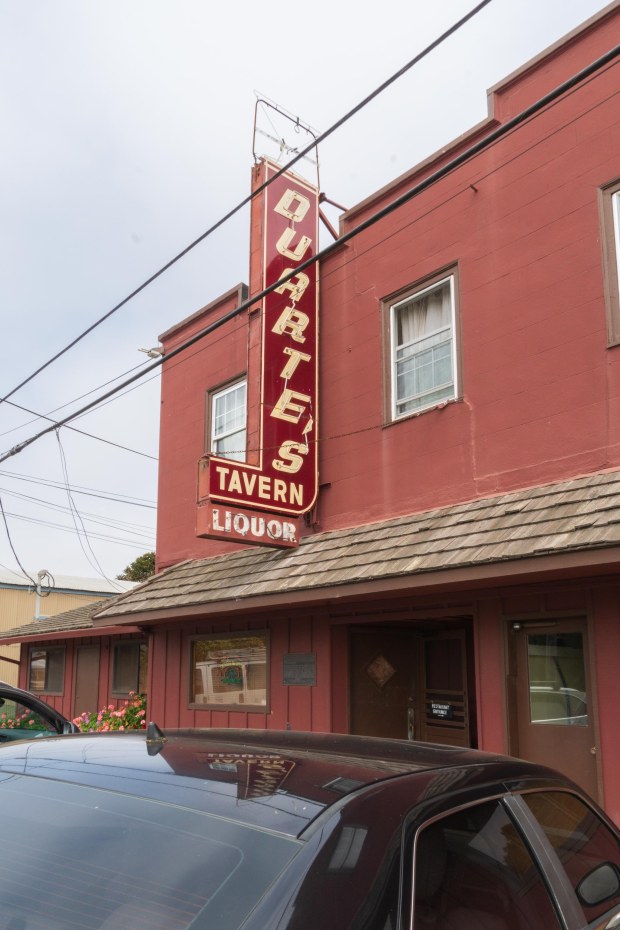
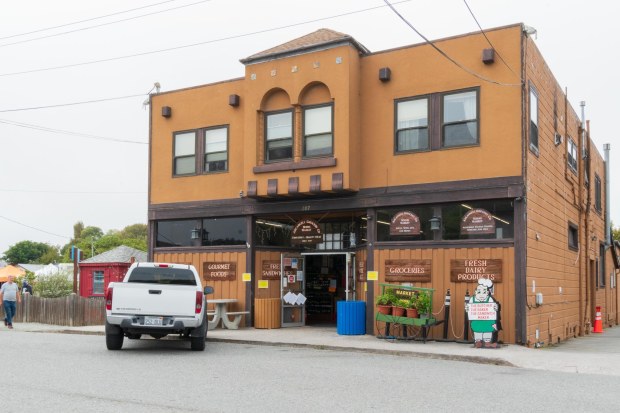
I had the pleasure of working near Pescadero a few times during my accounting days and was introduced to Duarte’s Tavern, where I remember having one of the best pieces of pie.
No pie for us. Duarte’s was closed.
We drove there expecting to buy a slice to take home. Unfortunately, they were closed. A couple walking by told us the restaurant hadn’t kept regular hours since the county enacted pandemic health restrictions. I hope they survive the restrictions and the economic downturn. I’d sure love to taste the best pie I ever ate again. Will it taste as good as I remember?
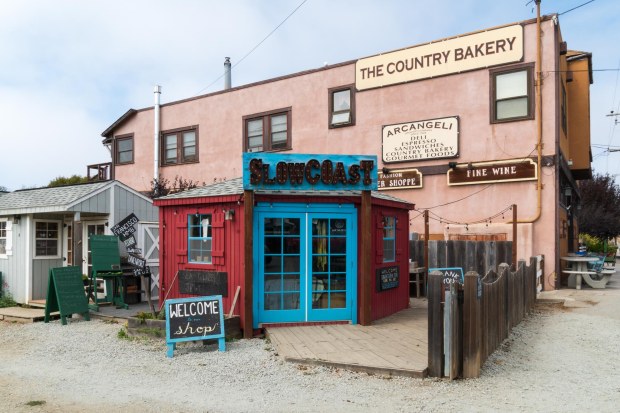
Shops in sheds
A plaque on the building dated September 29, 1990, states the Duarte’s Tavern is run by the third and fourth generations of the Duarte Family. The plague also states that Frank Duarte started it all when he brought a barrel of whiskey from Santa Cruz in the 1890s and set up his bar.
Popular place for groceries and sandwiches
Closed during prohibition, Duartes reopened and expanded with the restaurant in 1937. The original building burned in 1926, but the bar was saved and is still in use today.
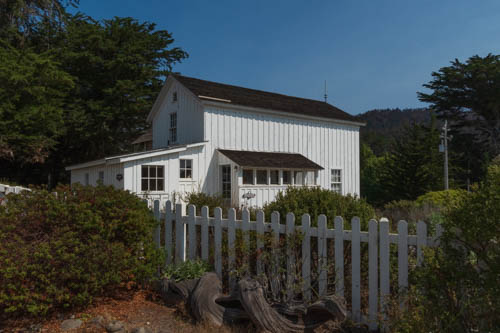
House in Pescadero
Cemeteries
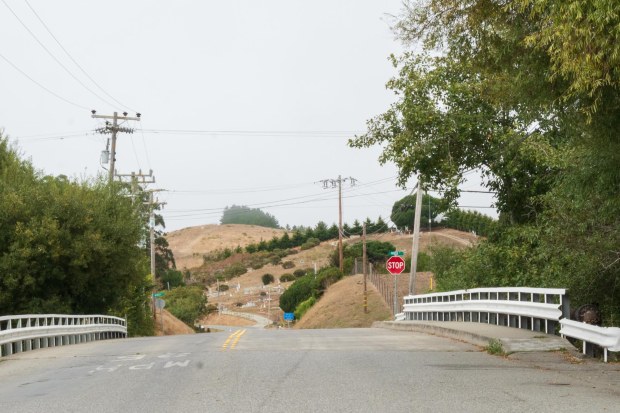
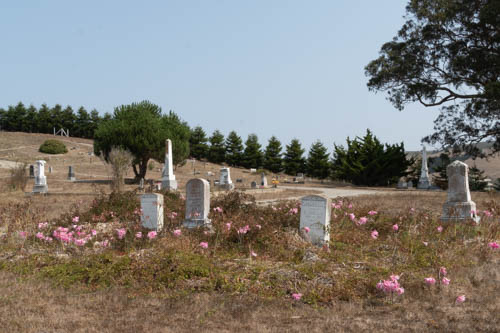
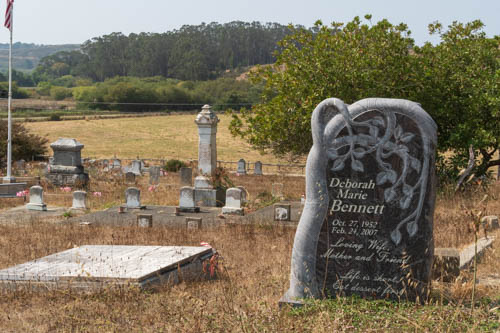
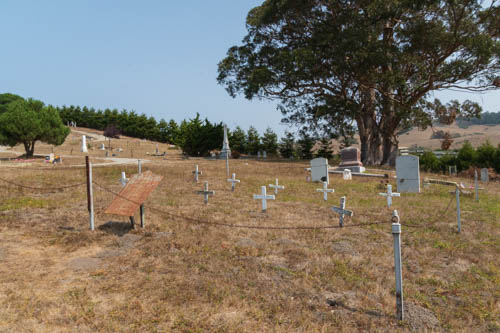
I recently learned there’s a name for people like me who like to wander around cemeteries. I’m a taphophile, a person who is interested in cemeteries, funerals, and gravestones. I’m not so enamored with funerals, but cemeteries and gravestones pique my interest. And the more historic, the better. Pescadero has two cemeteries side-by-side on a hill at the end of the downtown area.
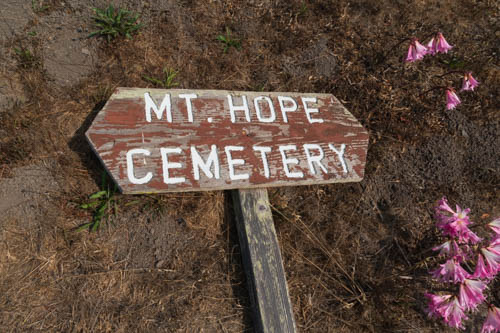
Cemetery on the hillMt. Hope Cemetery’s sign fell down
Mt. Hope Cemetery and St. Anthony’s Catholic Cemetery are not your typical modern-day cemeteries. No manicured grounds there. One must walk carefully around the plots to avoid tripping over a molehill or twisting an ankle in a gopher hole.
St. Anthony’s Cemetery
Family plots, containing generations of ancestors and relatives, are sectioned off. Some plots are well maintained while others appear abandoned. New headstones, small and large, mix in with the faded and eroded markings from historic eras.
Lillies add color to this family plot
Why do I like cemeteries? I’m intrigued by the people buried there. Each grave represents a person who lived on this earth, who was loved, who was special in their own right. There are so many stories buried in graveyards, and I yearn to know them all.
Old and new
What kind of life did they lead? What were their goals and achievements? What were their hardships and struggles? Who did they love? Did they have big families or small families? What were their views on politics, religion, and faith? Did they suffer, or did they lead happy lives?
Older family plot
And when I see a grave that holds the remains of a child, my heart breaks to think about the pain suffered by the parents, or the life that never grew and matured and loved.
Tree protects the headstones
Maybe it’s the emotions that attract me to cemeteries, the happiness I feel for the person who lived a long life, the sadness for the person who did not, combined with the stories I imagine in my head from reading the names, the dates, and epitaphs. Whatever it is, I’m sure I’ll continue to turn my head whenever I pass a cemetery and want to stop the car, get out, and walk through the graves.
Well, that concludes our brief visit to the California Coast. Next up we’ll start our October 2020 COVID-19 Adventure.




































 The Traveling Todds