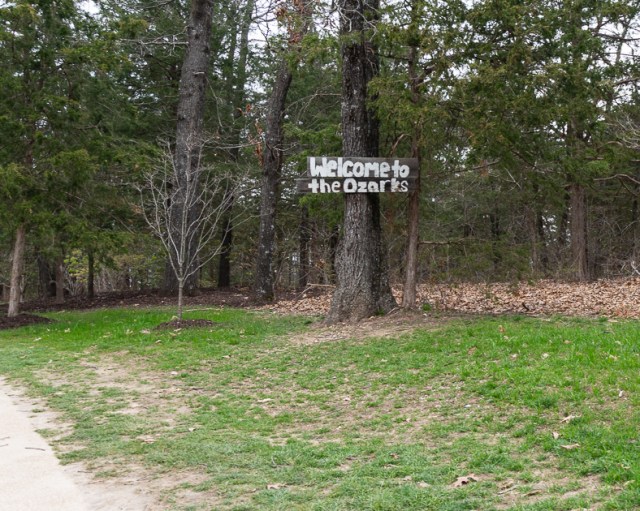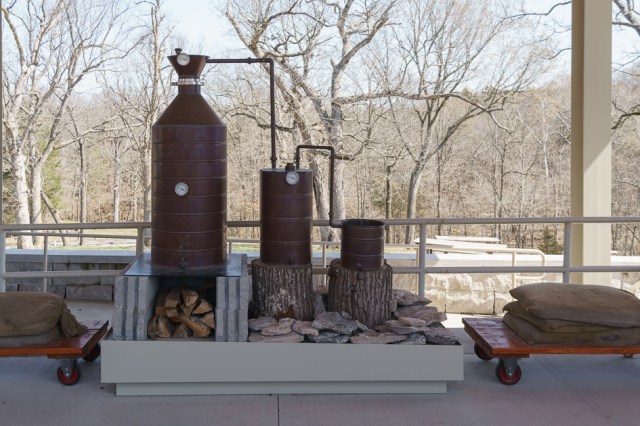
Spring 2023 Adventure Episode 4: A Little House on the Prairie

I’ve often heard it said that you’re never too late to write the story of your heart. It’s a good thing that Laura Ingalls Wilder (1867–1957) didn’t let her age of 65 hold her back from writing hers. Encouraged by her daughter, Rose Wilder Lane (1886–1968), Laura wrote the first four books of the Little House on the Prairie series in the Rock House on Rocky Ridge Farm.
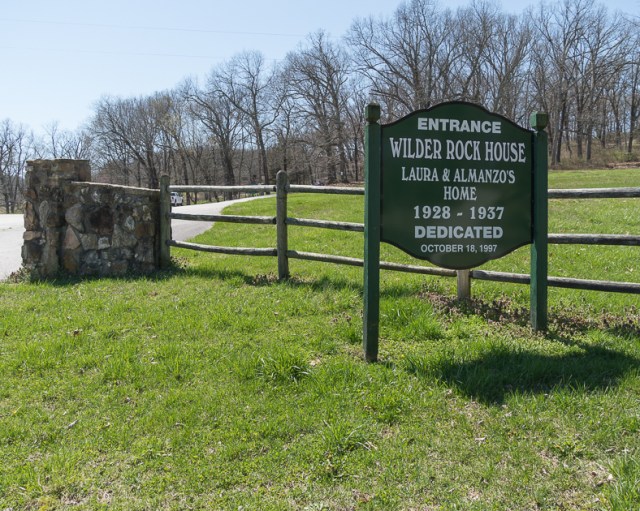
Wilder Rock House

Rocky Ridge Farm Rock House

We drove to Mansfield, Missouri, on April 2, 2023, and joined a docent and several guests at the front door of Rock House on Rocky Ridge Farm. We learned Rose built the house for her parents, Laura Wilder and Almanzo Wilder (1857–1949, birth year disputed). Our tour guide crammed us all into the small rooms, not allowing us to wander or linger behind, so interior photos were impossible to snap.

She regaled us with stories about the family, much of which I’ve forgotten, as she ushered us from one small room to another. I should record these presentations, but I’m usually so enthralled with the tour guide’s presentation, I forget to ask permission.
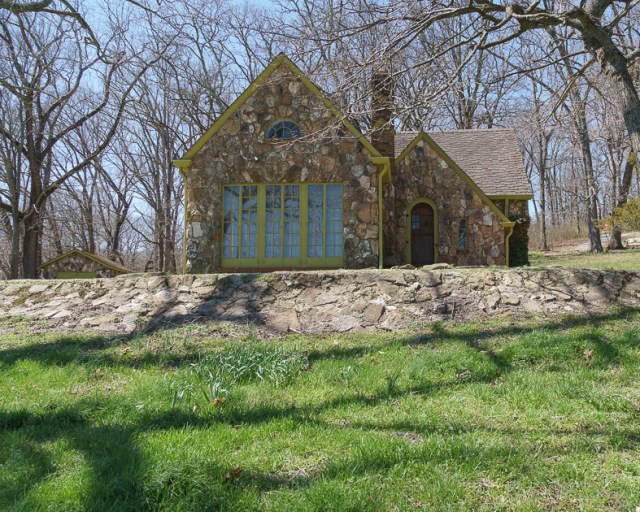
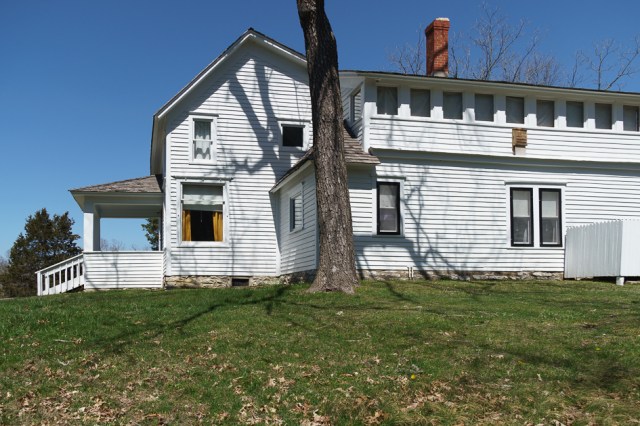
Front of Rock House

Rose had the Rock House built upon her return from travels in 1928. The home included many of the modern conveniences of the day as a gift to her parents. Laura and Almanzo moved in at Christmas time that year.

The couple lived in the home until 1936 when they moved back to the Rocky Ridge Farm farmhouse. I guess living in the farmhouse was more to their liking than the modern conveniences afforded them at the Rock House.
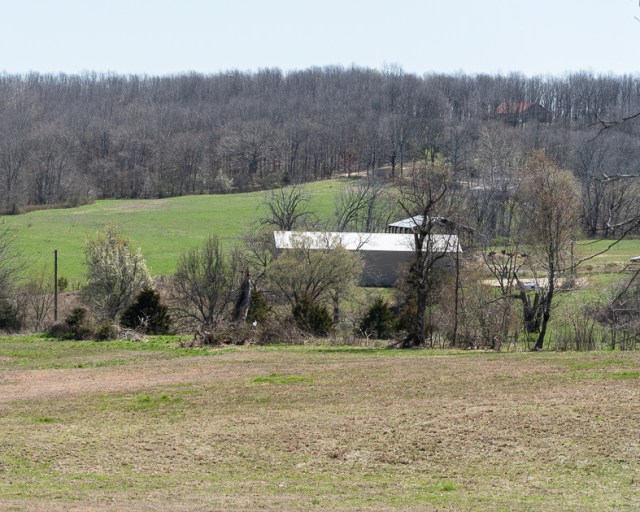
View from front of Rock House

A portion of the property and Rock House was eventually sold and passed through a few owners before the Wilder Home Association could repurchase it. Amazingly, many of the original fixtures and design features remained intact.

Barn across the street from Rock House

Rocky Ridge Farm farmhouse

The farmhouse was our next tour with a different guide. The process for the tour was the same in the farmhouse as at the Rock House. The guide crammed us first into the kitchen area and then into each subsequent room. However, this time I could take a few quick photos by lagging behind a bit.
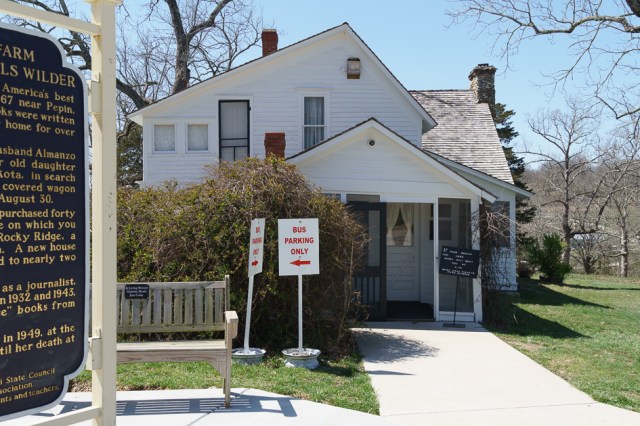
Entrance to the Wilder farmhouse is through the kitchen

Arriving in Mansfield, Missouri, from South Dakota in August 1894, Laura and Almanzo purchased a forty-acre farm with a one-room log cabin near a spring and ravine. A year later in 1895, they built a room onto the side of the house and the next year they moved the new room to the present historic house location where it is now the kitchen. Additional add-ons included a two-room house with an attic bedroom for Rose. Construction on the home was completed in 1913.
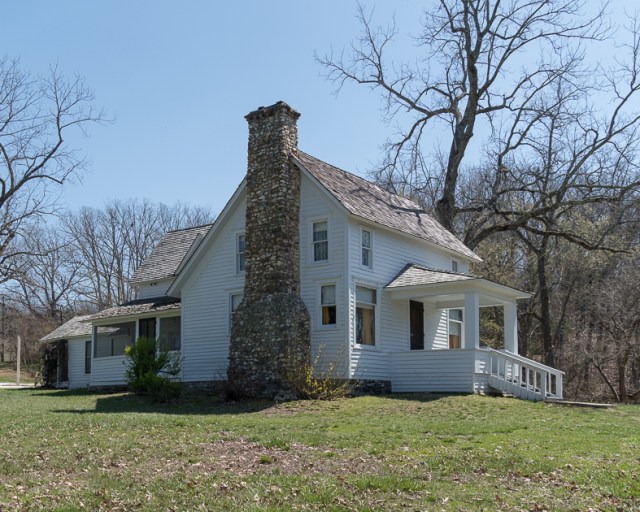
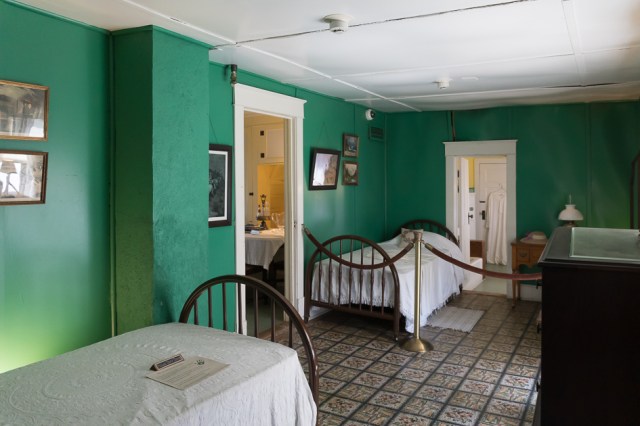
Laura and Almanzo shared the room with each having their own bed.
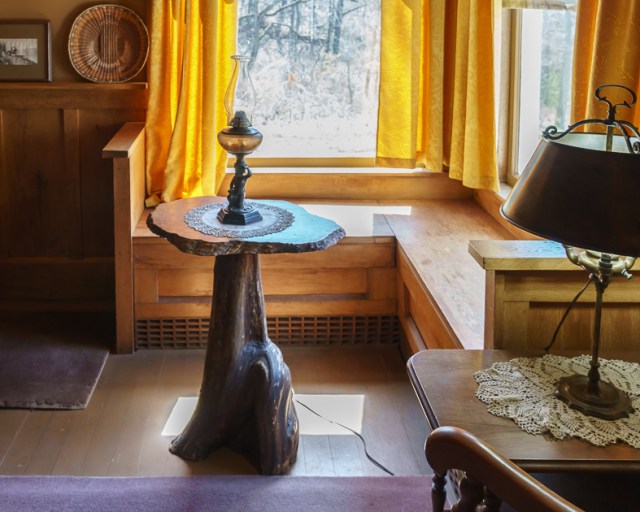
Reading nook in the living room

The home remains as it was in 1957 with the same furnishings, dishes, and pictures. Conservation projects began in 2018 to preserve the furniture. The rose-colored armchair in the photo below was the first piece of furniture to be preserved under the Save America’s Treasures National Trust for Historical Preservation. Additional preservation projects are underway.
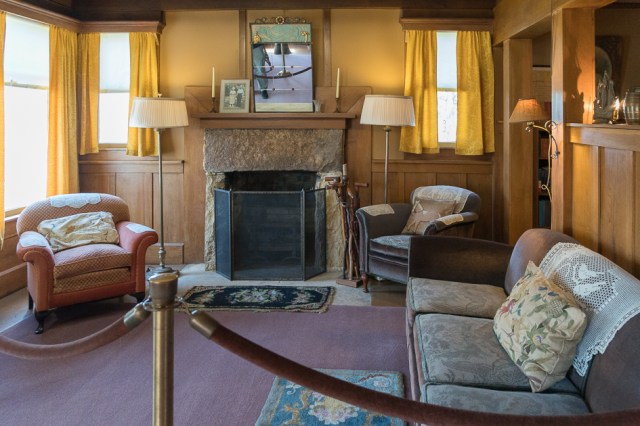
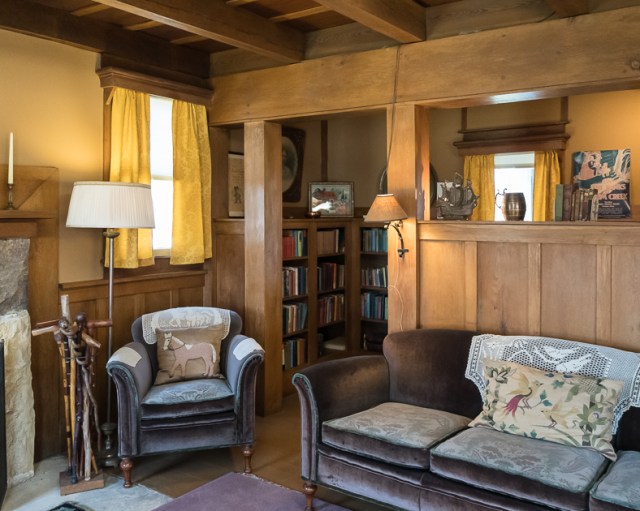
The rose colored chair is the first piece of furniture to be preserved
A peek at the library adjacent to the living room
A portrait of Rose hangs on the wall of the music space to the side of the living room

Museum at Rocky Ridge Farm

Our final stop was the Museum at Rocky Ridge Farm. Here is where the Ingalls and Wilder family collections are displayed. Artifacts include: The Little House on the Prairie books, Pa’s fiddle, handwritten manuscripts, keepsakes, tools, and objects Almanzo made.
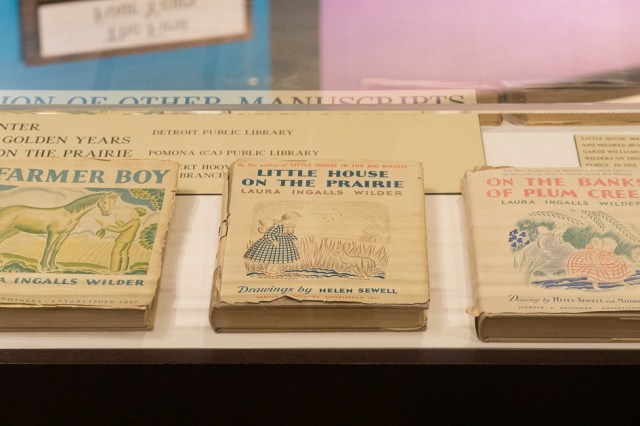
Early editions of Little House on the Prairie books
Dresses worn by Laura
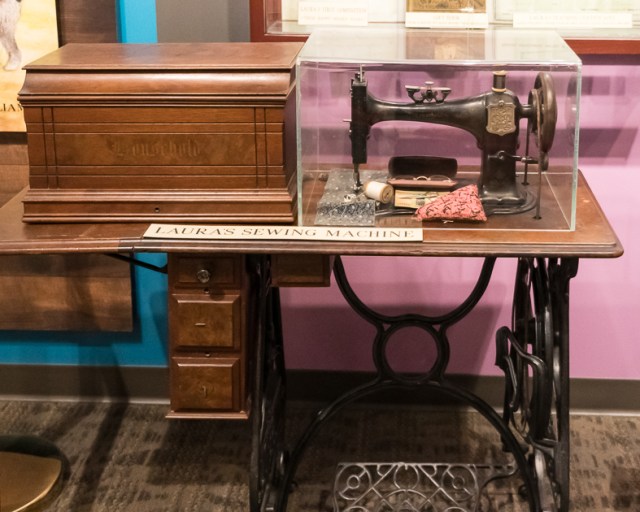
Laura’s sewing machine
Historical timeline across the top with displays of each of her books
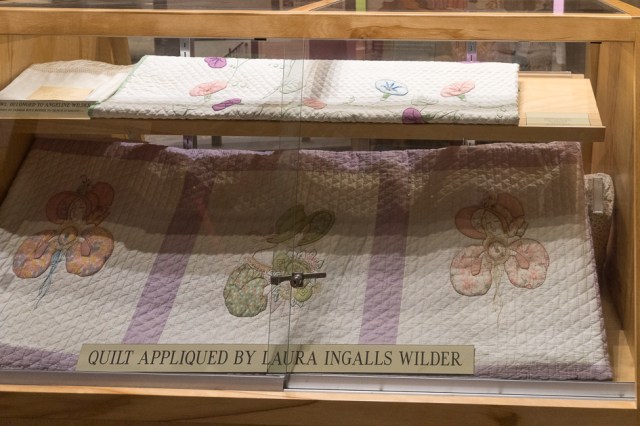
Laura appliqued these quilts

There is also a section dedicated to the life of Rose Wilder Lane, who was a writer. Her writing career, the objects she used, and her clothes are on display.

Rose’s typewriter and displays of her books, featuring Let the Hurricane Roar
Samples of clothing worn by Rose Wilder Lane

City of Mansfield

Before leaving Mansfield, we stopped at the town square to take in the town where Laura, Almanzo, and Rose called home. In 1881, F.M. Mansfield, a Hartville attorney, and George H. Nettleton, a Kansas City surveyor, purchased land that would become the City of Mansfield, Missouri, “Where the Little House Books were written.”

Mansfield town square includes a tribute to Laura Ingalls Wilder
Mansfield Historical Society and Museum was closed during our visit
Wingo’s Cafe looked like the place to eat. Too bad we weren’t hungry yet.
A New Chapter sells books on the square. They weren’t open but a walk around the corner and a peek in the windows revealed a collection of books the likes of which I’ve never seen.
The Weaver Inn B&B looked like a quaint place to spend a night or two while exploring the area.
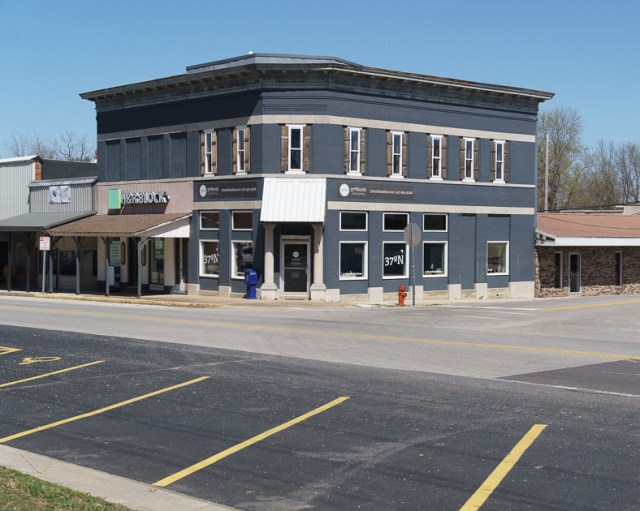
37O North Realty and H&R Block occupy a prime location
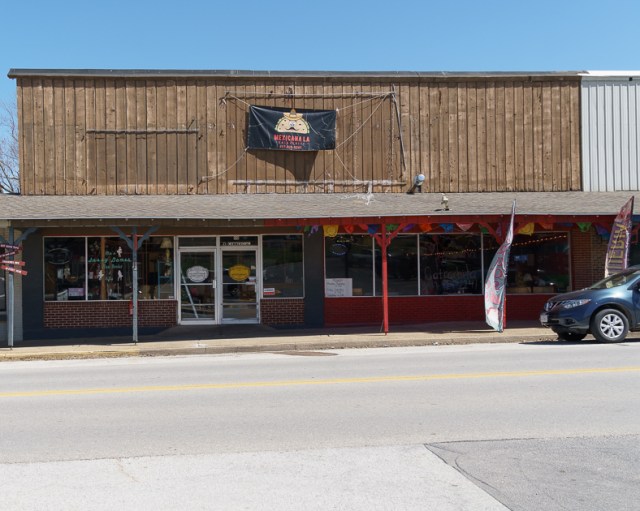
Mexicana La Catrachita might have been a good choice for lunch too if we had been hungry
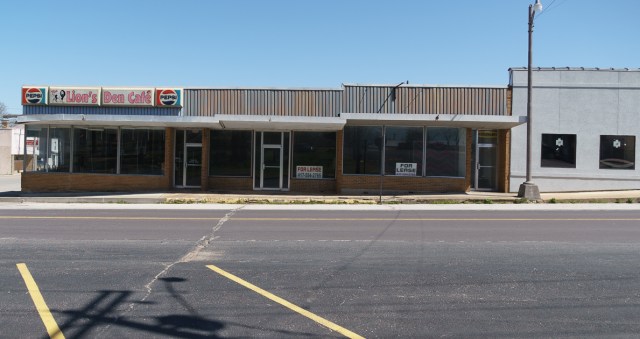
Lion’s Den Cafe listed on Google search as permanently closed
HomePride Bank

As you might have noticed from the photos, the city downtown area could use revitalization. I’m sure it’s hard to have a thriving downtown area with a population of approximately 1230 people. Wouldn’t it be nice to return in a year or two and see the stores filled with businesses?

I found the City of Mansfield’s website interesting. It has a detailed historical timeline listing dates such as when the first post office opened, or when the first school was built. Mining was an economic driver in the 1880s until the boom ended in 1920, then the dairy industry took over and remains strong. Instead of listing out the entire timeline, I’ll let readers visit the website on their own if they are interested.

Let me close out this post with quote:

I am beginning to learn that it is the sweet, simple things of life which are the real ones after all. — Laura Ingalls Wilder

Has Laura Ingalls Wilder inspired you to write the story of your heart?

Next up: Green County Botanical Center and Mizumoto Japanese Stroll Garden in Springfield, Missouri

Safe Travels
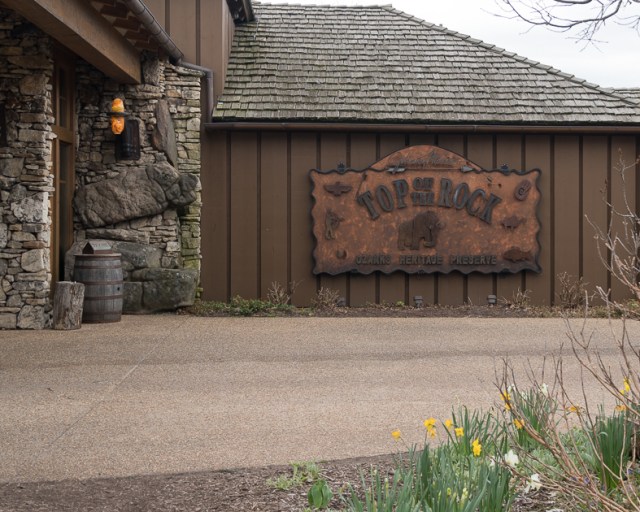
Spring 2023 Adventure Episode 3: Top of the Rock Ozark Heritage Preserve

The ad for a 2-1/2 mile golf cart tour piqued my curiosity with its promise of rock formations, trees, flowers, bridges, waterfalls, and views of Table Rock Lake. So, on March 17, 2023, we loaded Laura and the grandkids in the pickup and headed for Top of the Rock Ozark Heritage Preserve near Branson, Missouri.

Top of the Rock

Golf Cart Tour

Bass Pro Shops founder, Johnny Morris, created the preserve and developed Big Cedar Lodge along with five golf courses and other amenities.

Tickets are timed to limit the number of golf carts on the trail at any given time, which was good because cart parking at the pullout areas was limited. We bundled up in our jackets, put the pedals to the metal, and puttered down the trail.

And away we go
View of what’s to come
Water, water, everywhere in Missouri
Redbud blooming as winter turns to spring
Strike a pose
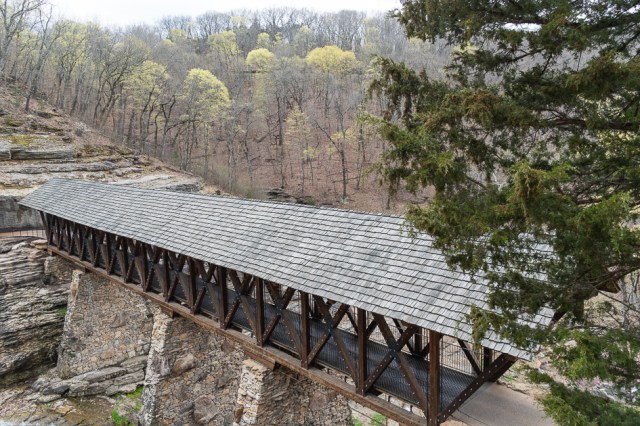
A bridge to cross
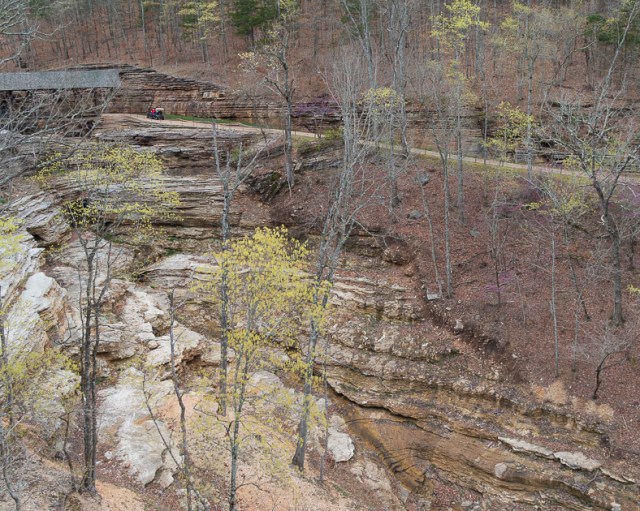
Gnarly-looking cliff
Come on everybody, here we go
Swing wide to catch the spray? Too cold.
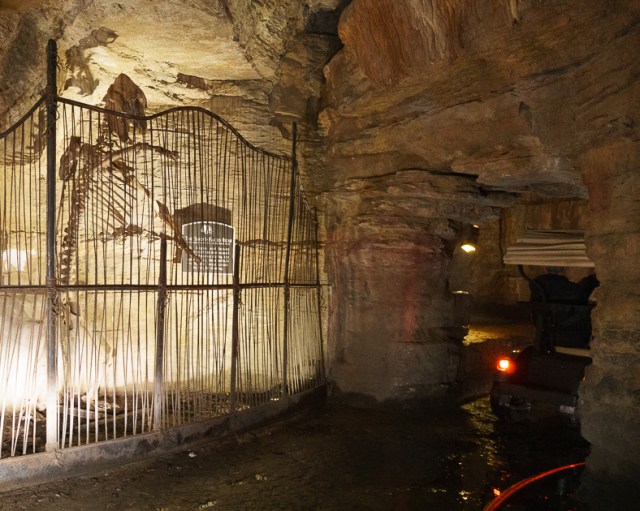
Short-faced bear skeleton
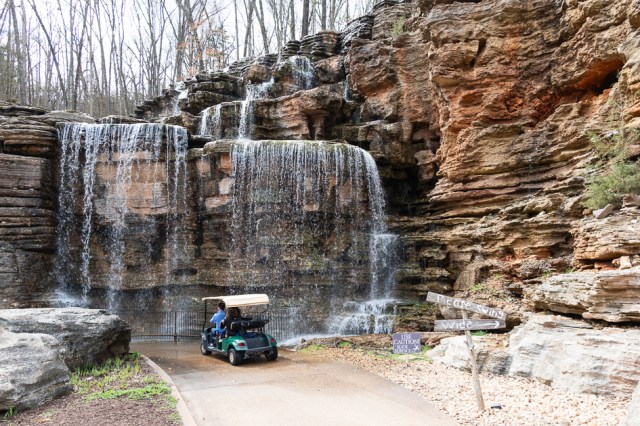
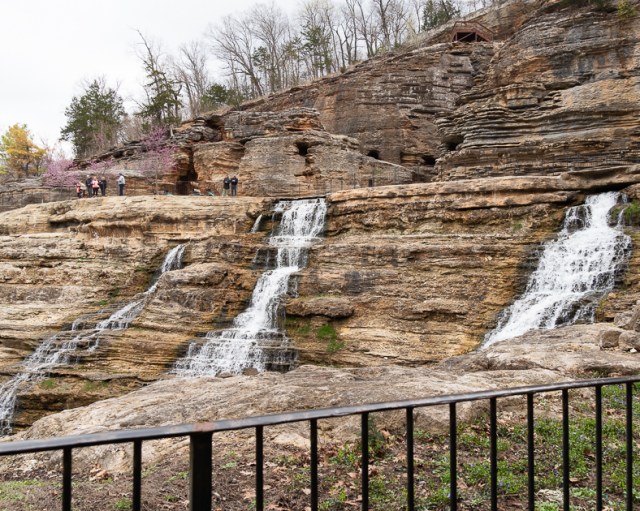
Wall of waterfalls
Traffic jam at waterfall
Guurraaaaawwwrr!
More waterfalls
Wow! That’s steep.
Table Rock Lake overlook

We finished our golf cart tour and then rode the shuttle to Top of the Rock. We had lunch at Arnie’s Barn, one of several restaurants on the property. Arnie’s Barn served up some tasty Mexican-inspired cuisine. The food, along with the bird’s-eye view of the construction activity going on outside, made for a relaxing and entertaining meal.

Besides Arnie’s Bar, Top of the Rock also includes the Osage Restaurant and Buffalo Bar the museum and End of the Trail All-American Wine Cellar. This is also where the Chapel of the Ozarks, Jack’s Cabin, the Arnold Palmer Practice Facility, and pro shop are located.

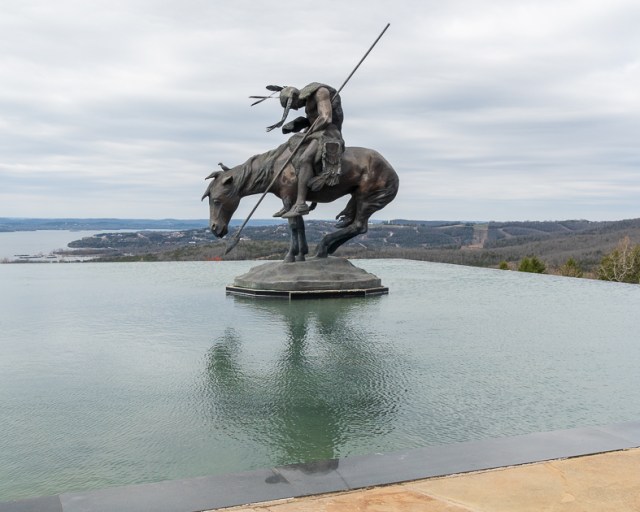
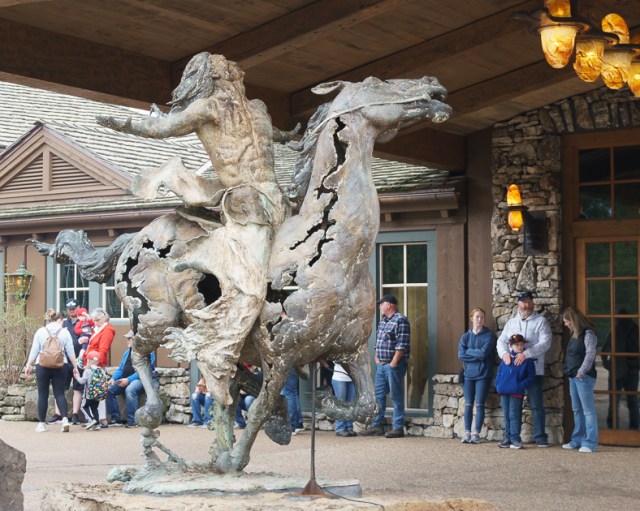
Inscription: Crazy Horse, killed 1877 Defending his Country
End of the Trail sculpture in the infinity pool

When a sinkhole opened up in May 2015 near the golf course, Morris said, “No worries. Instead of filling it in, we’ll excavate it and create The Cathedral of Nature.” Well, maybe not those exact words. I imagine there was a bit of hand wringing and stomach churning before the engineers made their assessment. During our visit, heavy equipment roamed over the red earth, shaping and forming the land into a vision of what the Cathedral of Nature will become.

.

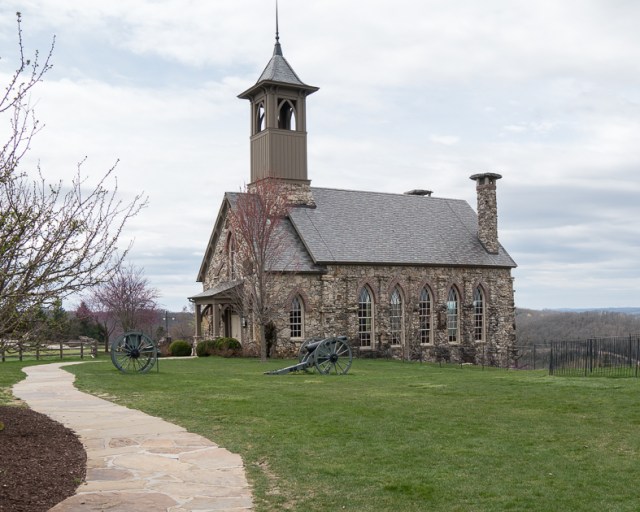
Imagine a wedding at the Chapel of the Ozarks. Inside are 23-foot ceilings, pews to accommodate up to 180 guests and a spectacular view of Table Rock Lake. A sunset wedding would be the best for capturing the “golden hour” light.

Chapel of the Ozarks
View of Table Rock Lake from chapel
Jack’s Cabin accommodation

Ancient Ozarks Museum

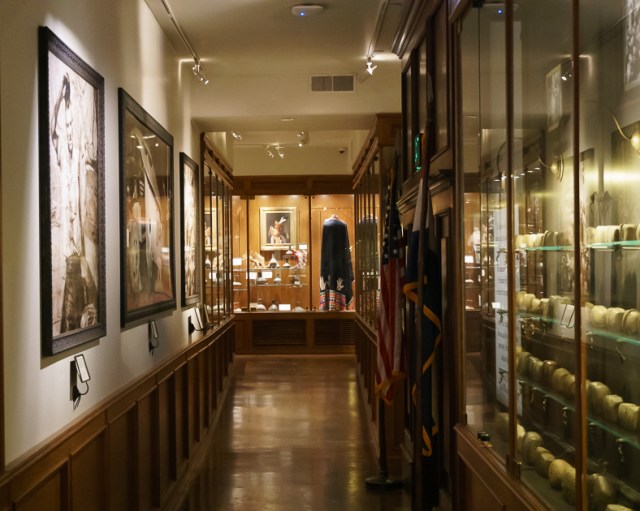
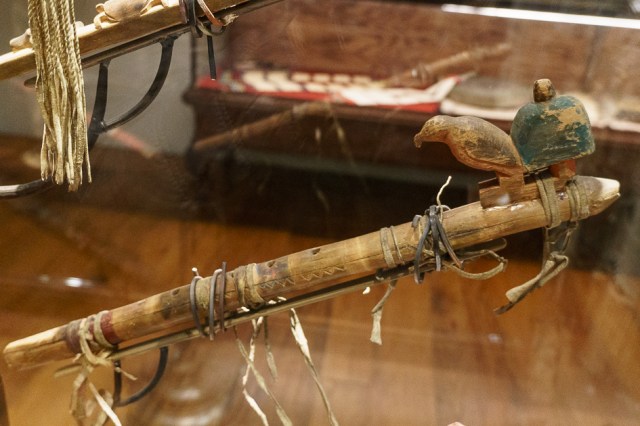
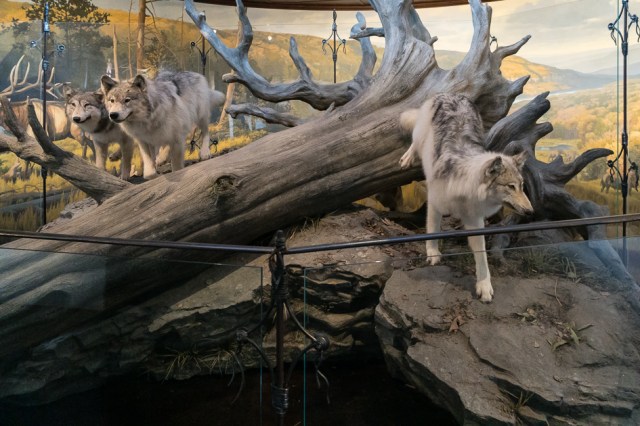
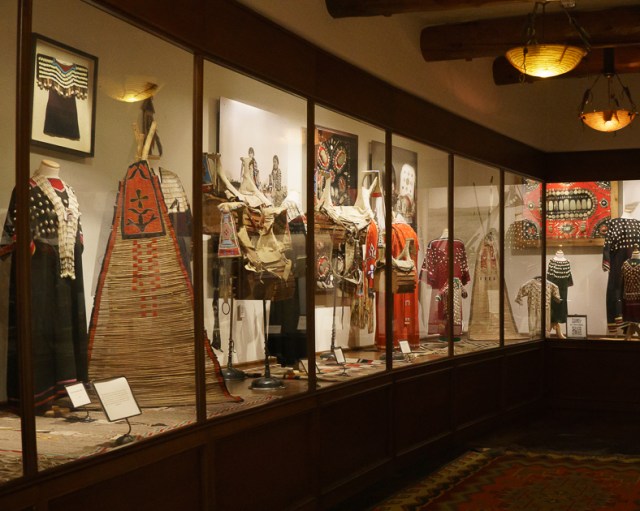
Ancient Ozarks Museum encompasses 35,000 square foot. Exhibits showcase approximately 75,000 artifacts. The Ozarks’ history, Native American artifacts, the Wild West period, and Civil War are all featured. The photos below are a sample of the art and artifacts in the museum.

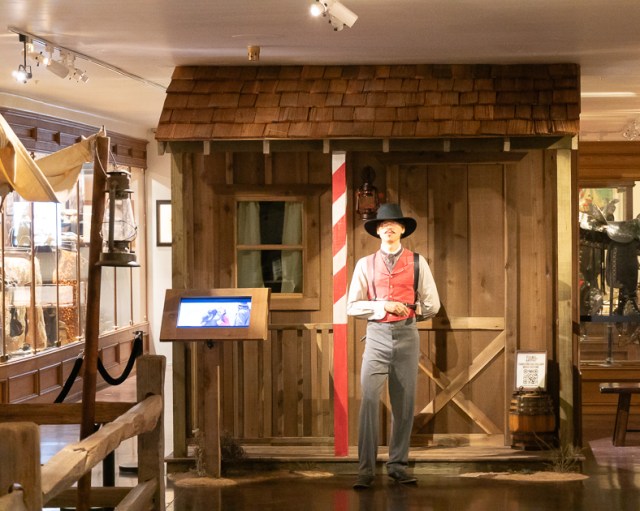
This mannequin wears a Tombstone Doc Holliday movie costume

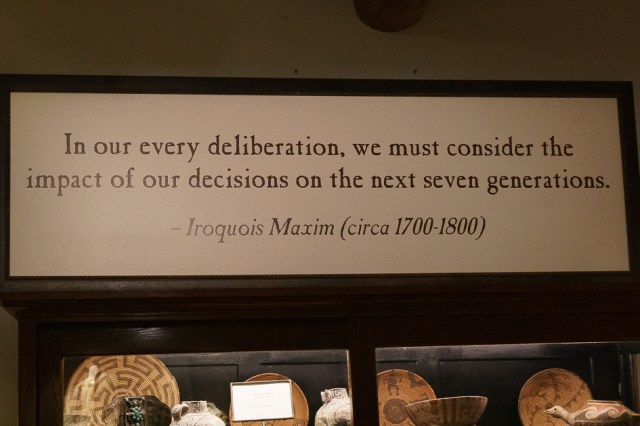
Also included in the museum are words of wisdom attributed to Native Americans. Words of wisdom too many people have never learned, have forgotten, or just don’t care.

Guests waiting for the shuttle back to their cars

A Short History and Other Amenities at the Preserve

After Morris purchased the property in 1987, he restored two buildings built by previous owners and began building his wilderness resort. Big Cedar Lodge opened in 1988. It encompasses 4.600 acres and includes a wooded hollow. The lodge overlooks the 43,000-acre Table Rock Lake. Guests can rent rooms in the lodge, in lakeside cottages, and in private log cabins. For one of the exclusive accommodations, book a stay in Jack’s Cabin.

The resort is a golfer’s dream with five golf courses to play. Famous golfers Jack Nicklaus, Arnold Palmer, and Tiger Woods each had a hand in designing one of the five golf courses.

In addition, there are two marinas, one public and one private, that have boat rentals, ski schools, guided fishing, and boat cruises.

Conservation, the environment, and ecology are top priorities for Morris and his companies. Throughout all aspects of their operations—land management, restaurants, accommodations, or the other amenities offered to its guests—best practices are considered and incorporated in the day-to-day activities.

Our visit to Top of the Rock receives a top rating from all of us and we highly recommend the resort for a visit. We hope to come back again, maybe book an RV site, and stay awhile.

Up Next: Laura Ingalls Wilder Home and Museum in Mansfield, Missouri

Safe Travels
Spring 2023 Adventure Episode 2: Will Rogers Archway and Fantastic Caverns

We had three more days of travel before arriving in Springfield, Missouri, on March 25, 2023. Beside the landscape beyond the windshield, the most interesting thing we stopped to look at was the Will Rogers Archway in Vinita, Oklahoma.

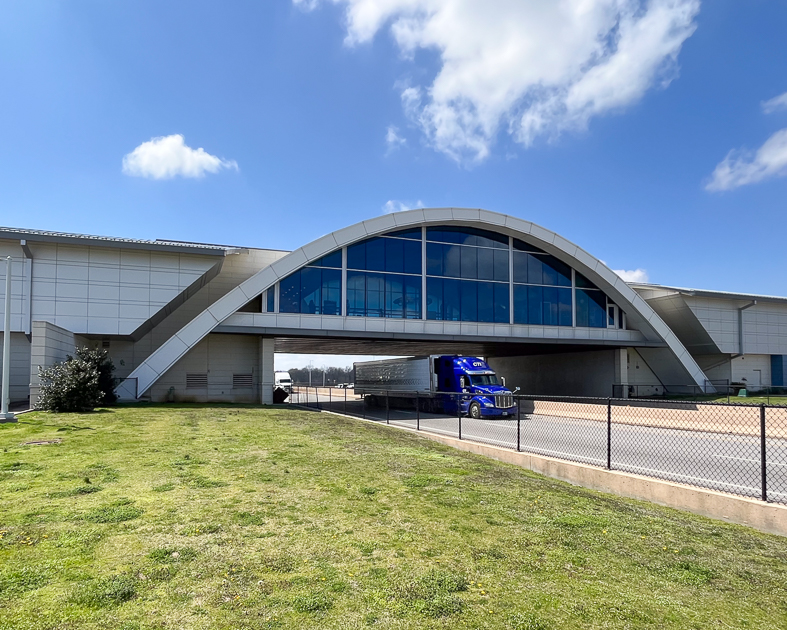
Will Rogers Archway

The Will Rogers Archway came along just as we needed a break and a bite to eat. “The Glass House” was its original name when built in 1957.

Big blue coming through

After a renovation in 2014, it was renamed the Will Rogers Archway. Inside, travelers can enjoy a McDonald’s meal or a Subway sandwich. Or, they can select snacks from the Kum & Go convenience store.

We didn’t dally too long, though. With only 1-1/2 hours of drive time left before we arrived at our campground in Springfield, getting back on the road was our goal.

Come on. Time to go.

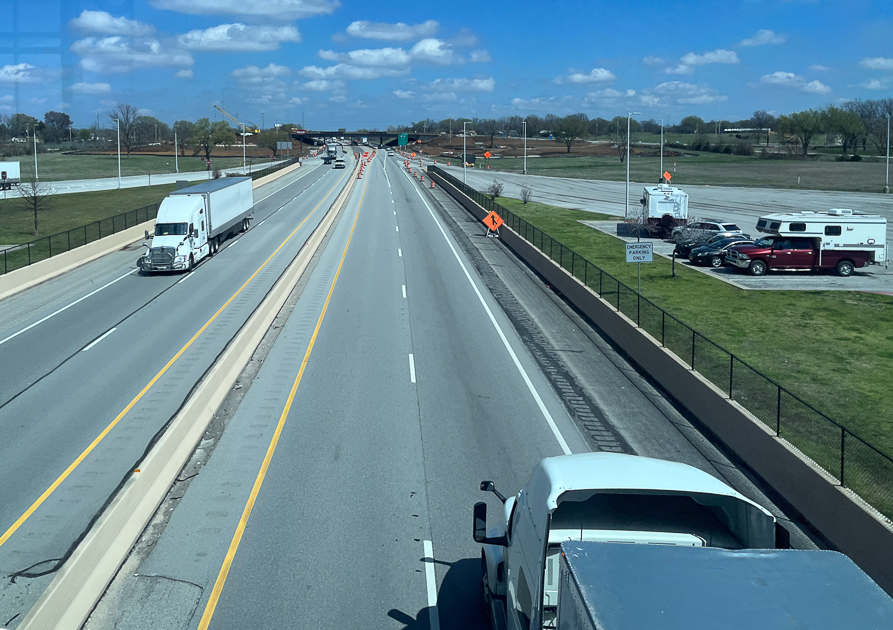
The vehicles and big rigs driving below and maneuvering in and out of the parking lots entertained us while we ate lunch.

The super short acceleration lane made it difficult to merge onto the turnpike and avoid the big rigs zooming toward us.

Fantastic Caverns

The Missouri Department of Natural Resources claims there are “approximately 7,500 recorded caves in the state,” which is probably the reason Missouri is considered the Cave State. The department’s website has a list of caves open for tours.

One such tour is Fantastic Caverns. Billboards advertising the Ride-Thru cave tours were a common sight along the freeways and roads throughout Missouri. Was this a hokey tourist trap or the real deal? We met up with our daughter and the grandkids to find out.

Jon, Maya, Laura, and Jackson pose with a cave explorer

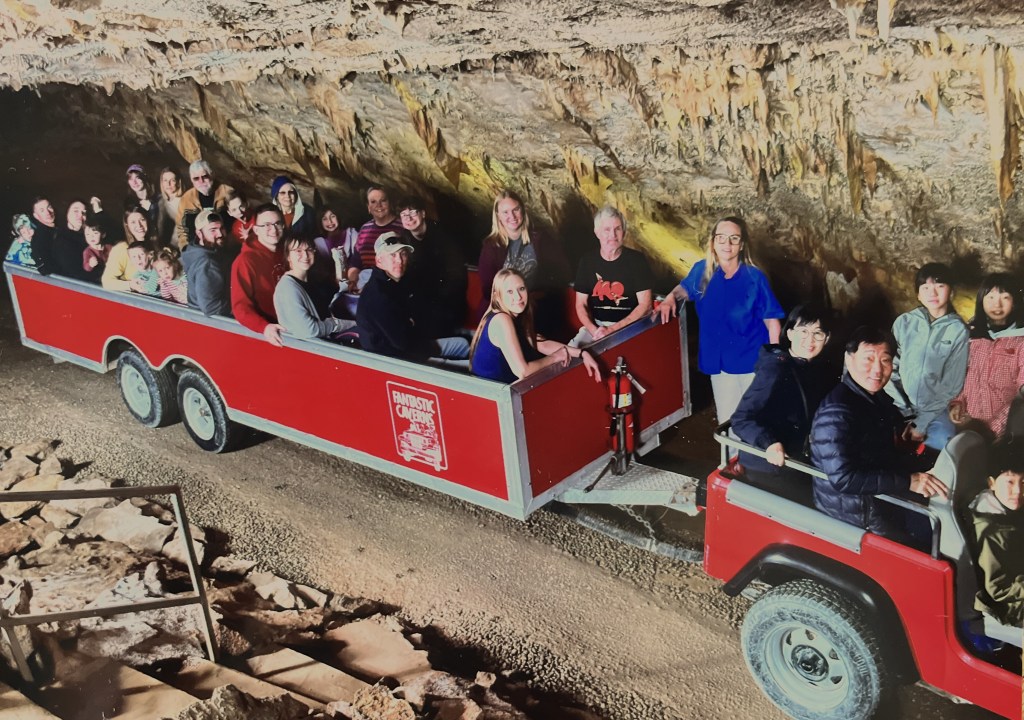
Inside the visitor center, we found a gift shop and various displays to keep us busy while we waited for our tour to start. Once aboard, our driver/guide regaled us with the history and geology of the cave.

Display outside

Credit for the cave’s discovery goes to a dog who went missing in 1862. The dog had slipped through a hole in the ground and its owner followed it, stumbling into the cave. The dog’s owner, John Knox, kept the cave a secret to protect it from the Union and Confederate sides of the Civil War. The armies had seized several other caves to mine the limestone for the production of ammunition.

Tribute to the dog that started it all.

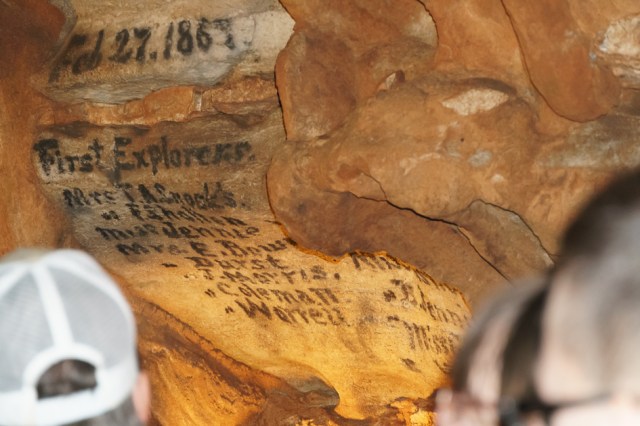
After the war, the Knox posted a newspaper advertisement requesting someone to explore the cave. The Springfield Women’s Athletic Club obliged and documented their presence on the cave wall on February 27, 1867.

Names of the first explorers (sorry about the fuzzy heads)

Since then, the cave has had many owners and has served as a meeting place, a speakeasy during prohibition, a concert hall, and a broadcast studio in the 1970s. The Ku Klux Klan is recorded as having been owners from 1924 to 1930.

My favorite type of cave formation are these columns that remind me of cauliflower or a fantasy forest.

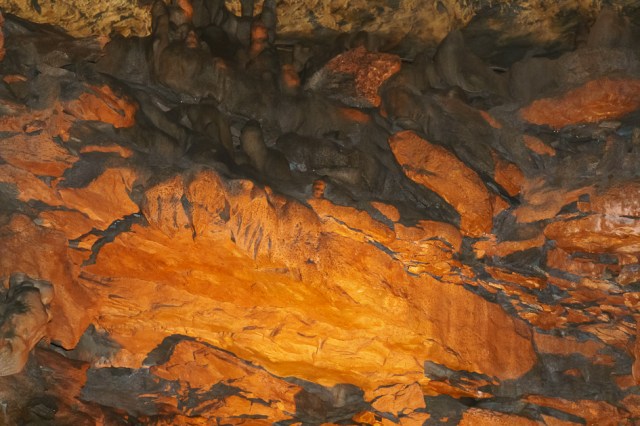
At one point, our guide stopped the tram in one room. I should have taken better notes, because I don’t recall what she was showing here, but it had something to do with saltpeter or gunpowder.

The orange and black gives an eerie abstract look to this wall.

One hundred years after the cave’s discovery came the first Ride-Thru tour. The Campbell family arrived in 1966 to manage the tours and in 1992, they purchased the property that included the cave. In 2017, LED lighting replaced the early 1970s lighting system.

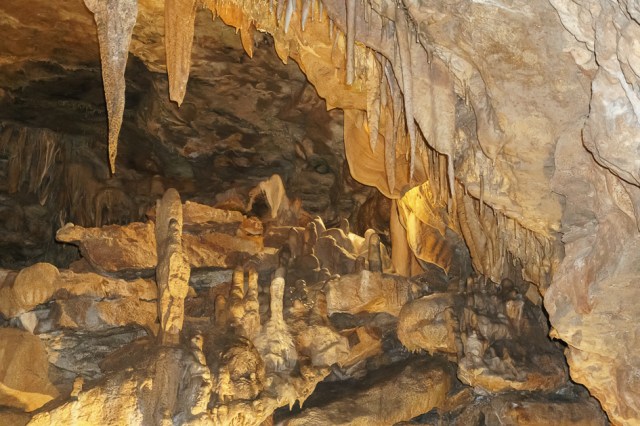
View of one of the side rooms

An ancient underground river created the usual formations common to caves: stalactites, stalagmites, columns, soda straws, flowstones, cave pearls, and draperies. Water still drips from above, a sign the formation of limestone process continues.

Baby drapery formations hang from the ceiling
This drapery formation has had a long life.
Can you find us hiding in the tram?

So what was the hokey verdict? Not hokey. The visitor center includes a gift shop with cave and geological themed items to purchase. And we had fun riding the tram with an informative and entertaining tour guide. We recommend Fantastic Caverns for anyone, young or old or anywhere in between, to hop aboard the tram and take a ride among the formations.

Bring a sweater or light jacket to ward off the chilly 60-degree temperature. And tall people should sit on the right side because the tram comes close to low-hanging formations on the left side.

Up Next: Top of the Rock Heritage Preserve in Branson, Missouri.

Spring 2023 Adventure: Episode One – On the Road Again

Our Spring 2023 Adventure to Springfield, Missouri, began on March 13, 2023, with a one-night stay in Tehachapi, California, followed by one-night stays in Barstow, California, and Kingman and Holbrook in Arizona. We enjoyed mustard fields and green hills on I-5 through the central valley of California, and flashes of yellow and purple wildflowers and gum drop-shaped pinon pines nestled atop yellow grass as we drove along I-40 in Arizona. Clearly, evidence of the bountiful rain this winter in the southwest.

Mustard fields
Jets making contrails in the sky
Gliders waiting for sunshine in Tehachapi

What we didn’t enjoy was the teeth-rattling, pothole-strewn pavement we had to drive on. Calling it a freeway was an insult to all other freeways in the country. It was easy to see three or four layers of the roadbed in the potholes, some spanning nearly 12 inches in diameter. And trying to dodge the smaller ones was an impossible task because there were so many of them clustered together.

The Troubles

On our fifth day, we left Holbrook, Arizona, toward Albuquerque, New Mexico, on I-40. Finally, the New Mexico welcome sign was in sight, followed by the Manuelito Welcome Center and rest area. It was a good place to stop, eat lunch, and release stress.

Jon did his usual cursory check of the trailer, and we were back on the road. I took the wheel and headed toward Albuquerque with only two and a half hours to go. My mouth watered for the dinner I’d have at El Pinto, one of our favorites in Albuquerque. A half-hour later a woman in the neighboring lane rolled down her window and waved to tell us, “Your tire is on fire.”

A tire on fire. How could that be? The side mirror revealed nothing. Was she playing a joke on us? I pulled into a Gallup, New Mexico, Maverick Gas Station and parked in the back, making sure the truckers could maneuver around us in their big rigs. We stood dumbfounded as smoke poured out of the trailer’s left rear wheel hub—its plastic cap melted and red-hot metal visible on the axle.

After spewing a string of choice words not fit to print, Jon said. “This will either be a quick fix or a very expensive one.” I hoped for the quick fix, although the pit of my stomach worried our bank account would take a beating.

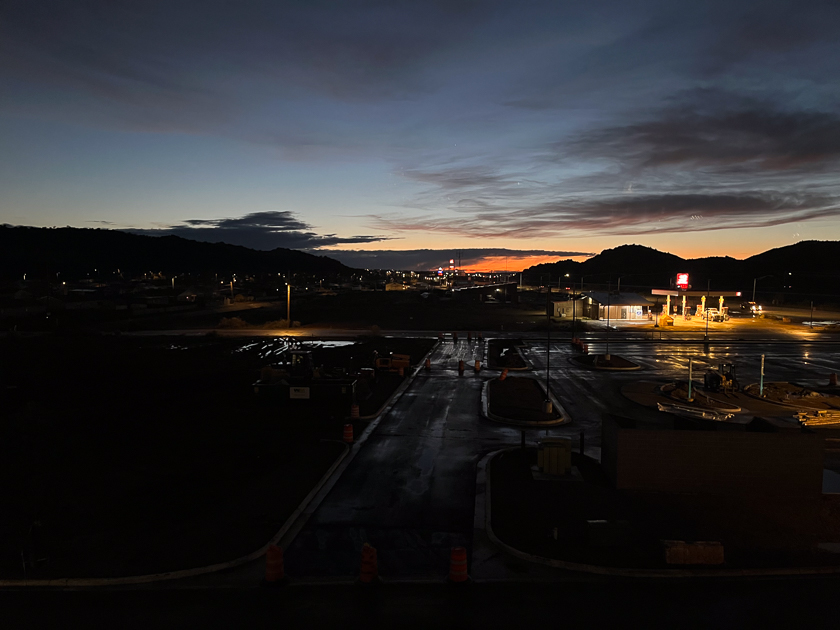
Time slipped by as Jon talked with the insurance company’s road service and made arrangements with the tow truck driver. After a five-hour wait for someone to arrive to help us, my dinner at El Pinto disappeared with the sinking sun.

No El Pinto tonight, but Jerry’s was tasty
Hey! It’s snowing out there.

Dennis, the tow truck driver, assured us he could help by removing the axle and reinstalling it if we drove to Albuquerque to either get it fixed or buy a new one. And when he removed the axle, he found the cause of our issue: the right rear leaf spring had broken, causing the weight to shift, putting too much pressure on the left bearing, resulted in disintegrating the bearing and ruining the axle. It’s possible I-40 through Arizona was also a contributing factor. We left the fifth wheel on jack stands in the Maverick parking lot, spent the night in the motel next door, and drove in a snowstorm to Albuquerque and back.

Tell me about it.

We didn’t return to Gallup until 5:30 pm. Dennis came and finished installing the new axle (new axle including new leaf springs and brakes and drums $1,159) at 11:00 pm (Dennis’s rate $844). We extended our one-night stay in Albuquerque to four since all the RV service and tire stores were closed by the time we arrived on Saturday, March 18.

With a new rear axle, packed bearings, and brakes, we felt it necessary to have the front axle bearings packed and brakes replaced, all 4 tires replaced, and both axles aligned. New tires were the easy part ($1,054). The axle alignment ($1,054) required us to grovel to get it done on the day they promised it, and after waiting all day for the brake work ($569), we learned they couldn’t look at until the next day. We brought it back at eight in the morning and they promised it by noon. It was three until we left Albuquerque, putting us in our Amarillo, Texas, site at ten. We hate driving and setting up in the dark. Unfortunately, when you’re depending on others to do what they promised, you are at their mercy.

National Museum of Nuclear Science and History, a Smithsonian Affiliate

While we waited for the brake work, the National Museum of Nuclear Science and History, established in 1969, promised us a respite from our troubles and helped to keep our anxiety in check.

Through its displays and exhibits, the museum traces the timeline of nuclear science from its infancy, the development of the WWII bombs, the cold war, and current and future uses. Outside is a nine-acre exhibit that includes various planes and rockets and missiles.

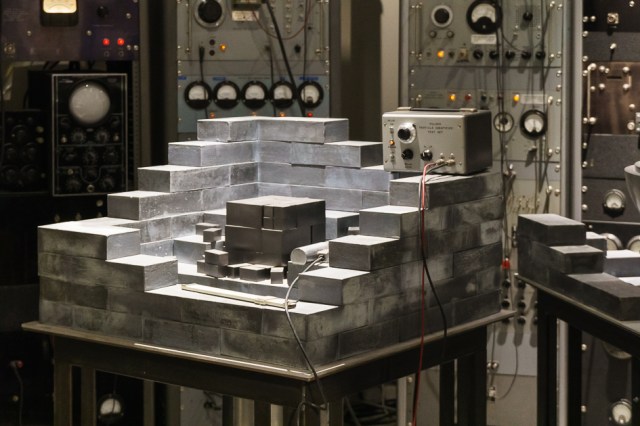
For several minutes, I stood in front of the Critical Assembly, the Secrets of Los Alamos 1944: An Installation by American Sculptor Jim Sanborn.

All the objects on display amazed me. Many of the items are actual instruments, hardware, furniture, and tools used by the Los Alamos National Laboratory during the 1940s. Sanborn fabricated any items he could not locate.

Critical Assembly, The Secrets of Los Alamos

Curated by The National WWII Museum in New Orleans, the Bob Hope exhibit brought to mind memories of watching him entertain the troops on television. This exhibit closed on April 30, 2023.

Various missiles
Play space for the kiddos

The Delorean is part of the Atomic and Pop Cultures exhibit. Remember the Flux Capasitor from the movie Back to the Future? It’s what made time travel possible.

The Delorean is part of the Atomic and Pop Cultures exhibit.

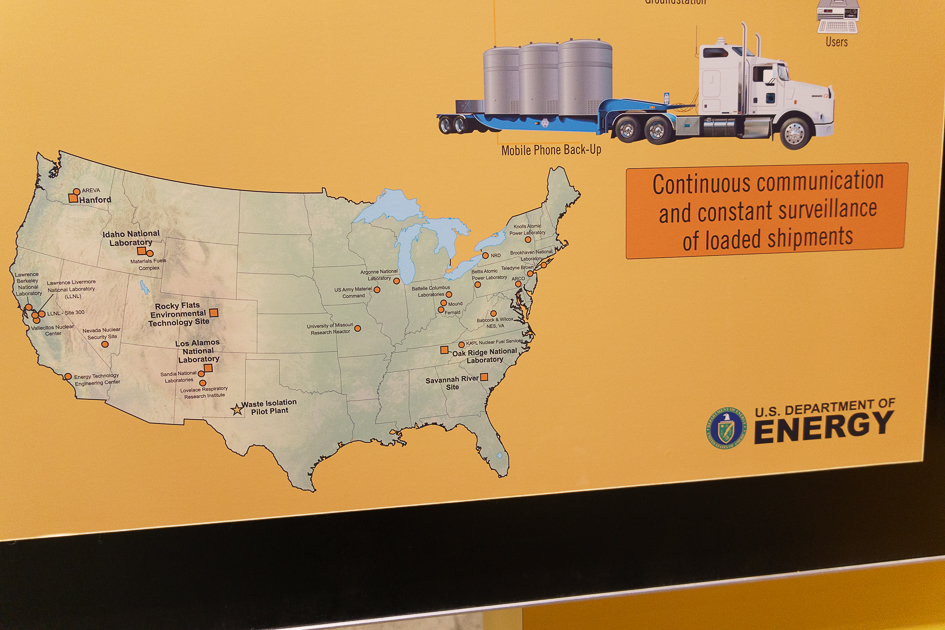
I found the nuclear waste exhibit interesting. I knew about the Livermore and Berkeley Labs and Vallecitos Nuclear Center when we moved to the San Francisco Bay Area nearly 30 years ago, but seeing the cluster of orange circles on the map gave me pause. I also liked learning about the communication and transportation precautions taken when waste materials are moved. I’ll be on the lookout in the future for anything that looks like the cargo truck below.

The museum continues outside in Heritage Park, a nine-acre outdoor space. The exhibits include planes, rockets, missiles, various missiles, an F-16 fighting Falcon, and an F-104 Thunder Chief.

Heritage Park behind the museum

The black object with the number 645 in the photo below is the sail from the USS James K. Polk nuclear submarine. Powered by a pressurized-water nuclear reactor she served from 1965 to 1999.

Nuclear submarine sail

This is a replica of the Trinity Tower from which the first atomic device (plutonium bomb) was tested. It is similar in design to the Fat Man bomb used to attack Nagasaki. Near Alamogordo, New Mexico, the Gadget was raised to the top the hundred-foot steel tower, and detonated on July 16, 1945. The bomb vaporized the tower, transforming the asphalt and sand into green glass, justifying the US military’s use of plutonium for an atomic bomb.

Trinity Tower replica with Gadget
Close up of the Gadget

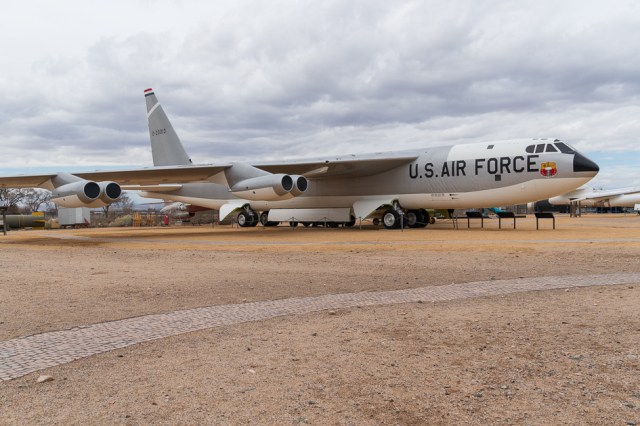
The B-52B Stratofortress began its Air Force career in 1955. Its mission was to drop atomic bombs during testing. Restored in 2016 at a cost of $120,000. It is the only remaining B-52 that dropped an atomic bomb during testing.

The B-52 is so big it was hard to fit within the frame.
Bundled up against the cold and wind.
Replica of Fat Man bomb

I’m glad we took the time to visit the museum, although it raised mixed feelings. It reminded us of the negative aspects and devastating potential of the use of nuclear energy for good and evil. And we learned of the many positive uses. It also reminded me that the Livermore Lab recently opened its Discovery Center, so I’ve added it to my Things To Do list.

Next stops: One night stays in Amarillo, Texas, and Oklahoma City, Oklahoma, and then Springfield, Missouri for a couple of weeks.

Safe Travels