Richfield, Utah

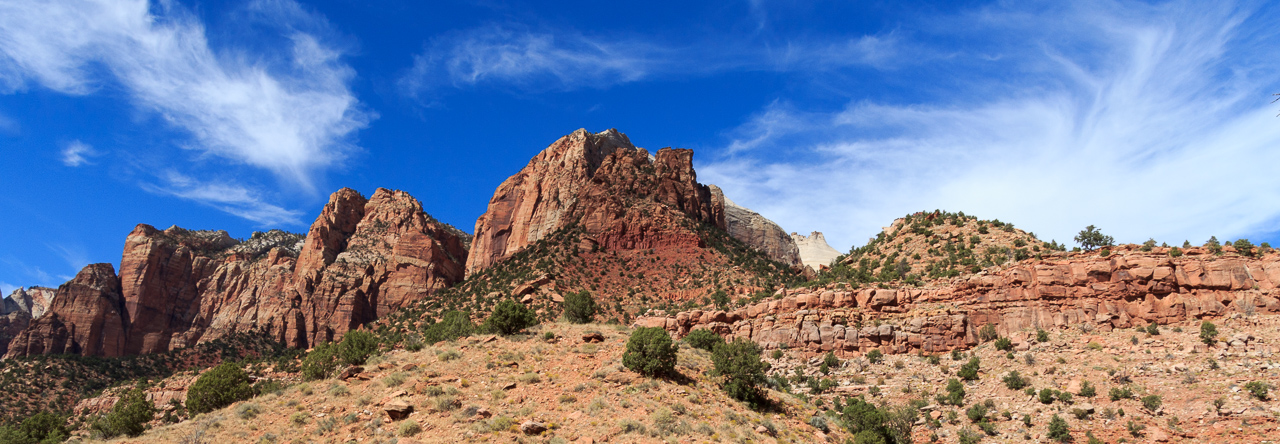
We found the Richfield KOA to be one of the best places we have stayed. Their shaded sites are so large they can accommodate a tow vehicle and a large toy hauler or motorhome with plenty of room to spare for a few ATVs. Since our rig is not large and we don’t tug along ATVs we enjoyed the extra room to move about. The park also has easy access to the miles of trails that wind their way throughout Richfield and the surrounding area.
Fremont Indian State Park and Museum

Besides the ATV trails there is the Fremont Indian State Park and Museum, and Candy Mountain within a reasonable driving distance.

Fremont Indian State Park and Museum

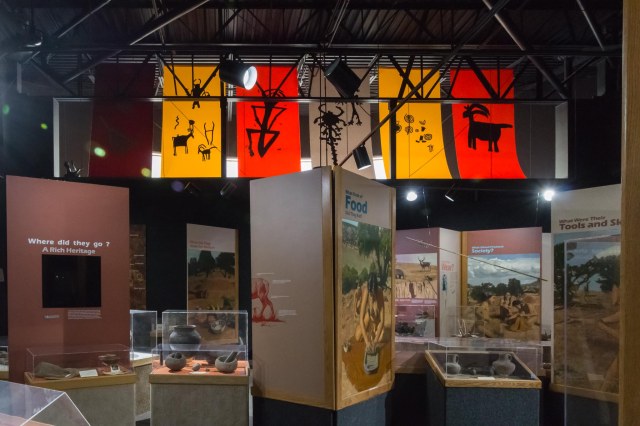
We started out by visiting the Fremont Indian State Park and Museum where we watched a movie about how the museum came about. It all started with the construction of I70 during the 1980s. The plan was to take down four of the five-finger range hills and use them as fill to build up the valley after diverting the river/creek.

The last of the five finger hills

When the crew began digging, they found an ancient Indian settlement consisting of several pit houses and storage facilities. Archeologists rushed to the area to document and preserve what they could. It turned out that this was the largest Fremont Indian settlement found.
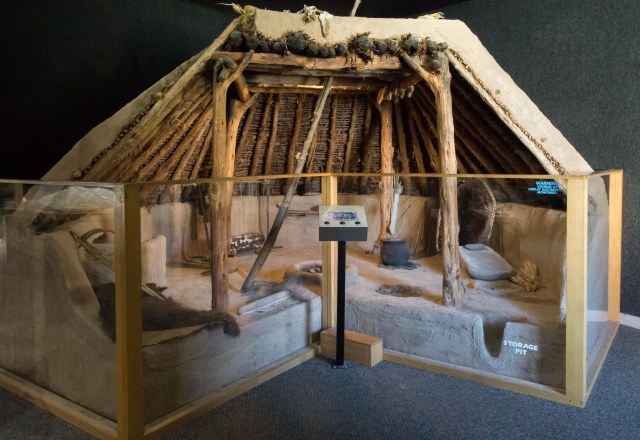
A depiction of family life in a pithouse
Possible trapper attire and tools of his trade

The neighboring community did not want the artifacts to sit in a university somewhere and pushed for the state park. Their dream came true and the park preserves the history of these ancient peoples.

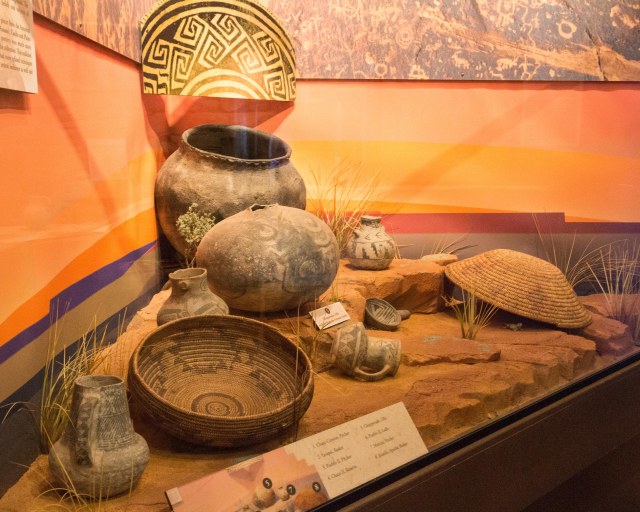
What a find this jar was. It was found upside down in a pithouse

The museum depicts life as it was including a mockup of a pithouse with a vent that brought fresh air in and a hole at the top where smoke escaped.
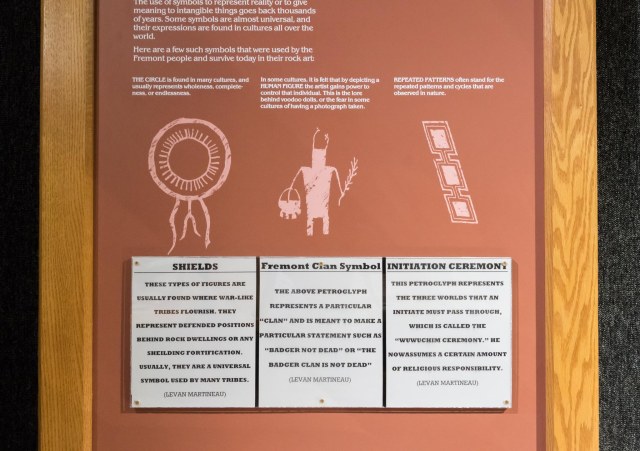
Possible meanings of petroglyphs

Cooking and work areas are also displayed. One of the most interesting objects was a recreation of remains that were found a few miles away. The recreation shows how the woman might have looked like when she was alive. A push of a button starts audio so visitors can hear her story and learn how tall she was, the condition of her teeth, the age when she died, and how she was buried.
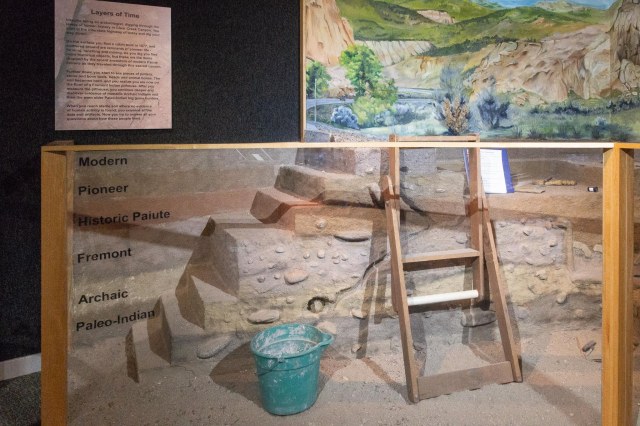
Layers of time

Clear Creek Road and I70 run through the middle of the narrow park with trails on both sides of the freeway to explore the terrain and view petroglyphs and pictographs. When we finished in the museum, we ventured outside to explore more. a short drive on Clear Creek Road took us to panels where petroglyphs and pictographs have survived erosion.

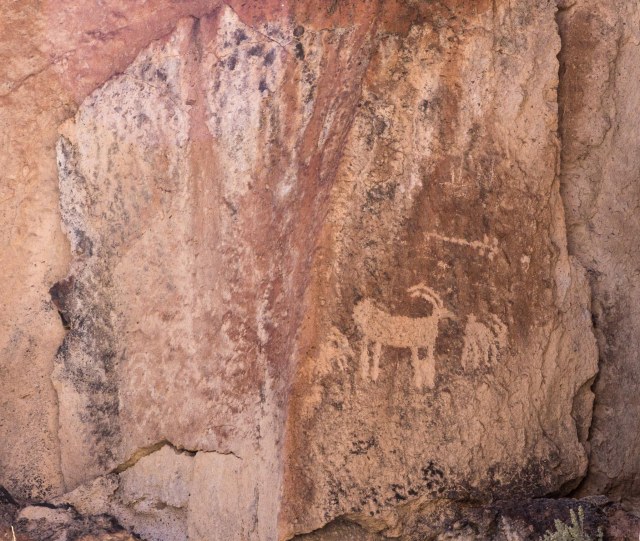
Petroglyphs are carved into the stone and depict a story, the meaning of which has been lost over 500 to 1,000 years
Pictographs are drawn using some kind of coloring or pigment. These seem to represent blankets.
It’s amazing that these have lasted so many years

Across the freeway are caves and the Sevier River.
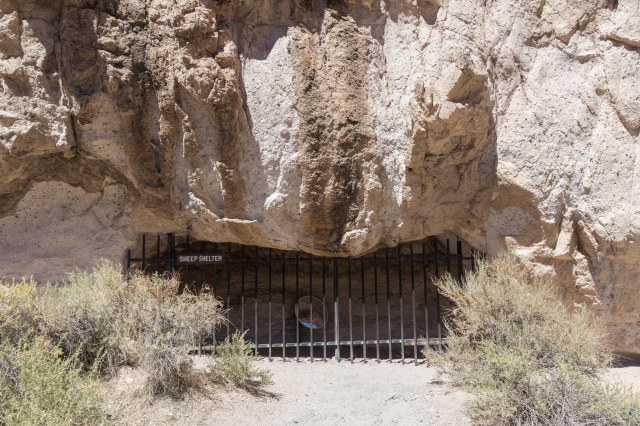
Sheep Shelter
The mirror in Sheep Shelter reflects a view of the ceiling where more petroglyphs are carved
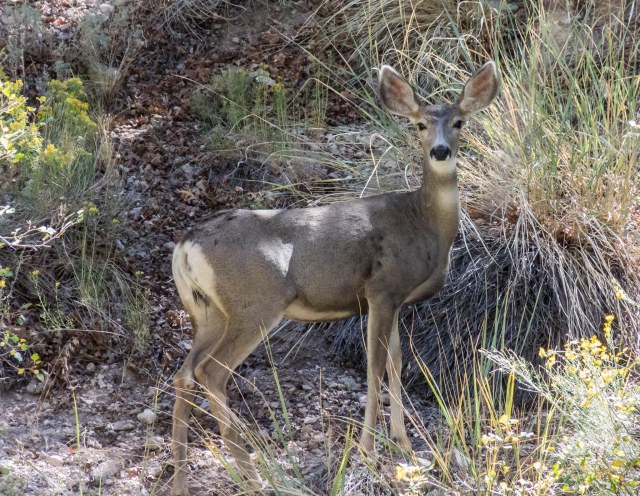
I love it when wildlife poses for a photo. It sure is better than when they show me their backside.

This cabin is similar to what the Joseph Lott family may have built on this site when they settled here in the 1880s.

1880s cabin

The 100 Hands Cave caught my interest. When were they placed here? Why did they make the pictograph? Was it some kind of ritual? How long did the pigment stay on their hands?
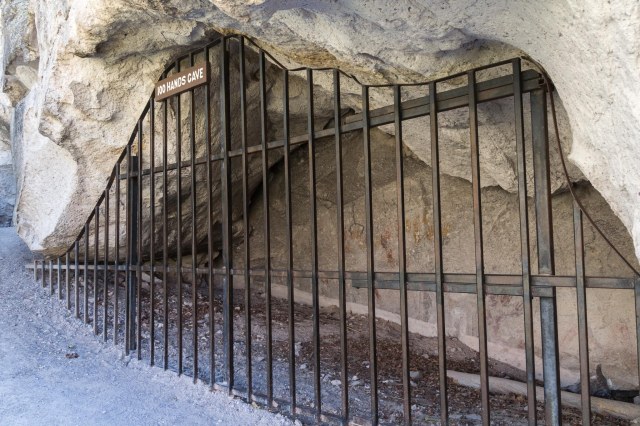
100 Hands Cave

It’s a good thing the park protects this art with a wrought iron gate. Given the evidence that modern day artists had a mind to destroy this artifact, I can’t imagine what it would look like if not for the protection.
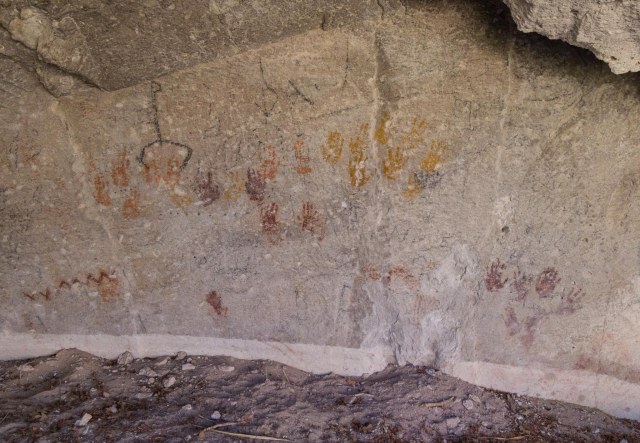
Close up of 100 Hands Cave

The last stop on our adventure at the Fremont State Park was the Jedediah Strong Smith Memorial. Yes, the same hunter, trapper, and explorer of the American West who traveled through the Great Salt Lake, Colorado River, Mojave Desert, California, and Oregon. To think of all the changes made since the 1820s when Smith roamed the west, it boggles the mind. I wonder what it will all look like in another 200 years.

Jedediah Strong Smith Memorial

Big Rock Candy Mountain

What attracted us to Big Rock were the mountains that looked like cakes dripping with yellow, white, and caramel icing. Volcanic activity is what gave the mountains their colorful feature. Different types of minerals produced different colors.

Big Rock Candy Mountain

Besides the mountain, hiking and ATV trails and access to the Sevier River are also available.
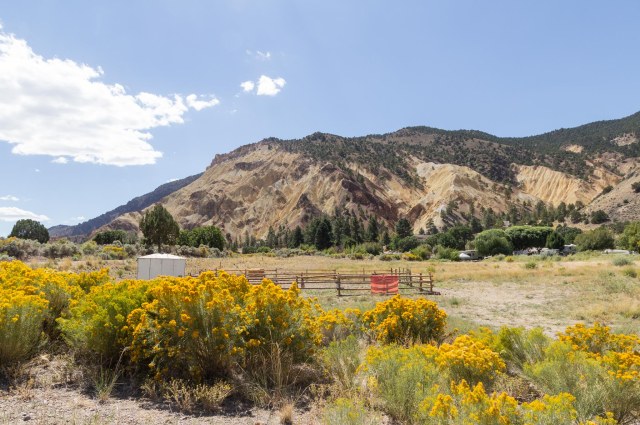
Big Rock Candy Mountain across the field. On the far right and middle of the photo is the RV park under the cluster of trees

The Big Rock Candy Mountain Resort offers places to stay in an RV Park with about 30 sites including water, sewer, and electricity; eight suites in the lodge; and 12 converted train cars in the Caboose Village. It looks like Big Rock Grill and Smokehouse serves breakfast, lunch, and dinner. At least as I write this.
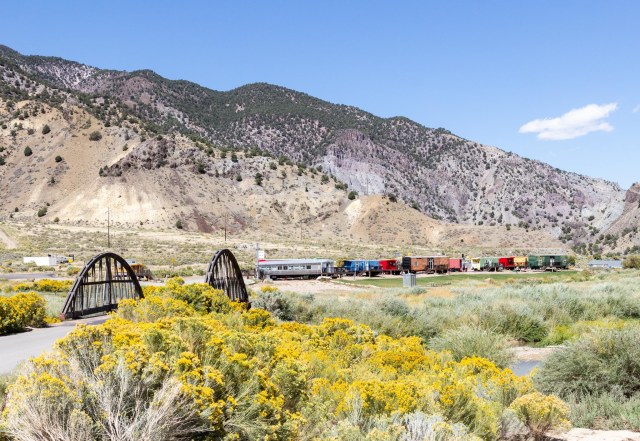
Caboose Village from across the river

Piute State Park

No, I did not misspell the word Piute. Although the park was named after the Native Americans who lived in the area at one time, the state legislature decided to change the spelling. I’m not sure why they would want to do that.

The park was abandoned when we visited, most likely due to the low level of water in September. The reservoir is used for irrigation purposes, so I guess it was all used up. I’m not sure how fish could remain alive in the reservoir at this low level, though. The water was quite murky, as was the runoff.

Low tide at Piute Reservoir. This is the boat ramp.

The park sits on the Sevier Plateau and contains a portion of the Piute Reservoir where anglers can try their luck for a trophy-sized rainbow, cutthroat, or brown trout. A boat ramp and day-use shade shelters are also available.
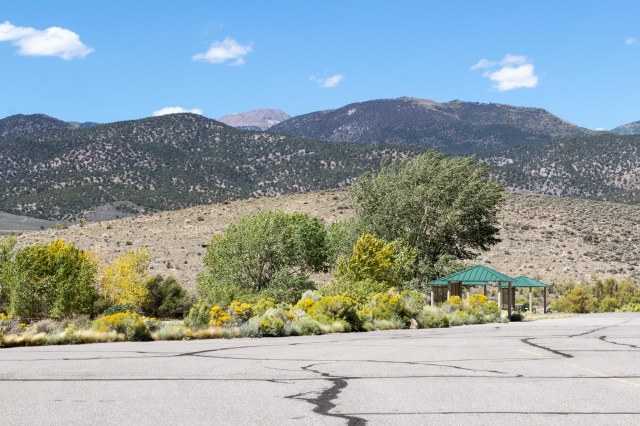
Day use shade cabanas

The park is quite primitive, including the campground. Only pit toilets are available and there is no water, so be sure to bring what you need. There are also three ATV trail systems accessible from the park.
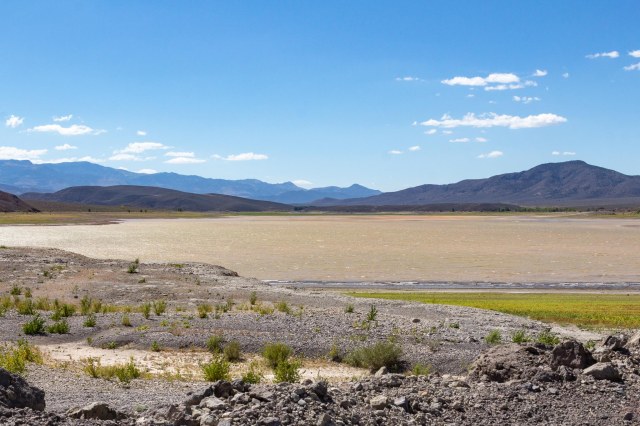
Looking south across the Piute Reservoir

Next up we continue our trek west toward California.

Safe Travels

Montrose, Colorado, and Black Canyon at the Gunnison National Park

Decision time had arrived. Our original plans were to hang around Mesa Verde for a few days or a week and then drop down into New Mexico, staying on the road until the first part of November. Except one of those life-happens-as-your-making-plans moments popped up on the day before we began our Summer 2018 Tour.

When my cardiologist broke the news that it was time to repair my weakened mitral heart valve, I thought I could push it off until April or May. After spending a month and a half on the road, I realized it was best to get the surgery over with as soon as possible. The worry hung over me like an anvil and I needed to get out from under it. We cut our trip short and turned the truck for home on September 9, 2018. But that didn’t mean we weren’t going to stop to see a few more sights along the way.

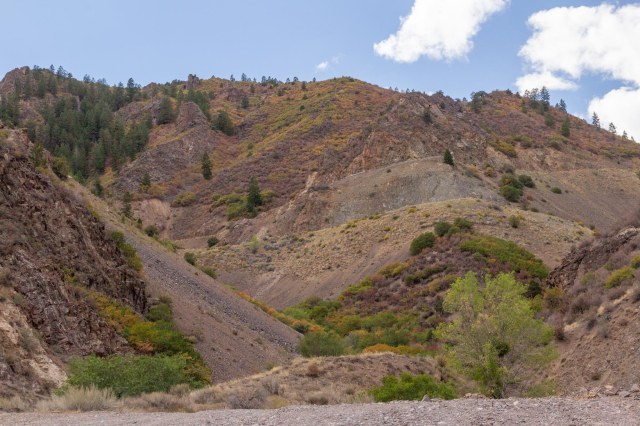
Preferring the back roads, we took the scenic route heading west on U.S. 24, making a left at U.S. 285 and continuing to U.S. 50 toward Montrose, Colorado, passing through Monarch Pass. The colorful hills and forests kept us alert during our 4-1/2 hour drive.

The hills begin their fall displays
San Isabel National Forest
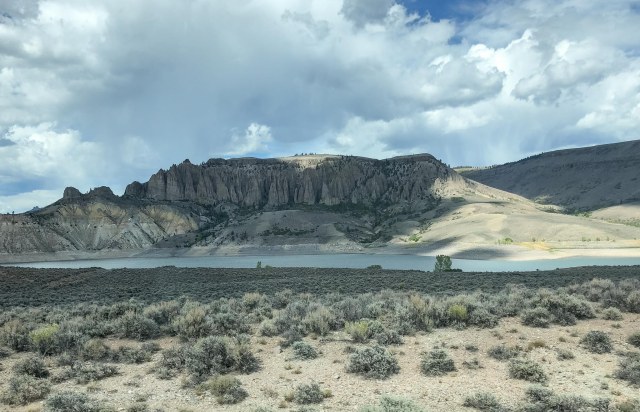
Dillon Pinnacles and Gunnison River in Curecanti National Recreation Area

We checked in at Black Canyon KOA, a nice campground with large spots and plenty of shade trees. Our focus for staying in Montrose was to visit the Black Canyon at the Gunnison National Park. Established as a national monument in 1933, Black Canyon became a national park on October 21, 1999.

South Rim

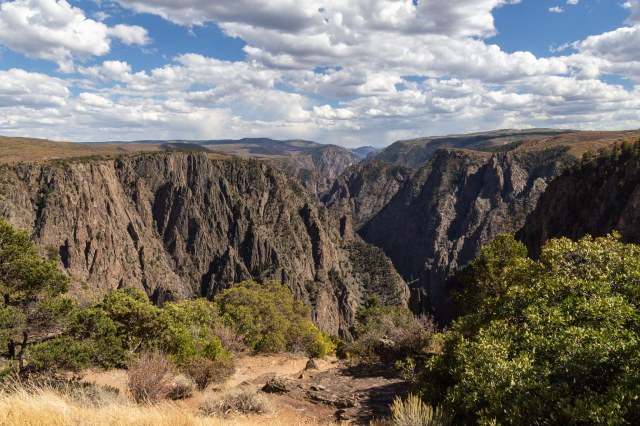
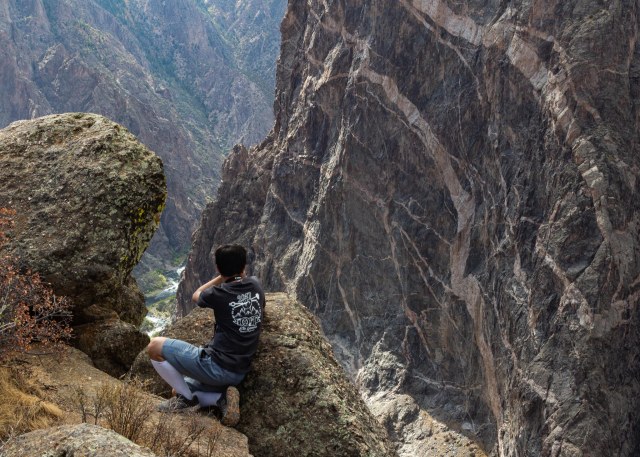
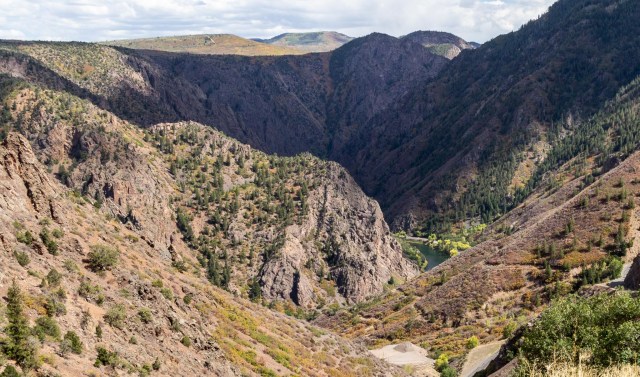
The park features a 7-mile road along the south rim with 12 overlooks where we found differing views of the canyon and the river 2,000 feet below. Some of the overlooks were more popular than others, especially with the tour buses. If we missed an overlook going one way, we caught it on the return trip.

Tomichi Point View toward the east
View from visitor center

While at the visitor center we noticed what looked like a natural bridge. When we asked one of the rangers about it, he said, no. Not a bridge. He had never seen it before and guessed the rock recently fell and wedged itself between the pillars. It was cool to think we were one of the first people to have seen this phenomenon.

I dub thee Fallen Rock Bridge

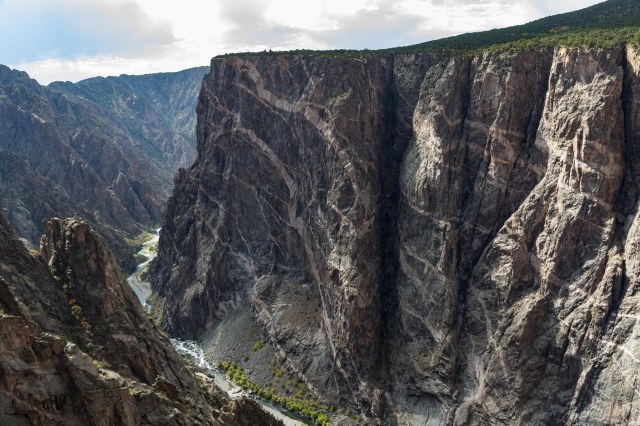
The Painted Wall was definitely a do-not-miss overlook. The cliff stands 2,250 feet above the river. The stripes on the wall consist of pegmatite, a type of granite containing quartz, feldspar, and mica.

Painted Wall with photographer
Painted Wall with Gunnison River
Spires in Black Canyon of the Gunnison

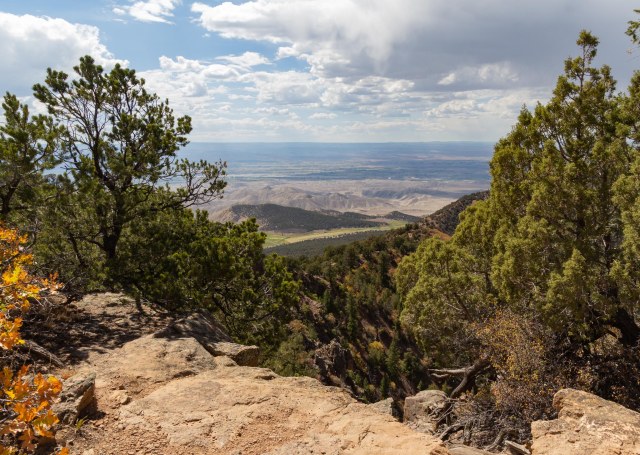
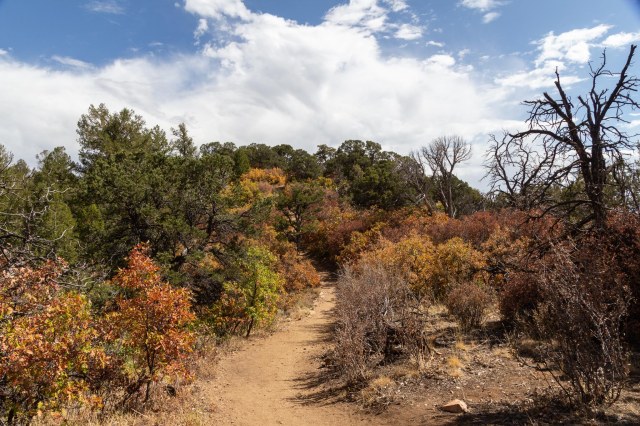
When we arrived at the High Point overlook, we were ready to stretch our legs on the 1-1/2 mile Warner Point Nature Trail. The pamphlet led us through pinyon pines, juniper, Douglas fir, and Gambel oak trees.

We kept our eye on the storm brewing across the valley. Luckily, it stayed east of us during our entire walk.

Keep eyes on any storm
View of Uncompahgre Valley from Warner Trail
View of Adobe Hills and Uncompahgre Valley from Warner Nature Trail
Warner Nature Trail – Fall is rushing in
Warner Nature Trail and greener pastures thanks to the Gunnison Tunnel

East Portal

The East Portal road is the access route to the Gunnison River, Gunnison Tunnel, Gunnison Diversion Dam, Crystal Dam, a campground, and picnic area. It sounds like a lot to see after reading that list, but everything is contained within about a mile, so not really. And a chainlink fence with concertina wire on top prevents anyone from getting near the Crystal Dam. Take note that the road includes a 16% grade and numerous switchbacks. Vehicles over 22 feet long are prohibited.

East Portal Road switchbacks

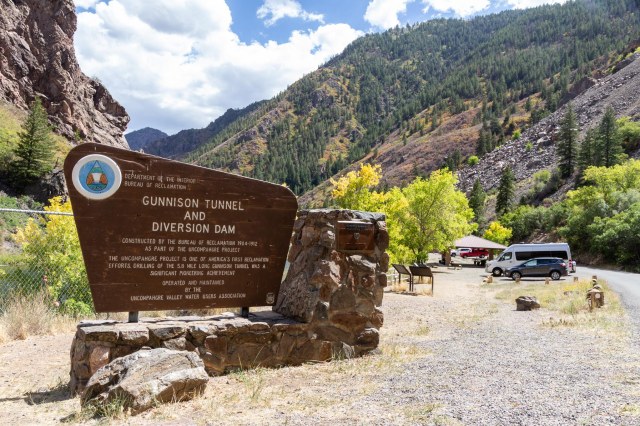
Water diverted from the Gunnison River flows through the Gunnison Tunnel, built between 1905 and 1909. I marvel at the engineering it must have taken to blast through rock to create the 11-foot by 12-foot tunnel 5.8 miles long through the granite cliffs of Black Canyon. Starting at opposite ends of the mountain the workers met in the middle using a heading and bench system. First, a heading was cut out of the rock at the top of the bore then cut down six to eight feet, leaving a bench of seven to five feet. Then they cut deeper into the rock and eventually removed the bench portion. President William Taft dedicated the tunnel on September 23, 1909.

Gunnison River from 1/2 way up the East Portal Road

The tunnel is not visible, however, a pump house containing a 5-hp pump and a flat surface under the water is.

Gunnison River Diversion Dam
The dam at end of East Portal Road
Gunnison Tunnel and Diversion Dam Parking and Picnic Cabana

All of our sightseeing must have been too much for us (I mean Jon) to cook dinner while in Montrose because we ate out twice in the short time we were there. First up was the Horsefly Brewing Company. We both opted for the fried shrimp basket. I had sweet potatoes fries with mine, and Jon chose onion rings. A crisp cold Hefeweizen washed it all down.

Horsefly Brewing Company

Check out the barstools at the end of the bar on the right.

Horsefly Brewing Company

Mi Mexico served bargain margaritas for $3.00 when we stopped in for an early dinner. While a bargain price wise, the restaurant did not skimp on the volume or taste. The taco/enchilada lunch special filled our bellies and did not disappoint our taste buds.

Next up we leave Colorado behind and head for Richfield, Utah.

Safe Travels


Colorado Springs, Colorado

Moving day arrived on Tuesday, September 4, 2018, the 43rd day of our Summer 2018 Tour. We checked in at Garden of the Gods RV Park in Colorado Springs for five nights. We had no problem whatsoever getting reservations. In fact, the RV park never reached full capacity during our time there. We must have entered the shoulder season, that time before and after peak season.

Pikes Peak

Speaking of peaks, the campground sat nestled below the foothills of Pikes Peak, America’s Mountain, and only three miles from Pikes Peak Cog Railway in Manitou. Unfortunately, the railway had closed due to the need for repairs. Their website now says they plan to reopen in 2021. I hope we are able to make a trip there when the railcars once again traverse the steep grade to the top of Pikes Peak.

Watch your step

Of course, had the railway been running, we would have missed the beautiful drive up the mountain and the many W turns. Vehicles can only drive so far up the 14,115-foot mountain due to the ongoing construction at the top. Parking and shuttles are available at two locations. The first is at the 7-mile marker and the second is at the 16-mile marker. We opted for the 16-mile marker. The less time I spend in the back of a crowded van on a twisty-turny road the better. Motion sickness is not my idea of fun.

Parking lot and shuttle pick up

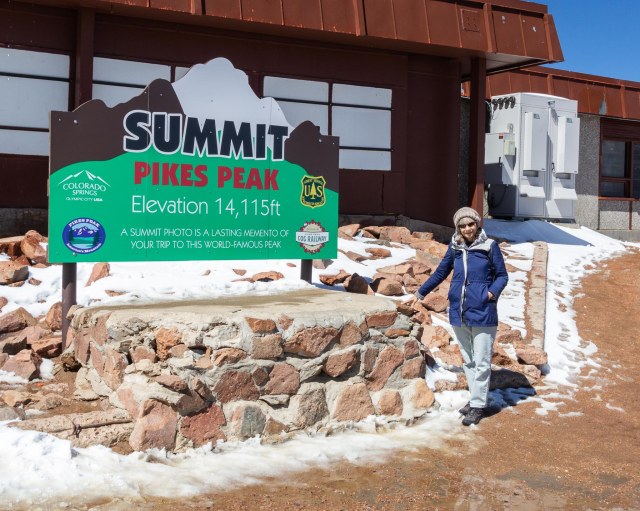
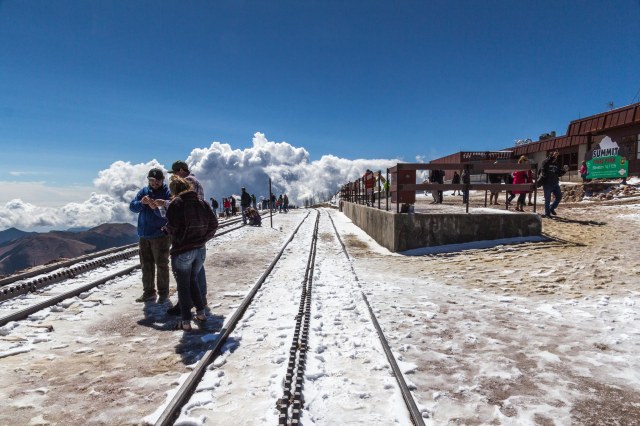
When we first arrived at the top, cold seeped through to the bone of my face and legs. Why did I not wear a base layer under my jeans? After a trip to the bathroom and a spin around the gift shop, I walked out onto the back patio and it didn’t seem so cold even though the ground was covered in snow.

View from the visitor center and silent railway

With all the construction, melting ice, and snow, we walked gingerly to avoid falling on our butts on the muddy walkways. The need for reconstruction was evident in the condition of the bathroom and gift shop. I’m sure it had been at least 30 years since the building last saw upgrades.

A few people (not pictured) hadn’t planned ahead, wearing flip-flops, shorts, and no jackets or sweaters, in the slushy snow and mud. Crazy.

Railway and buildings at top of Pikes Peak

The views from the peak were the best part of our trip and we saw that the cog railway ended conveniently at the back of the visitor building.

View from Pikes Peak
This photo shows switchbacks in the form of a W on Pikes Peak road

Miramont Castle High Tea

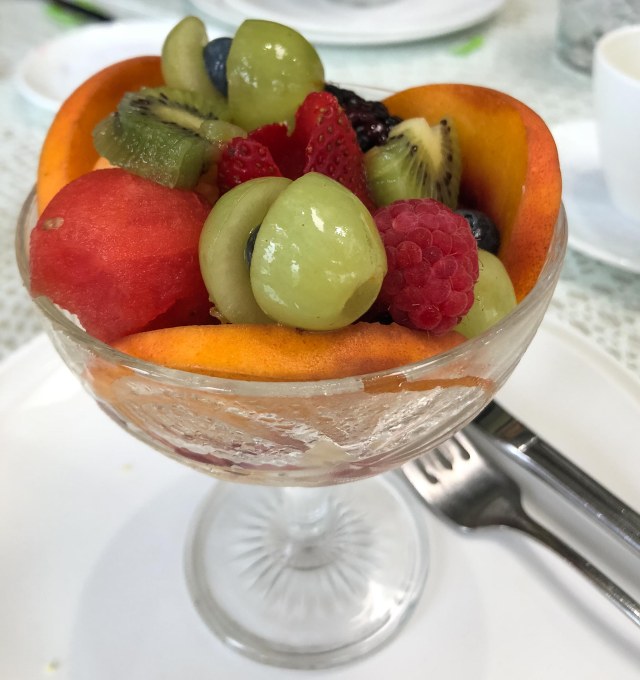
We missed out on tea at the Dushanbe Tea Room in Boulder, so when we saw that Miramont Castle in Manitou served High Tea we called for reservations. They serve the goodies different from what we have experienced in the past. Instead of displaying all the food onto a tiered serving tray, each course comes separately. We started with scones. Then a dish of fresh fruit with strawberries cut to look like a tulip flower, spiraled grapes stuffed with blueberries, and melon balls of cantaloupe and watermelon.

Fresh fruit served icy cold.

Next came the sandwiches. I liked the fig and chicken Paninis the best. The pickle and mayonnaise sandwich was not as tasty, but I ate it anyway.

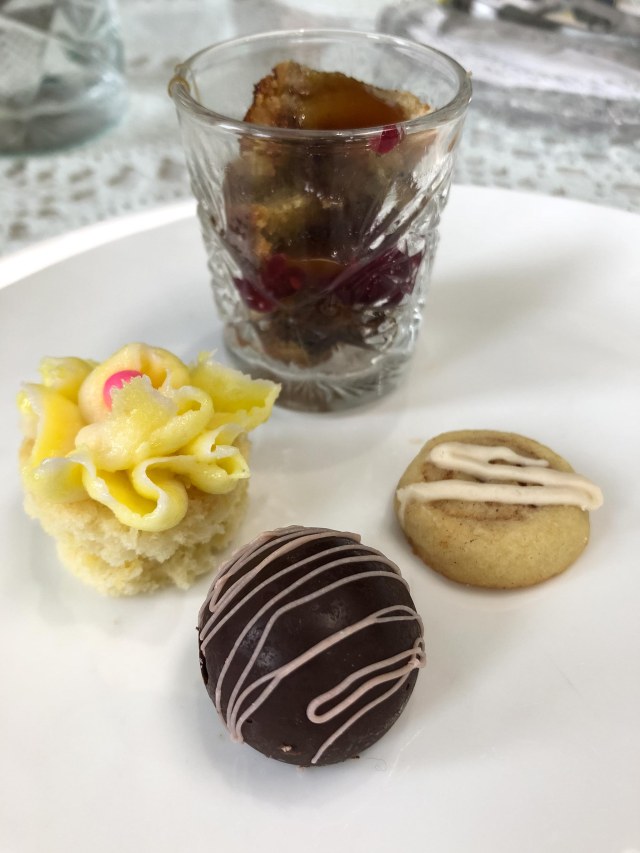
Dessert was an assortment of bread pudding, yellow cake with buttercream frosting, and a salted chocolate caramel truffle. I can’t believe I ate it all along with a pot and a half of two types of tea.

Yummy goodness
Two choices of tea included

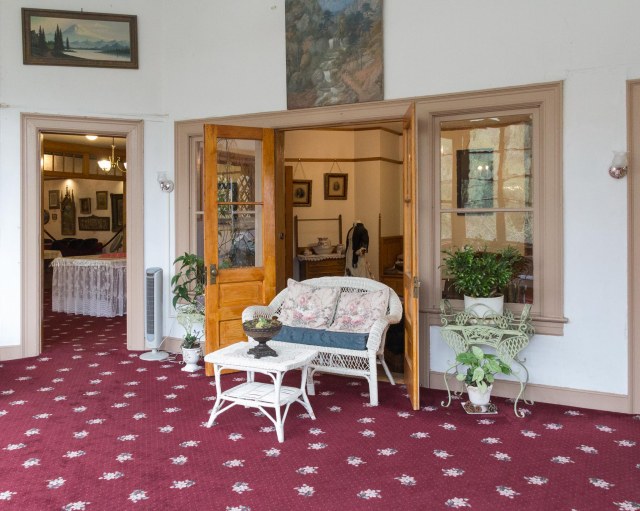
Before and after our reservation, we had time to poke around the castle. Contractors Angus and Archie Gillis constructed the building in 1895—adding a wing in 1897—using plans developed by the owner, Fr. Francolon, and his father.

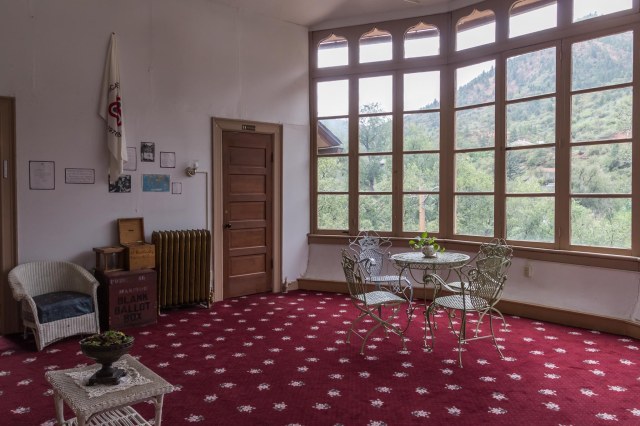
Solarium Photo 1

The 14,000 square foot home features 40 rooms, some of which are eight-sided. There is also a sixteen-sided room, a solarium, and arched doors and windows. There are nine separate architecture styles represented in the construction including Queen Anne, Romanesque, English Tudor, and Moorish. With two-foot thick walls made of native green sandstone, indoor plumbing, and electricity the castle was ahead of its time.

Solarium photo 2

Fr. Francolon came to Manitou for its popular healing waters and clean air hoping to restore his failing health. His mother arrived from New Mexico in July 1893, bringing four French-speaking servants because she did not speak English.

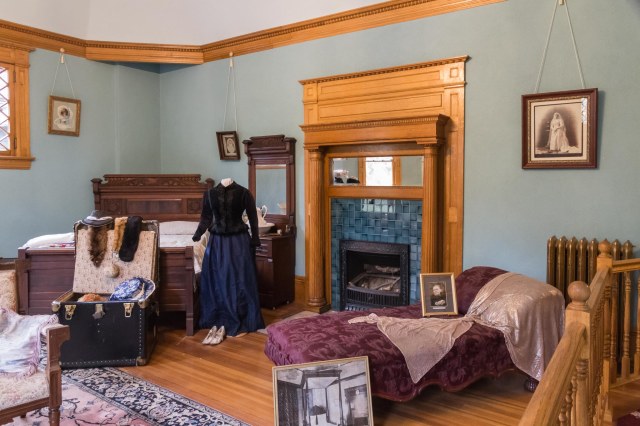
Bedroom 1

It is believed that the Francolons left for France unexpectedly in 1900 taking valuable artwork with them but leaving furniture. They never returned to Colorado.

Staircase

The Sisters of Mercy, who operated the Montcalme sanitarium nearby for the treatment of tuberculosis, purchased the castle in 1904. After a fire in 1907 destroyed Montcalme, they moved their operation to the castle until 1928 when they discontinued their treatments.

Bedroom 2

The property then served as a boarding house for the wealthy and a retreat for clergy. It stood vacant until 1946 when it was sold to private owners. Manitou Springs Historical Society purchased the castle on February 17, 1976, and began restoration. It was listed on the National Register of Historic Places on May 3, 1977.

Example of Moorish architecture?

Besides a photo gallery, there are five other exhibits throughout the castle including history and displays about the Manitou Volunteer Fire Department and Pikes Peak International Hill Climp, which will hold its 97th Race to the Clouds on June 30, 2019.

Garden of the Gods

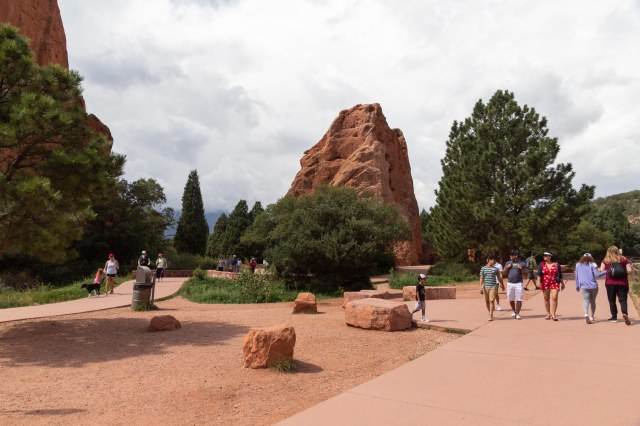
We visited and returned to Garden of the Gods a few times during our stay. Our first trip was to the visitor and nature center where they have interactive exhibits on geology, wildlife, and history of the park. On subsequent trips, we hiked one or more of the trails.

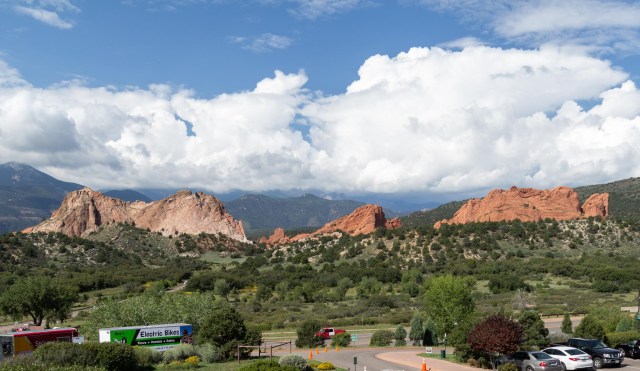
View of Garden of the Gods from the visitor center

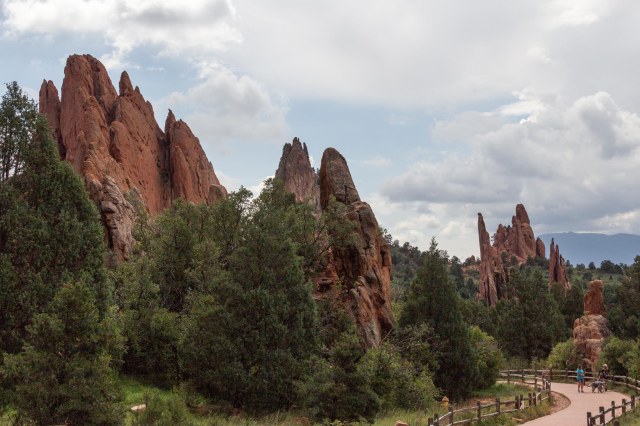
The city park, registered as a National Natural Landmark, has free admission. Highlights include red rock sandstone formations that attract over one million visitors each year.

Kissing Camels

Fifteen miles of loop trails intersect as they wind their way around and through the formations, giving hikers, bicyclists, and horses plenty of places to roam around the 1,364 acres.

Hikers yield to horses

Perkins Central Garden trail is accessible for wheelchairs and strollers along its concrete paved 1.5 miles. The city only allows climbing in certain areas with a permit.

Siamese Twins – Hello out there
Central Garden Trail

We have Charles Elliott Perkins and his family, William Jackson Palmer, and  Colorado Springs to thank for public access to these unusually shaped rocks.

Cathedral Spires

A portion of Garden of the Gods was included in 480 acres of land Perkins purchased in 1879. When he died in 1909, his family gave the land to Colorado Springs with the stipulation that it would be a free public park.

Steamboat on the left and Balanced Rock on the right

When Palmer died, he donated his Rock Ledge Ranch to the city. Today, Colorado Springs parks and recreation staff operate and maintain the visitor center and park.

No, Jon. You won’t fit through that crack.

Old Colorado City

We happened upon a huge farmers market at Bancroft Park in Old Colorado City. The colorful canopies, mouth-watering aromas, and friendly people laughing and talking was a delight to see. Had we known about the market we would not have loaded up on fruits and veggies the day before.

Bancroft Park Farmers Market

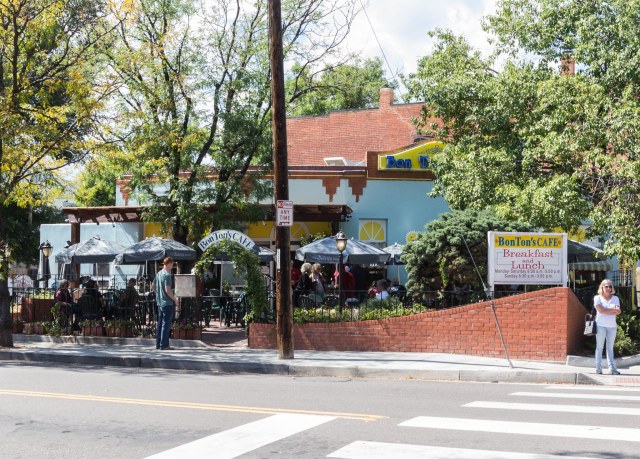
Lunch is what we were after. Bon Ton’s Café looked like a good bet and we were not disappointed.

Bon Ton’s Cafe – a great place for breakfast and lunch

We both had coffee and the apple streusel pancake. It was so huge it covered the entire large plate. There was no way we could have eaten more. Well, perhaps Jon could have.

Then we spent about an hour scoping out the historic buildings.

This 1904 public library has been in continuous use as a library since it opened.
This cabin, built in 1859, has had many lives, even as the capitol of territorial Colorado in 1862.
Example of architecture in Old Colorado City
Old Colorado City in reflection

It was nice to settle in Colorado Springs for the few days we were there. We had plenty to see and do without driving long distances. This we appreciated after our stays in Strasburg, Lyons, and Rocky Mountain National Park. We saved other attractions for our next visit when we have more time.

Safe Travels


Strasburg, Colorado – Visits to the Comanche Crossing Museum and Limon Heritage Park and Museum

Saturday, September 1 seemed like a good day to visit the local Strasburg museum. Unfortunately, the museum’s last day for the year was August 31. I would think they would want to capture the Labor Day weekend traffic. Then again, the people who operate the museum may have needed a vacation after their summer work and before they settled into their fall and winter activities.

Comanche Crossing Museum

Although we could not go inside the buildings, we wandered around the place reading the signage and looking at the outside displays. I even managed to take a few photos through windows.

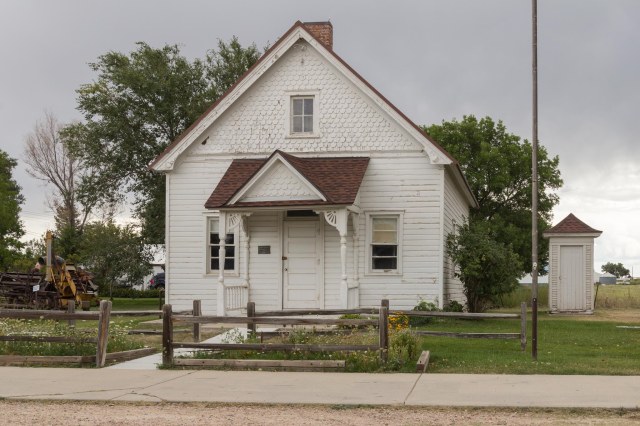
Homestead House 1910
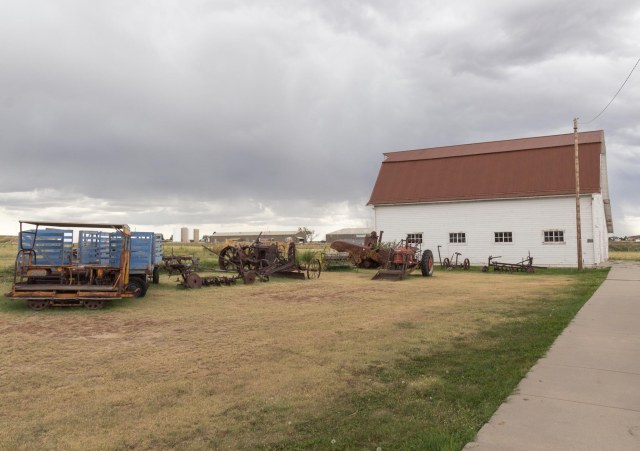
Farm Equipment and Barn
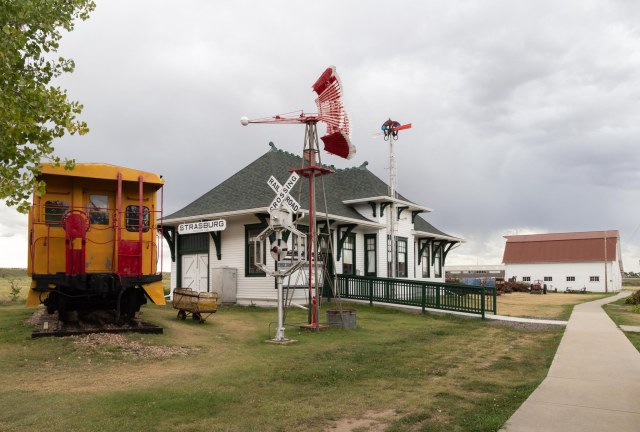
Strasburg Railroad Depot
Inside depot through the window

Still itching to spend some time in a museum, we drove to Limon, Colorado. There wasn’t much to see on Interstate 70 between Strasburg and Limon except the Great Plains. Miles and miles of wheat, corn, and hay fields dominated the land to the horizon and windmill farms covered the small hills that rise above the grasslands.
Fall comes early to Limon the Hub City

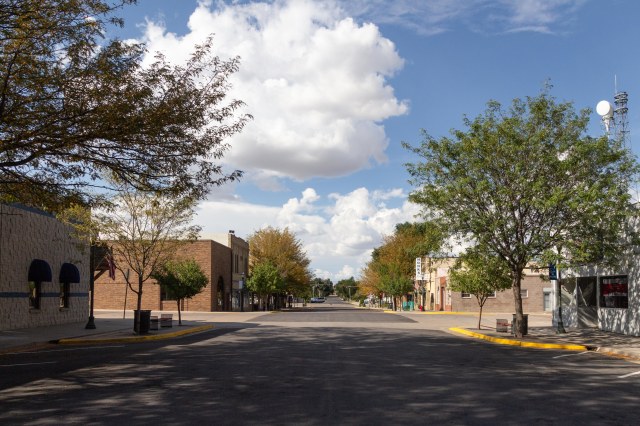
It was a slow day when we arrived in town. Although we could see that businesses occupied some storefronts, many of the buildings sat empty. No cars lined the streets making us think we had landed in the Twilight Zone.

Deserted city streets
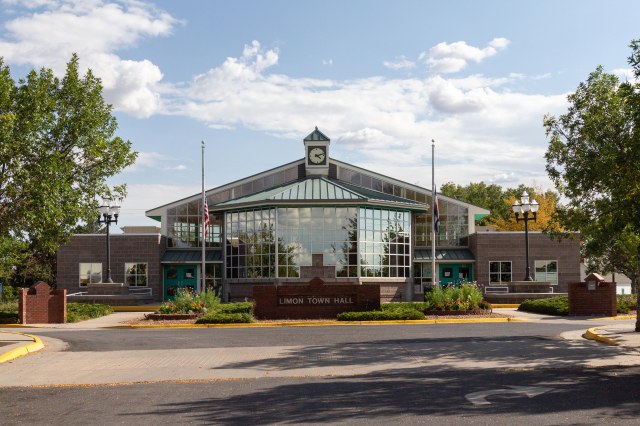
Limon Town Hall

Our greeting by a docent at the Limon Heritage Museum train depot eased our fears of having landed in another dimension. The docent explained that Limon was once a hub for freight and travelers. When the interstate was built, the town began its slow death. “No one wants to live in Limon anymore,” she said, although she seemed happy to live there.

An F3 tornado tore through the city in 1990 destroying most of the downtown business district. Due to the brick construction, the depot still stands today even though the tornado tipped several train cars on their sides. The docent also gave us a brief history of the depot and invited us to look around inside and view the train cars outside.

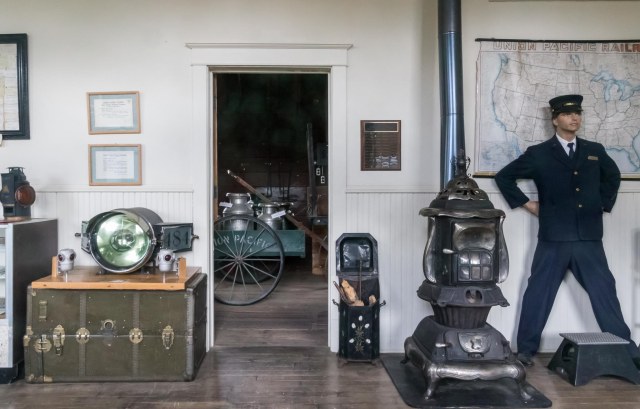
Depot waiting room
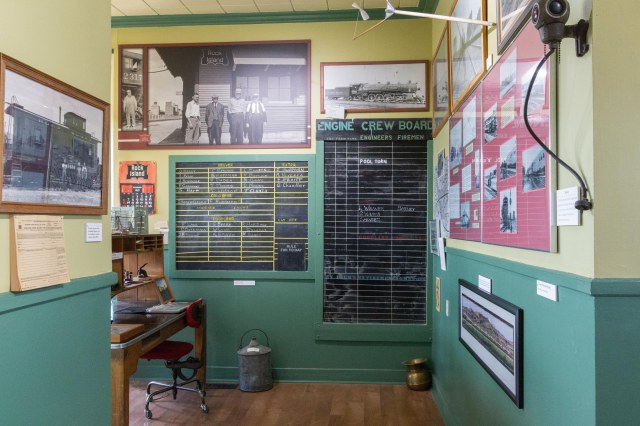
Control room
Drugstore display
Native American artifacts
JT surveys the train cars
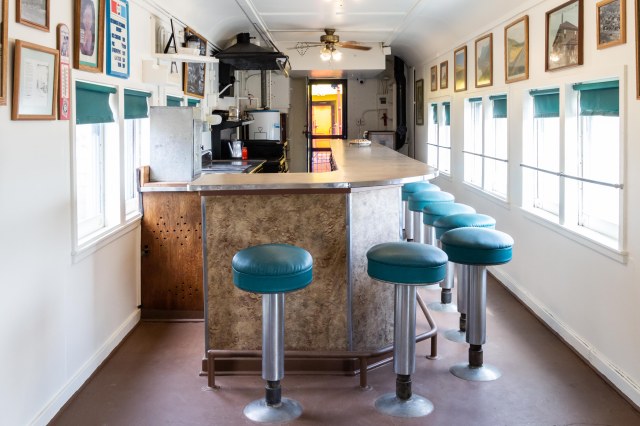
Meal car. Not much room for passing between the stools and the windows.

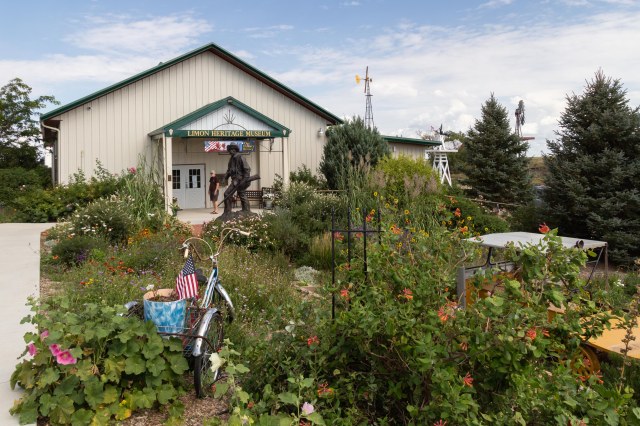
Besides the depot, a warehouse type building houses artifacts and other exhibits. Sunflowers and other bee and hummingbird attracting plants filled the garden in front of the building. I’d love to have such a colorful plot in our yard. It would be my little contribution to improve the environment by providing a place for bees, hummingbirds, and maybe a few butterflies to rest and gather their fill of pollen. Somehow, I believe all the effort to establish such a place would fall to ruin when we are traveling.

Limon Heritage Museum garden
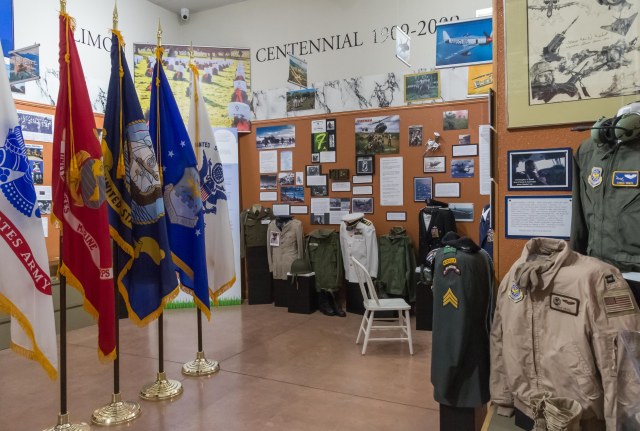
Military History exhibit
Example of 1930s attire for women
Prairie living room and kitchen
Wheat industry exhibit
Sheep wagon, cook wagon, and more

For a town with a population of fewer than 2,000 people, we found the museum well organized and the artifacts presented professionally and recommend anyone traveling on Interstate 70 to make Limon, Colorado, a stop on your route. They are open 7 days a week between Memorial Day weekend and Labor Day weekend from 1 p.m. to 8 p.m. Monday through Saturday and 1 p.m. to 4 p.m. on Sundays.

We drove around town, including the residential areas, before leaving town. Most of the homes showed pride of ownership in their well-kept yards, fresh paint, and newish roofs. That was a switch from some of the little towns we’ve seen. I wondered if the residents are happy with the situation preferring the rural atmosphere, or if they preferred more restaurants, shops, galleries and such to move in as an attraction for tourists to visit. If the museum had still been open, I would have gone back and asked the women at the museum.

I’m glad we took the time to drive out to Limon. We learned more history of the railroad and the town at the center of the crossroads for freight and travelers passing through. The roads that intersect the town include Interstate 70, U.S. Highways 24, 40, and 287, and State Highways 71 and 94.

Next up, we move to Colorado Springs for six days, checking in at an RV park near Garden of the Gods.

Safe Travels