Hawaii June 2022 Trip: Episode 5

Smith’s Fern Grotto Tour Wailua River

What could be finer than cruising on the Wailua River in Kauai? I can think of a few things, and the Wailua River Cruise to the Fern Grotto, known by the ancient Hawaiians as Ma`ama`akualono, is definitely on that list. The grotto is part of the Wailua Heritage Trail.
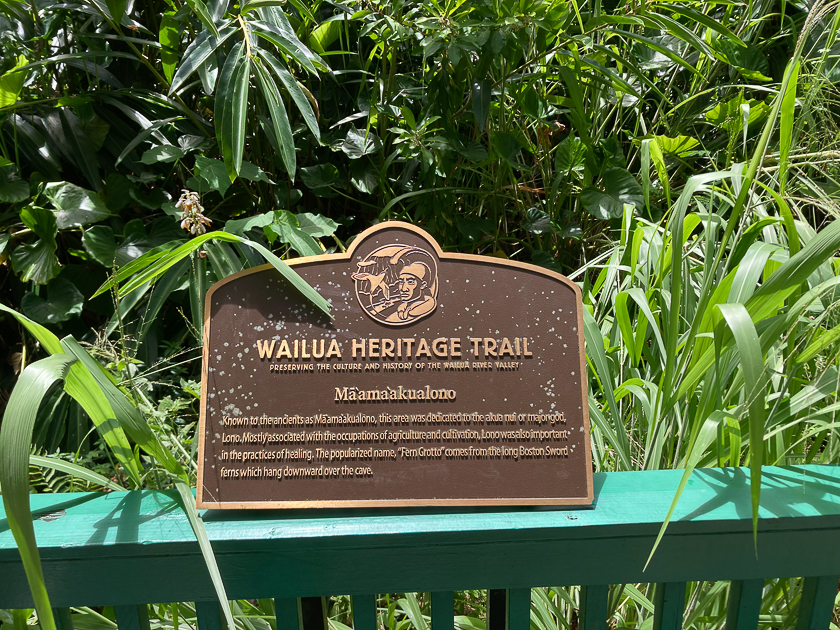
Wailua Heritage Trail lists nine sites to visit with historical significance

We hopped on the Smith’s Family cruiser—the Johnny-Mac, aptly named after the captain—for a ride upriver. As we motored along, our guide regaled us with stories of the Smith family and ancient Hawaiian history and myths as we passed kayakers.

Frog face rock formation?

I was glad we were riding in a motorboat. The last time Jon and I were in Kauai, we oared our way up the river in a tandem kayak. Although we had difficulty getting in sync with our rowing, it was an easy ride up. Going back against the tide coming in was much more difficult. To our embarrassment, our guide had to maneuver behind us and push us down the river.

On my count, paddle, paddle, paddle

The flat-topped trees towering in the background of the photo above are Moluccan albizia or Paraserianthes falcataria in Latin. The trees, native to New Guinea, were brought to Hawai’i as part of reforestation efforts in the late 19th century. And, although they are beautiful to look at, the trees grew better than expected and have crowded out plants native to Kauai.

We disembarked at the Fern Grotto landing and took a short walk through the rainforest. The guide told more stories and the ‘cousins’ sang songs and danced the hula. The fringed lava cave is not as lush as it once was. Hurricane Iwa damaged them in 1982 and ten years later, Hurricane Iniki nearly destroyed the rest. After 30 years, many of the ferns have grown back, but our guide said they aren’t as thick as they once were.

The gang’s all here: Kevin, Laura, Jon, Maya, Jackson, Chris, and Bailey. I’m behind the camera.
Entertainment at the grotto
Boston Sword ferns grow upside down from the cave’s overhang
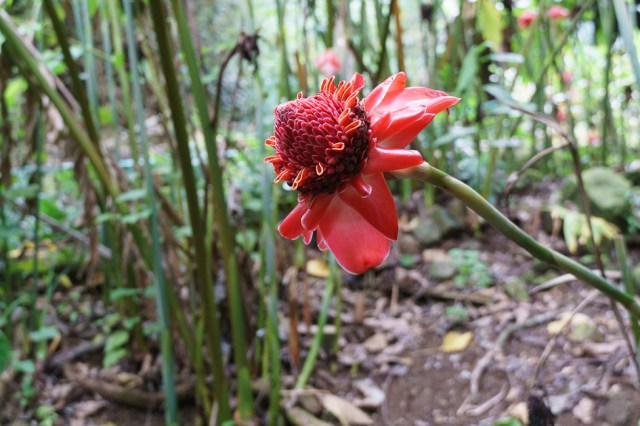
Etingera elatior or Red Torch Ginger
Loading up for the trip back

And on our way back, this lady serenaded us with Hawaiian songs and gave us a hula lesson. “Okay everybody, lift those hips and with your arms and hands make like a tree swaying in the breeze. Like this. Now like a wave on the ocean. You’ve got this.”
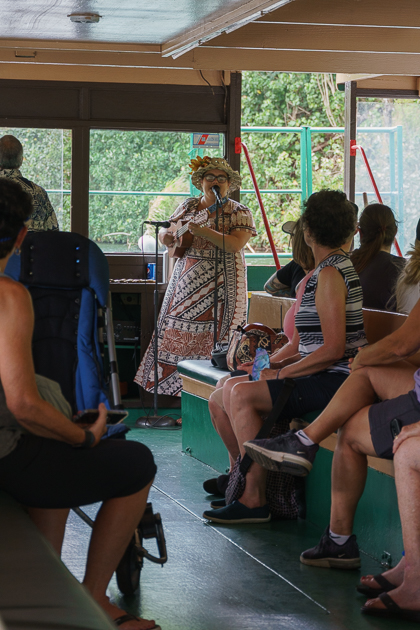
Serenading down a lazy river

The leisurely boat ride and short hike was a wonderful way to get into the Aloha Spirit, commune with nature, and let our troubles flow out to sea with the river.

Hanalei Bay

Not ready to head back to the house, we drove to Hanalei Bay. On the way, we stopped at the Hanalei Valley Overlook. Spread out before us was a valley of taro fields and the 4,363 ft. (1,330 m) Namaolokama mountain rising in the background.
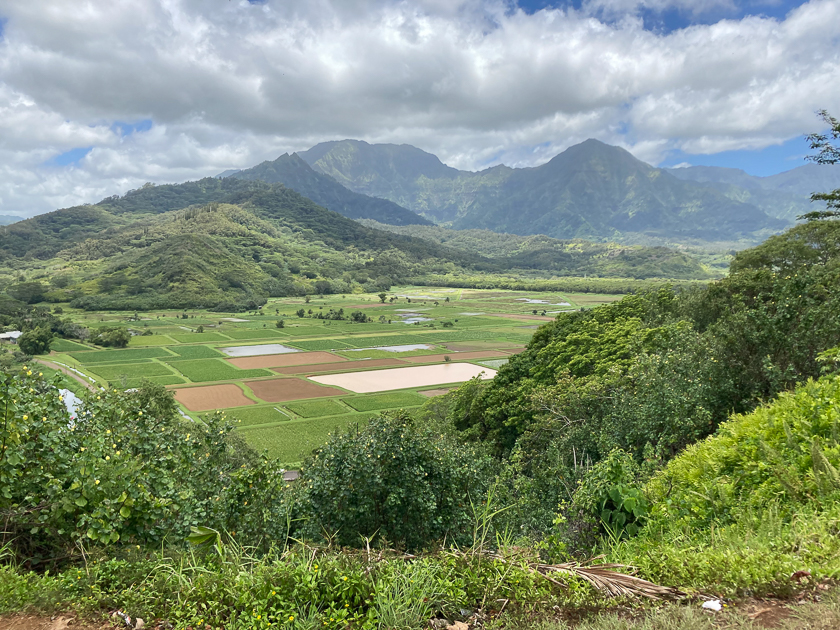
Hanalei Valley Overlook

The 2-mile-wide Hanalei Bay is great for surfing, body boarding, fishing, picnicking, and watching the sunset. It would have been nice to walk the shoreline to the Hanalei pier, but the grumbling of our stomachs told us we needed food. “It’s only two miles, let’s walk,” sounded like a good idea.

Only half of Hanalei Bay fit in the photo

Again, our poor planning had us scrambling for a table to seat eight. Had we driven instead of walked from the beach, we might have beat the large party eating on the porch when we arrived. As it was, we had to watch them sit and talk for another half hour after they finished eating.
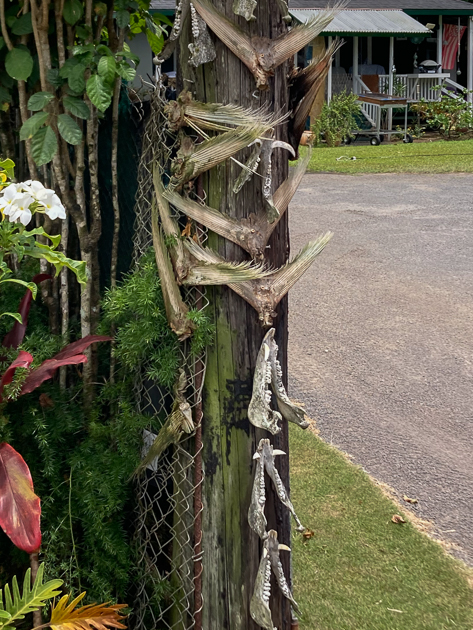
Telephone pole decoration seen on our walk from beach to town

A shaded picnic table and browsing through stores kept us busy during our one-hour wait for a table. Due to staffing shortages, other restaurants either were not open at all or didn’t open until 4:00 pm or after. The Arnold Palmer’s were refreshing after our walk and wait and our food tasty, so we couldn’t complain too much.

Tropical drinks, burgers, sandwiches and more await visitors at Hanalei Gourmet, in the Old Hanalei School
Stop in at Sand People and Yellowfish Trading Company for gifts and such, or relax with a massage at Hanalei Massage
Another view of Namaolokama from the town of Hanalei

It was a good thing we drove two cars that day. The heat had gotten to some of us and we were ready to head to the house, while the rest stayed to spend time at the beach. Next time we’re on Kauai, we’ll leave earlier in the day so we can spend more time in Hanalei Bay.

It looks like one or two more posts will wrap up our 2022 trip to Kauai.

Until then, safe travels.

Hawaii June 2022 Trip: Episode 4

On some days, we didn’t have a specific activity or destination in mind, so we just poked around. Some of us attended church, then we all visited the Kauai Coffee Estate, the Fort Elizabeth State Historical Park, and we ended our day at the Spouting Horn Blowhole.

Old Koloa Church

The history of the Old Koloa Church dates back to when missionaries first arrived in Kauai in 1820 and when Reverend Peter Gulick established the first mission in Koloa in 1834. Native grass houses served as meeting spaces until the mission constructed its first meeting house in 1837. Destroyed during a storm in 1858, the church was reconstructed and opened its doors in 1860. The congregation was formally organized in October 1923 as the Koloa Union Church and occupied the building until it moved next door in 1953. Pastors Harold and Christy Kilborn have led the current congregation at The Church at Koloa since 1981. Inside, the architecture is cozy and welcoming, as are the congregants and the pastors.

Old Koloa Church

Kauai Coffee Estate

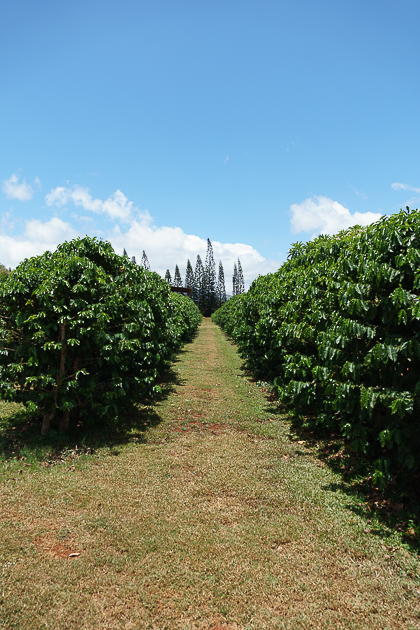
On a visit to Kauai Coffee Estate, we learned the estate operates the largest coffee farm in the US. Not just in the State of Hawaii, but the entire US. We took the self-guided tour around the visitor center where there were places to stop and read information signs that talk about growing and preparing the coffee for packaging. After our walk, we purchased a pound of roasted beans to take home and bowls of ice cream to eat on the patio at the back of the visitor center. It seemed only right to choose coffee ice cream at a coffee estate. My first bite stirred memories of sitting with my grandmother on her front porch after dinner, digging into a bowl of coffee ice cream, and watching the sun set behind the houses across the street. Ah memories. What would we do without them?

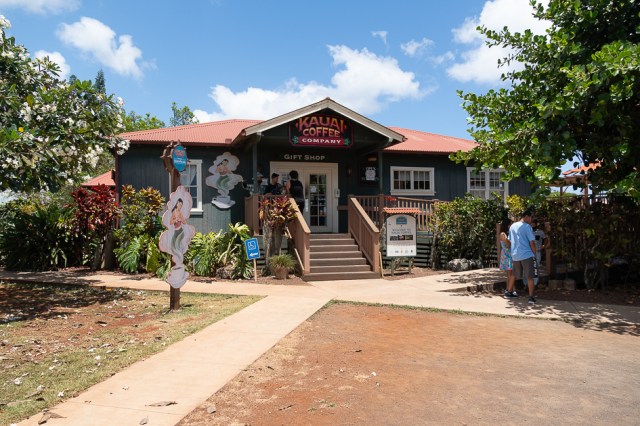
Kauai Coffee Company Visitor Center
Signs lead the way around the visitor center

The estate did not always grow coffee. For over 100 years, sugarcane stretched from Koloa in the south to Kalaheo in the west. Plantings of coffee trees began in 1987 and now total 4 million. One tree grows one pound of coffee a year. I wish we could have squeezed two pounds of roasted beans into our luggage.

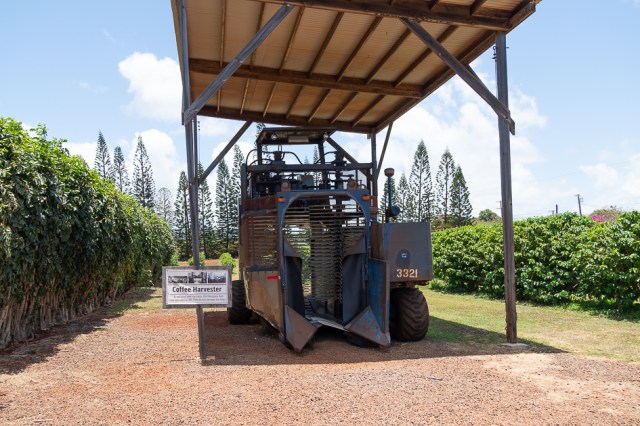
This piece of equipment drives over the trees and “tickles” the cherries off.
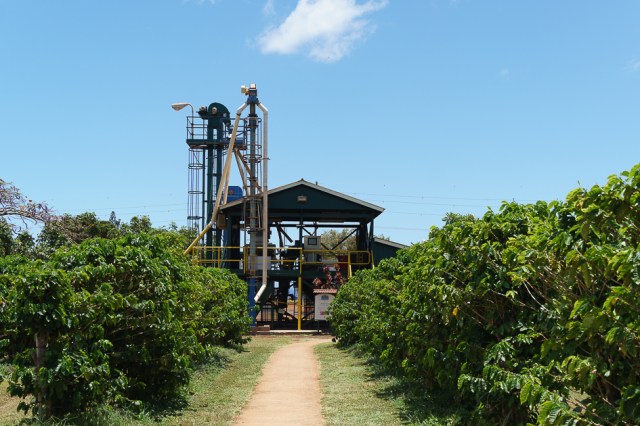
This shed sorts the cherries by maturity: ripe, natural, and immature
Logo stamped in the concrete walkway around the visitor center
Rows upon rows of coffee trees. Note the Cook Pines at the end of the row.
Hibiscus plants are common in Kauai. Love their paper-like petals.
Ripe coffee cherries

Among the coffee trees, we found a noni (Morinda citrifolia) tree, a member of the coffee family. With an odor so strong, the noni fruit may make one gag. Despite its awful stench, it’s believed to have health benefits and is often made into a beverage, powders, lotions, or soaps. Oil is made from the seeds and the leaves are ground to a powder and encapsulated into pills. Not enough fresh food to eat? Substitute noni as emergency food during famines. I hope I never have to resort to such a substitute.
Noni fruit

Ranchers brought 105 Cattle Egrets to Kauai in 1959 to control insects pestering their cattle. Today, they are the pest raiding the nests of Hawaiian duck, stilt, and other birds. In 2017, the state issued a control order calling for the culling of the birds from a population of over 30,000. Unintended consequences have the egrets running amok on the island.

Cattle Egret

Pa’ula’ula/Fort Elizabeth State Historical Park

There’s not too much to see at this state park that we could find. There are information panels that tell the history of the site with a map of what the Russian fort looked like, a rock wall, and a statue. We walked around the wall searching for the opening to the center and instead found the coastline.

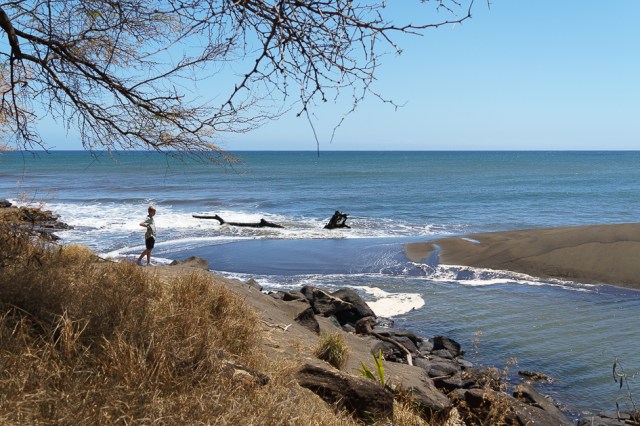
Waimea river meets the ocean
Looks like a nice uncrowded beach to spread out a towel

On our way back to the car, we guessed the wall outlined the fort, and I neglected to take a photo. Was the entry blocked or hidden? Had we missed the opening? Then I noticed the statue across the field from the parking lot. It looked new and well tended.

The Russian Fort Elizabeth State Historical Park was designated a National Historical Landmark in 1962 and the State of Hawaii acquired the property in 1972. On the Fort Elizabeth.org website, they list plans for the 17-acre site, including a visitor center. One of their plans was to honor King Kaumuali‘i, the last king in Kauai, with an 8’ bronze statue. This we found.

Statue Honoring King Kaumuali‘i

The king faces toward the setting sun on the day of the spring equinox, allowing him to enjoy the sunset of the winter solstice to his left and the summer solstice to his right. A small and large crescent in the floor pattern represents moon phases and the past and present.

I hope to come back once the center opens to welcome visitors and learn more about the fort, the king and all the historical figures that set foot on the site. For more information, visit the websites at National Park Service (https://www.nps.gov/places/russian-fort-fort-elizabeth.htm) and Fort Elizabeth (http://www.fortelizabeth.org).

Spouting Horn Blowhole

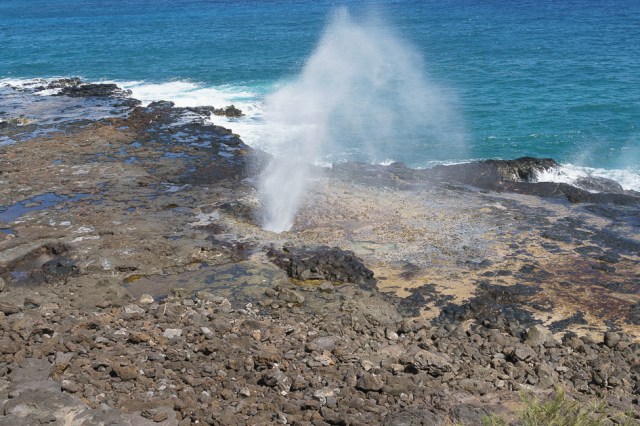
The Spouting Horn blowhole is a popular tourist stop. Whether they are walking, riding a bike, in a car, or on a bus, they come to take photos. Since this is one of the most photographed spots in Kauai, I joined in and set my camera on continuous shooting to capture the action. It was thrilling to watch the surf crash into the rocky shore and spout up through a hole in the rock like a geyser in Yellowstone. The gushers can reach up to 50 feet, depending on the tide level.

Spouting Horn view from left side of overlook

The hiss and roar that the water makes as it squeezes through a lava tube is the basis of the Hawaiian legend of Kaikapu, a giant moo, or lizard. There are multiple versions of the legend, as is common with legends. Was Liko a young boy who tricked Kaikapu, or was he a fisherman?

On the right side of the overlook, sea turtles played in between the rock formations. I couldn’t get close enough for a photo.

Whoever he was, he stabbed or speared Kaikapu in the mouth, swam under the lava shelf, and escaped through a lava tube. Kaikapu followed and got stuck in the tube. It is his moans and groans that create the hiss and roar. Or it could be her, depending on the legend. Who knows for sure?

Here a chick, there a chick, even at the blowhole

More to come in episode 5. See you then.

Safe Travels

Updated: August 20, 2022, to correct wording under the Old Koloa Church heading.

Hawaii June 2022: Episode 3

Kilohana Plantation and Kauai Plantation Railway

A train tour of the historic Kilohana Plantation sounded like fun, so we headed to Lihue. The narrated 2.5-mile rail line circles around the property and passes through original sugarcane and taro fields; groves of mango, banana, papaya, and pineapple; and experimental plantings of various crops. Along the way, pigs, goats, sheep, a donkey, and a cow entertain the riders.

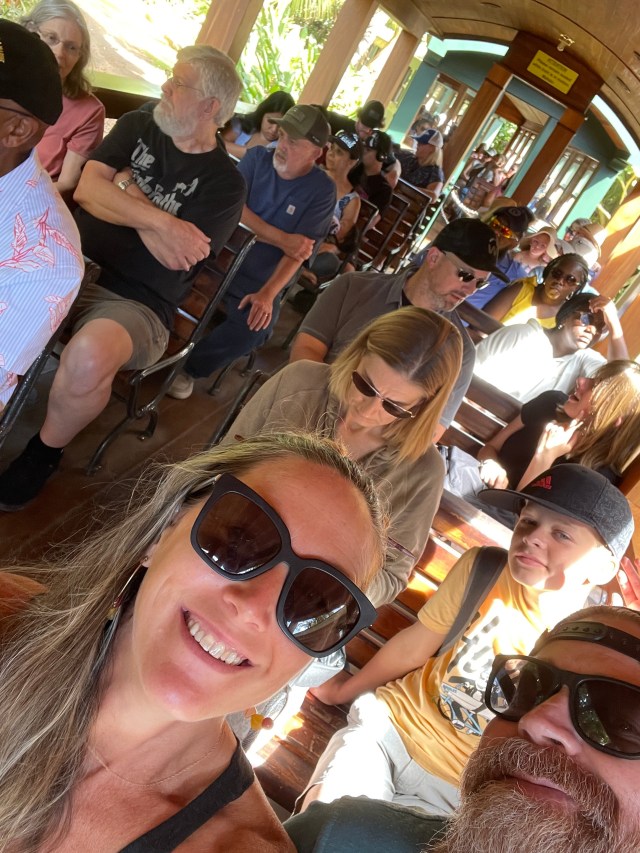
Great selfie, Bailey
On the train

Cook pine trees (Araucaria columnaris) are a common sight on Kauai. Johann Reinhold Forster, a botanist on Captain James Cook’s second voyage, classified the tree which is endemic to New Caledonia.

Cook’s Pines
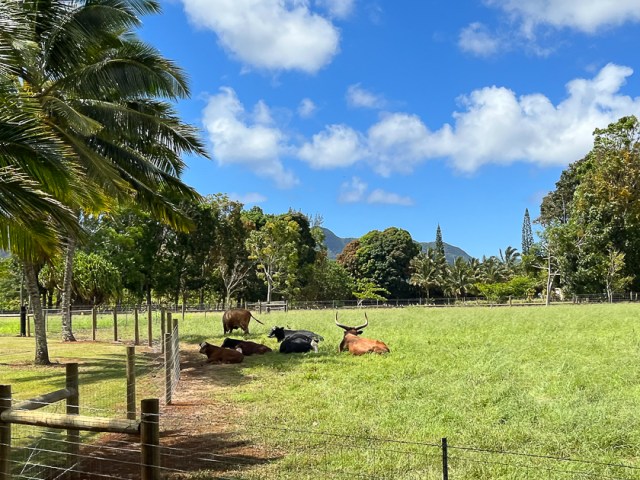
Cattle resting in the pasture

About halfway, the train stopped and let everyone off to feed tortillas to the animals. It was a challenge to fling the tortillas to the smaller animals so they would beat their larger friends to the prize. Back on the train, it was a delight to watch the pigs run with the train (behind their fence, of course) as the guide flung more tortillas.

Donkey and piglets eating tortillas.
Hey, Dude. I can’t reach that.
Outta my way. Coming through.

The guide told us that the plantation treats all the animals as pets, assuring us there was no danger the critters would end up on a luau banquet table.

Our guide had a garden plot here.

Not interested in the train? Hop on a Safari truck for a two-hour guided tour of the property, where adventurers drop into the Kahuna Nui Valley, stroll across a boardwalk through a tropical rainforest, and enjoy a Mai Tai at the Jungle Bungalow while listening to the flowing river.

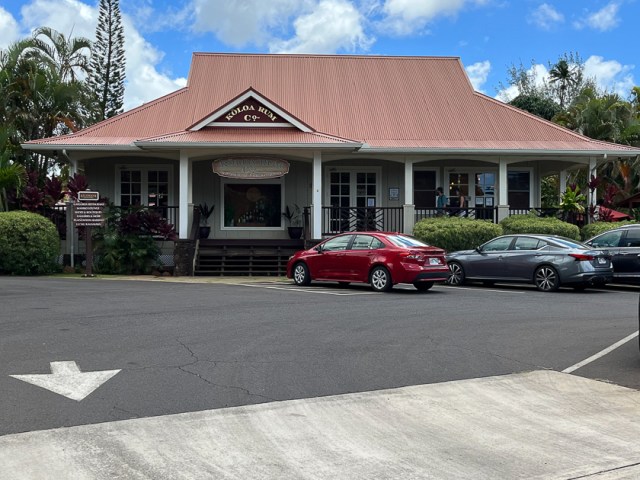
Koloa Rum Company offers tastings

The Kilohana Plantation was first developed in 1896 by Albert Spencer Wilcox as a working cattle ranch. Wilcox’s nephew, Gaylord Parke Wilcox, took over in 1936 and built Kauai’s first mansion.

Kilohana Plantation Mansion

After our train ride, we wandered around the 1930s restored 16,000-square-foot mansion, browsing through the specialty shops and art galleries. Some of our group waited patiently for the Kauai Sweet Shop to open so they could buy their sweet treats.

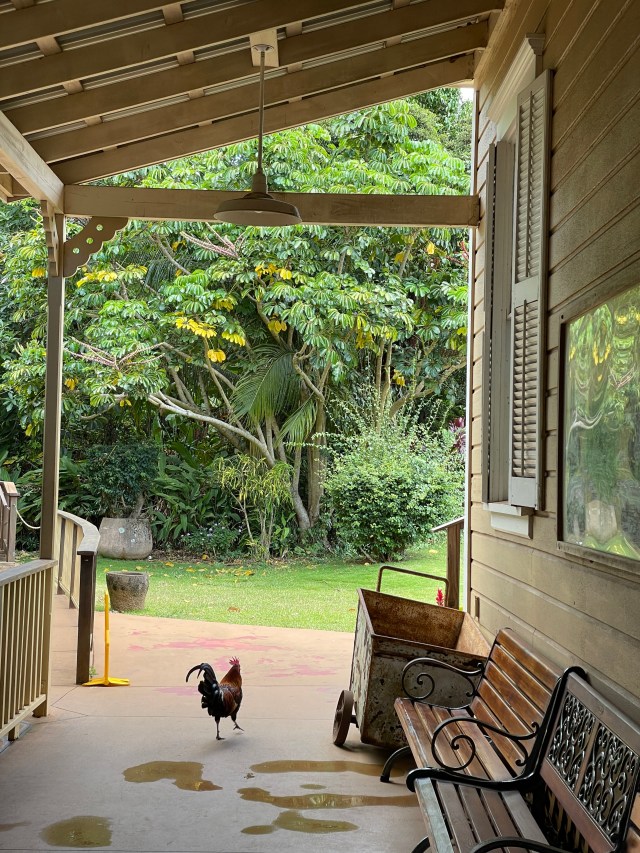
Chickens rule in Kauai
The colorful hibiscus is a common bush in Kauai
Farm equipment

Barefoot Bar at Duke’s Kauai

We thought about eating at Gaylord’s because their menu looked so good. But we opted to drive to the Barefoot Bar at Duke’s Kauai. Unfortunately, we had to wait about an hour in the tropical sun.

Let’s go swimming. Wait, no swimwear.

We found a few shady spots to cool our heels and stared out at the inviting bay water, wishing we had brought our swimwear.

Waiting, and waiting, and waiting

And then, the hostess called our name. Good thing because that hour wait in the heat and sun about conked us out.

Note for future reference: Always pack swimwear and towels even if you don’t plan on swimming. You never know when the opportunity might present itself.

Grand Hyatt Kauai Resort & Spa Luau

When in Hawaii, one must attend a Luau. We all dressed in our best island attire and drove to the Grand Hyatt Luau, where they served as many Mai Tais as we wanted. The drinks weren’t the best I’ve ever had because the tropical weather melted the ice, diluting the alcohol, but I didn’t turn them down either.

Our family from left: Laura, Jackson, Chris, me, Jon, Maya, Bailey, and Kevin

The buffet had an abundance of food with beef, pork, fish, chicken, fresh salads and vegetables, an assortment of fruit, and rice and rolls. The pork and fish were my favorites, along with the yams. And the best dessert was the coconut lemon cake.

But the luau isn’t just about the food and drinks. It’s the music and singing and dancing. Below is a little video I captured at the end of the fire knife dance, the climax of the show. It’s a bit grainy but still fun to watch.

Luau Climax

After the show, the photographer gave each couple the Aloha photo above as a souvenir. What a delightful surprise. The luau included free drinks and a photo. Usually at events like this, the drinks are overpriced and photos are not included.

The adventure continues. Stay tuned.

Safe Travels

Hawaii June 2022: Episode 2

The fun continued in Kauai when we loaded up the cars and drove to Kōke‘e State Park for an easy to moderate hike. A hike our entire group could navigate and which held the promise of standing above the Waipoo Falls, and looking out over the Waimea Canyon.

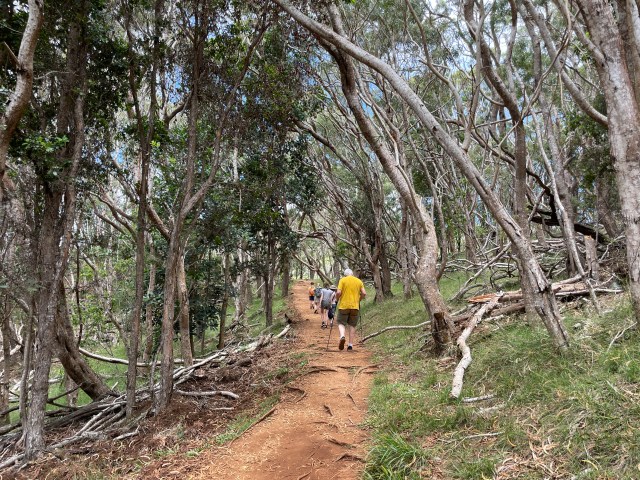
Let’s take a hike

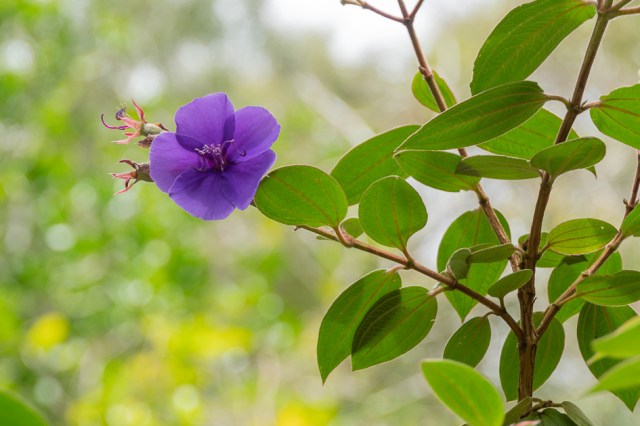
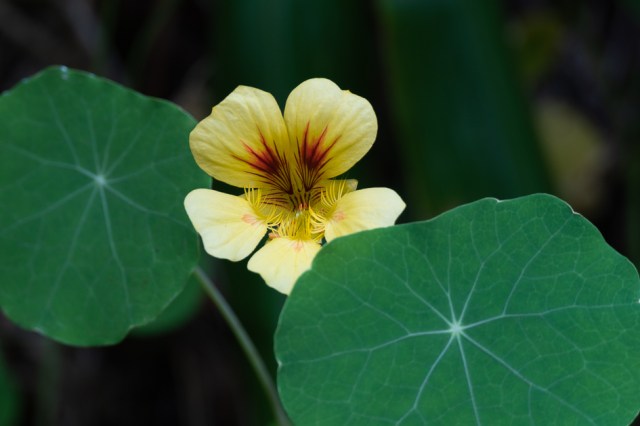
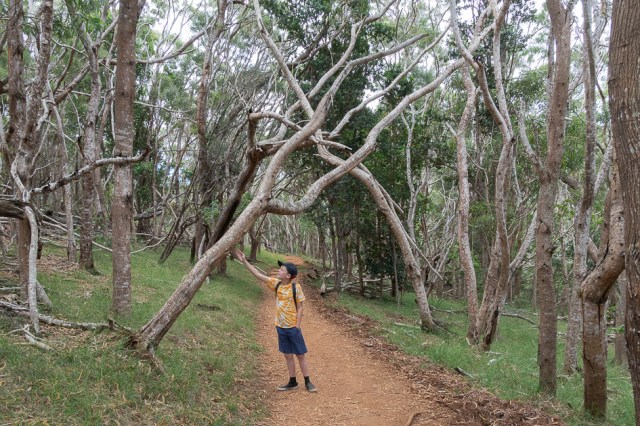
We enjoyed our walk along the well-marked trail through the forest. The flowers, of course, caught my photographic eye while the rest of the gang picked and tasted blackberries.

Lots of shrubs and shade to keep us cool
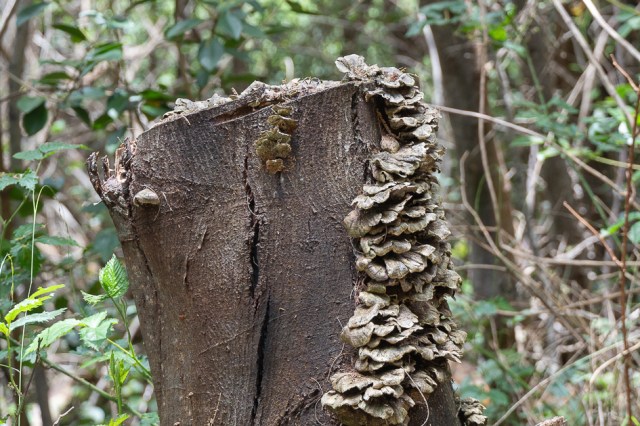
A tree stump nourishes fungi

Much of the trail was flat, with an occasional elevation gain or loss. At the fork, we took the Canyon Trail to the left. A few yards later, we encountered at least a 3-foot drop-off, requiring a jump or slide on our backsides. Sliding seemed the better choice for me.

A snack along the trail

A few people ahead of us struggled to navigate the drop but made it unscathed. Most of our group managed it without too much difficulty. Unfortunately, Jon’s trekking poles were of no use. Somehow, his foot and ankle got stuck in a tree root, and he couldn’t pull free. Our son, Kevin, and another hiker helped him get loose and on his feet. Whew! Disaster averted.

The falls were not too far ahead, so we continued until we encountered another drop. While we contemplated this new obstacle, someone coming toward us said there were three more drops—some worse than the last—so we turned back, not wanting to chance an injury.

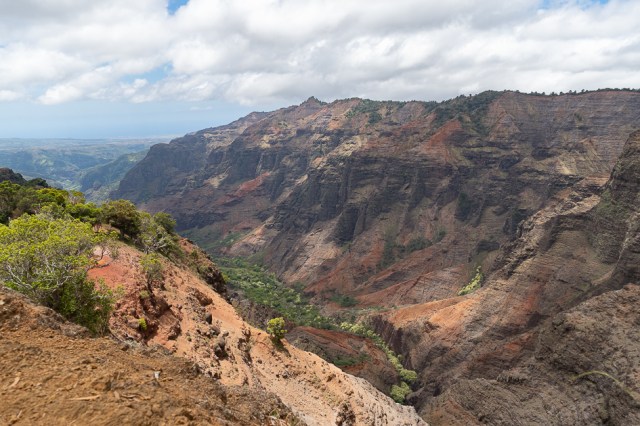
Back at the fork, we took the trail on the right, which led to the Cliff Trail Lookout. This was more our speed, and the view of Waimea Canyon made it clear why it is called the Grand Canyon of the Pacific.

Bringing up the rear
The Grand Canyon of the Pacific

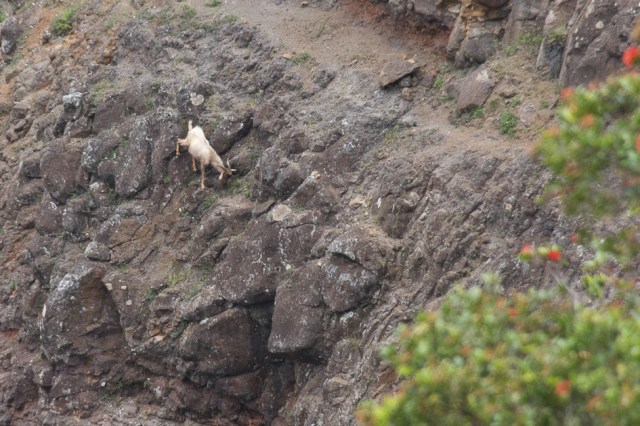
While gawking at the view and taking photos, we heard goats bleating. We scanned the cliff on the other side of the canyon but weren’t sure the white specks we saw were actually goats. Jon zoomed in with his 300 mm camera lens and captured a few on the cliffs.

Did you hear that? It sounded like a goat.
Hang loose

These goats are the descendants of goats introduced by English sea captain George Vancouver in 1792. Since their arrival, they have sped up the erosion of the canyon walls. Not a good thing.

Goat across the canyon
I wonder what kind of tree this is

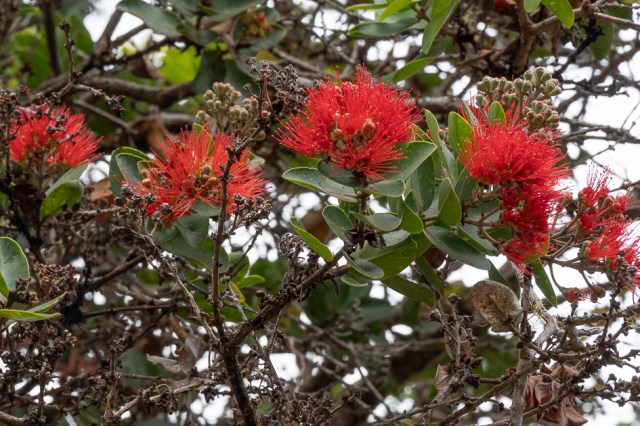
The ‘Ōhi’a tree is one of the most populous trees in the state. Whether grown as a small bush or trimmed into a tree, their gnarly growth pattern and colorful flowers are distinct and easy to spot. As a native of Hawaii, the tree has the honor of taking root first in fresh lava, even before the volcanic gasses dissipate nearby. They break down the rock and provide a more hospitable spot for other plants to grow.

When hiking around, be aware that the ‘Ōhi’a tree is under attack by two species of fungi. If you see leaves on limbs or the crown of the tree turn yellow or brown, notify the Kaua’i Invasive Species Committee at saveohia@hawaii.edu, or 808-821-1490. For more information and to learn how to prevent spreading the fungi, go to https://cms.ctahr.hawaii.edu/rod.

Lehua blossoms of the ‘Ōhi’a

So how did this tree come to be in the hostile volcanic rock in the middle of the Pacific Ocean? In one account, Pele, the goddess of volcanoes, plays the villain in the myth of the lovers ‘Ōhi’a and Lehua. Pele desired ‘Ōhi’a and offered her love to him. ‘Ōhi’a’s love for Lehua was so strong he rejected Pele’s advances.

In revenge, Pele turned ‘Ōhi’a into a tree. A distraught Lehua pleaded with Pele to return ‘Ōhi’a as he was. Understanding Lehua’s loss, Pele turned Lehua into a beautiful flower in the tree so that the lovers shall remain forever together. In another account, it was a group of gods, not Pele, that made Lehua into a flower.

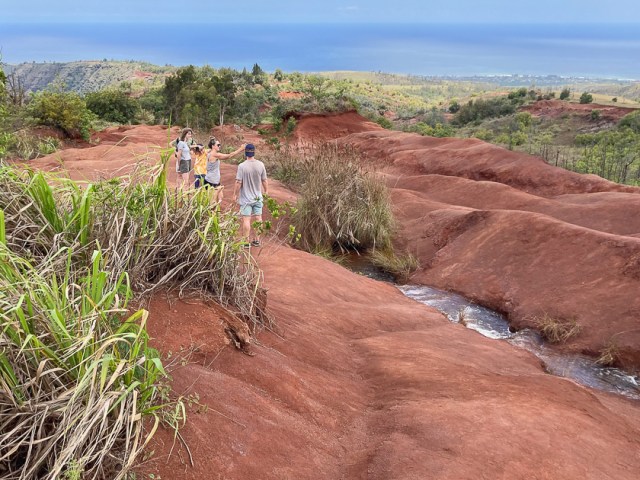
Exploring Red Sand Falls

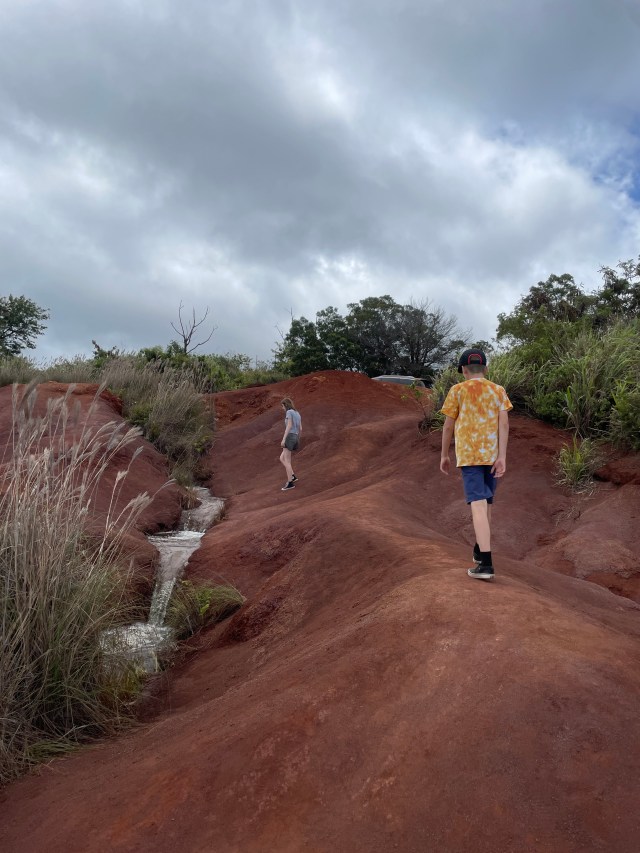
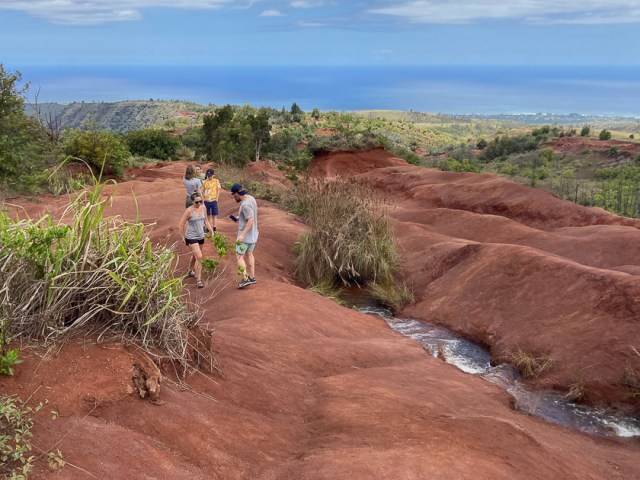
On the way up to Waimea Canyon, we had spotted the Red Sand Falls, or Red Dirt Waterfalls, so we stopped on our way back down to see this interesting scenery. Created by Mother Nature, the dirt is composed of oxidized iron-rich basalt rock that surrounds Waimea Canyon, and the falls carry it downstream.

Farmers love the rich red dirt

A few precautions when visiting this area:

  1. Don’t drink the water because it contains high levels of insoluble iron and aluminum oxides that may make a person sick.
  2. Be sure to wear proper shoes when walking on the rock because it can become slippery during wet conditions.
  3. Don’t jump into the water because it is too shallow and can cause an injury.
Grippy shoes are recommended especially after a recent rain

There’s a prettier spot below where we stopped, but we were all craving poke, so we didn’t bother to stop again. Ishikara Market in Waimea was the place to go for poke. Add on rice, seaweed salad, or other deli items for a satisfying lunch.

More Kauai adventure continues in our next post.

Safe Travels