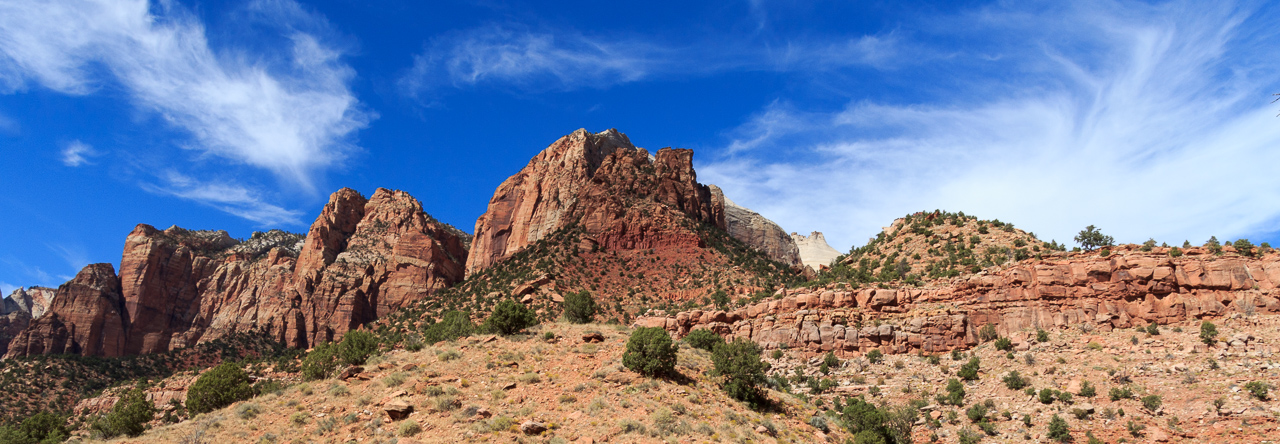
With Grand Rapids, Michigan, only 100 miles north of Elkhart, Indiana, we jumped at the chance to check off another presidential library from our list.
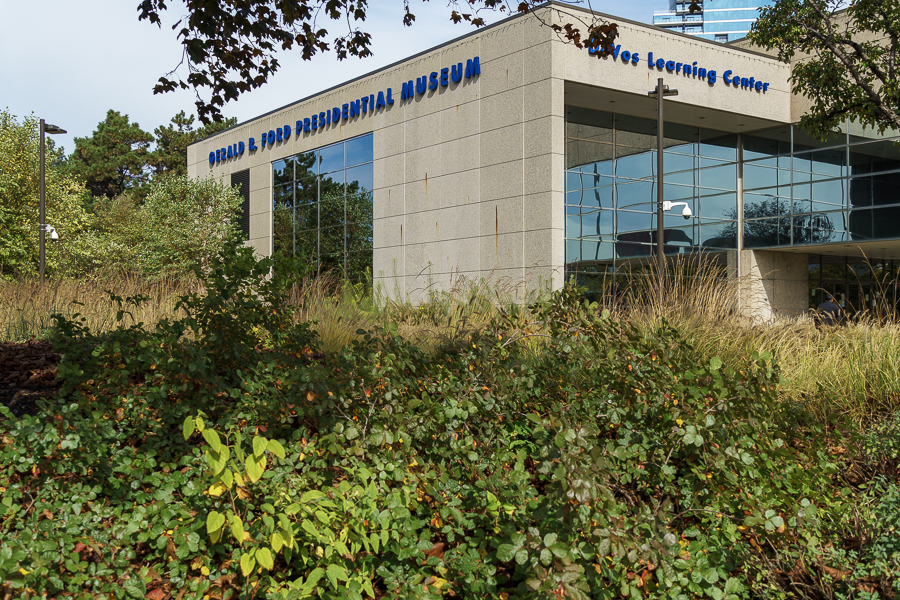
I wondered why Ford’s library was in Ann Arbor, and the museum was in Grand Rapids. Ford agreed in 1963 that Bentley Historical Library at the University of Michigan would house his congressional papers.

Upon leaving the presidency, he deeded his papers to the National Archives and a new presidential library at the university in Ann Arbor was born. Since considered Grand Rapids his hometown, he opted to build the museum there.

All three sculptures exhibit a suggestion of movement. Ford holds papers in one hand and takes a step. The astronaut floats in space. And Betty smiles and reaches her hand out as if to welcome visitors. Or maybe she’s dancing a step.
Like most presidential museums, Ford’s starts off by telling the president’s life from birth and early years. Then moves on to education, political career, and the years after presidency.

Gerald R. Ford was quite the catch in high school and at the University of Michigan. He played in the “All-City” and “All-State” football teams in high school. Then played on a national championship college football team in 1932 and 1933 at the University of Michigan where he earned a BA in economics. And in 1934 he was named valuable player.
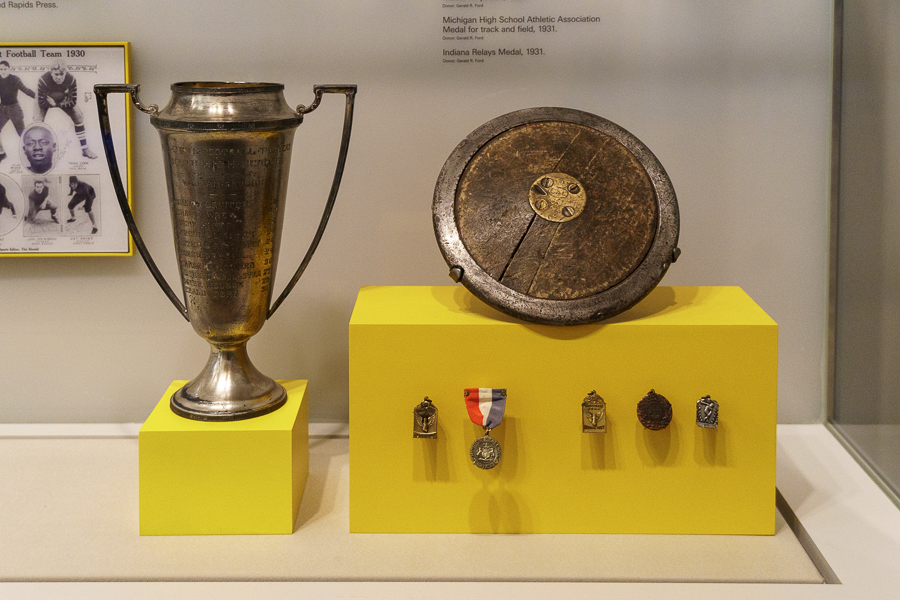
If that’s not enough to impress the girls, he worked in the family paint business and at a local restaurant and became an Eagle Scout in November 1927. With all of his extra-curricular activities, time for a social life may not have existed.

He rejected offers to go pro from the Detroit Lions and the Green Bay Packers. Instead, he went to Yale to coach boxing and assistant coach varsity football. The coaching positions allowed him to attend Yale law school.

In 1941, he earned his bachelor of law (LLB) degree, passed the Michigan bar, and opened a law practice with one of his fraternity brothers. He also became active in Grand Rapids’ republican politics.

When the United States entered World War II, Ford joined the US Naval Reserve. His athleticism qualified him as a physical fitness instructor at a pre-flight school in Chapel Hill, North Carolina. In 1943, he boarded the USS Monterey light aircraft carrier bound for the South Pacific. A typhoon in the Philippines in 1944 damaged the ship, sending Ford stateside until his discharge in February 1946.

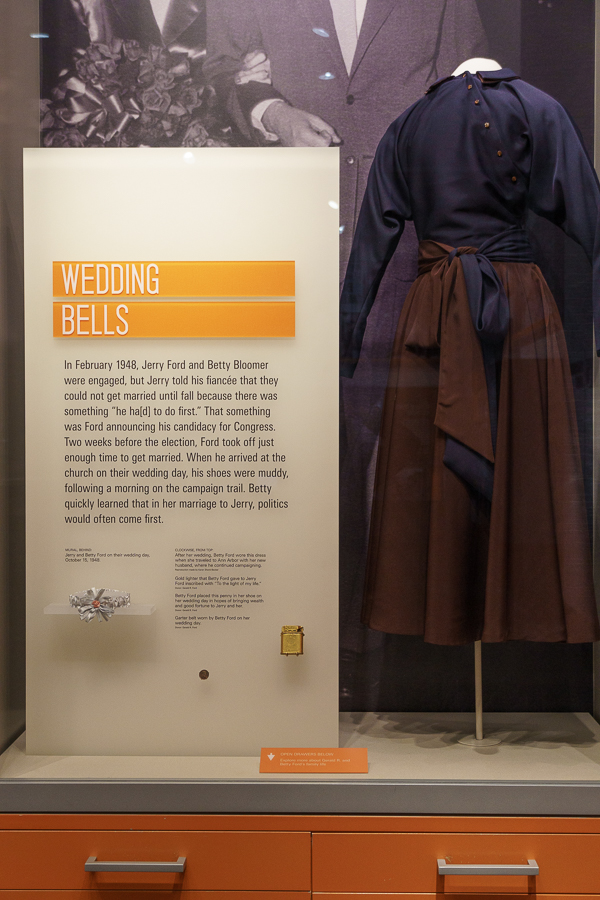
Ford settled into his congressional duties and Betty settled in her life as a congressman’s wife. They raised four children during their time in Washington, DC.


His dream to become the majority leader never materialized, although he served eight years as minority leader. In 1973, Nixon tapped Ford as vice president after Spiro Agnew resigned under pressure.

Ford supported and defended Nixon until evidence tied Nixon to the Watergate coverup. What more could a vice president have done?
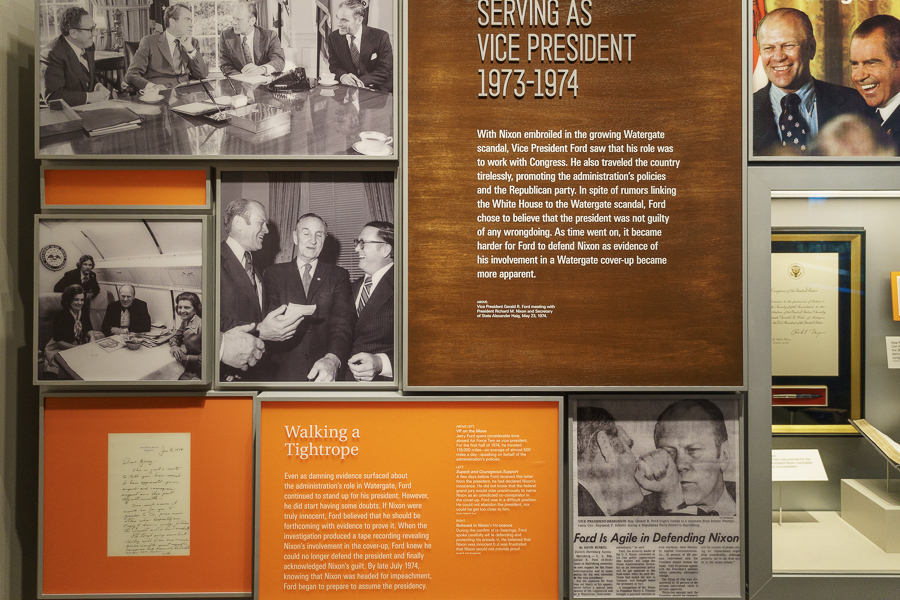
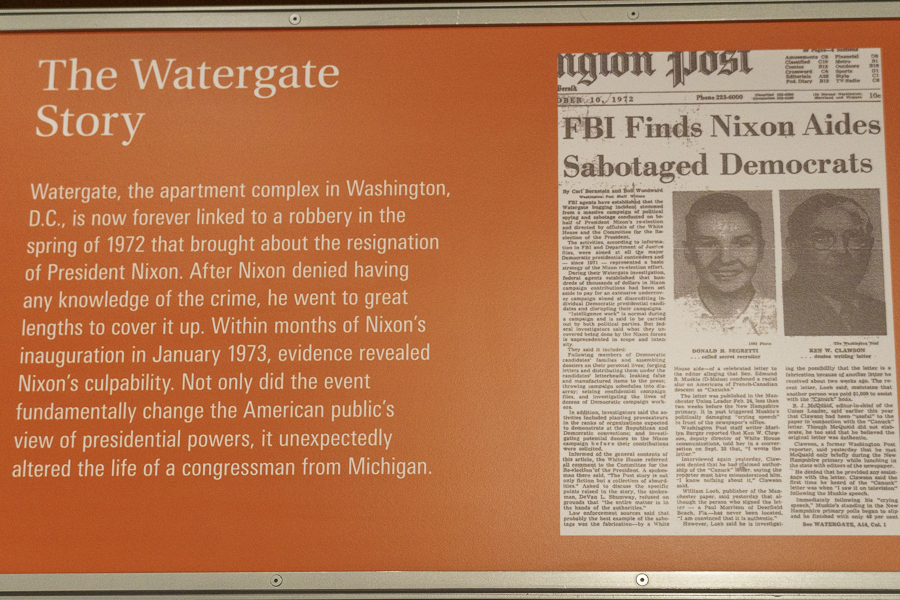
Nixon tried his best to hide incriminating tapes that revealed his knowledge of a burglary at Watergate. His efforts failed and on August 9, 1974, he resigned and Ford became president.

Timelines, photos, and artifacts at the museum display Ford’s presidency.
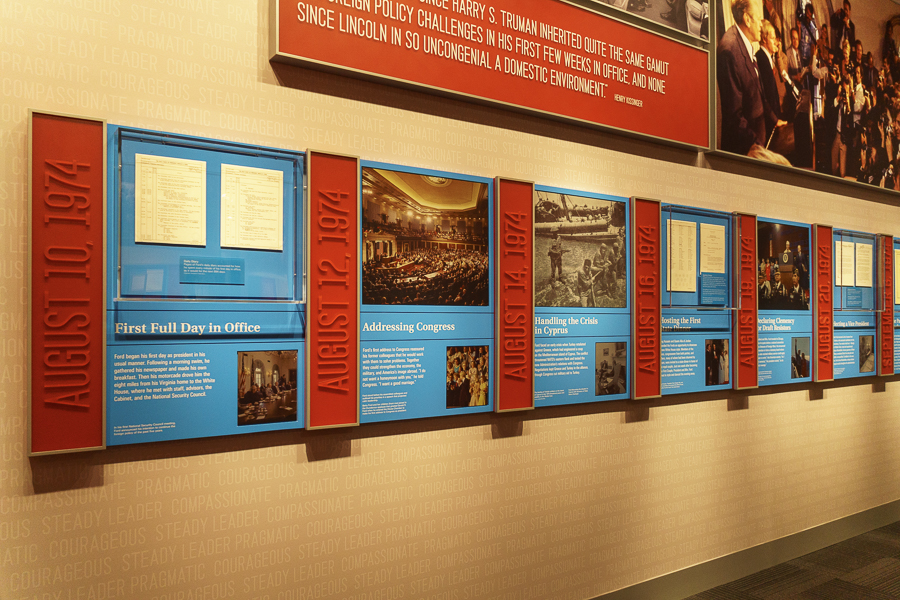
President Ford dealt with many issues, concerns, and problems plaguing the United States and the world. War, inflation, energy shortages, negotiations with the Soviet Union, and the Apollo-Soys joint-manned space flight are but a few of the issues that vied for the new president’s attention.

Three major events in 1975 are of particular note.
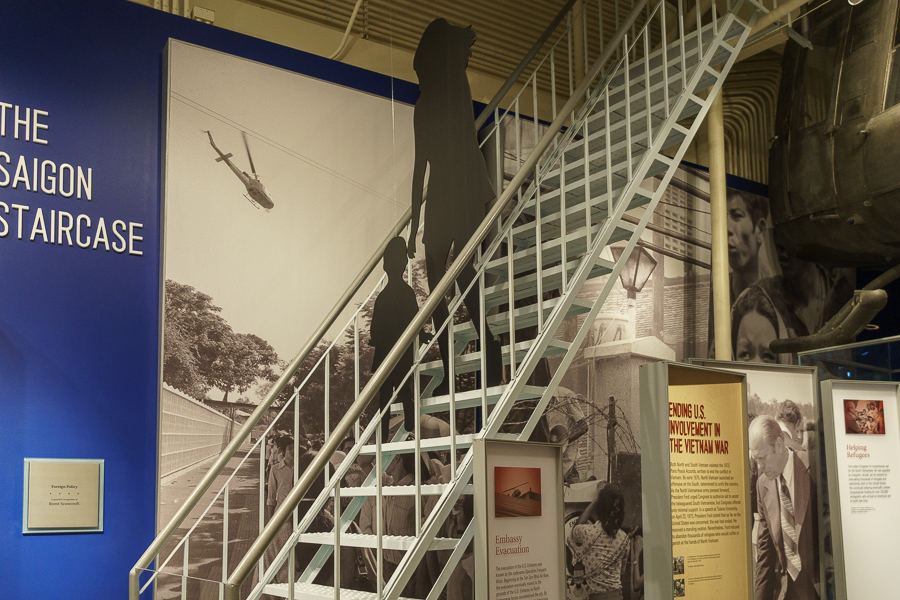
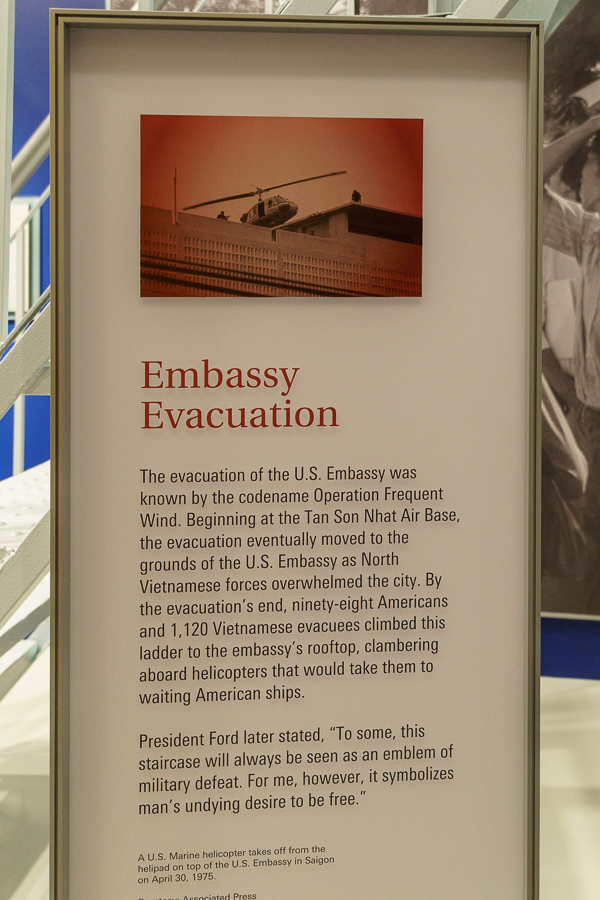
The Vietnam War ends. In early March 1975, the US began evacuations of civilians from Tan Son Nhut Airport and continued until April 28, 1975, when the Vietnamese People’s Air Force attacked the Tan Son Nhut Air Base.

Then Operation Frequent Wind began evacuations from the US Embassy in Saigon. Helicopters shuttled personnel, Vietnamese, and third-country nationals to USS Midway and other ships until April 30.
On May 12, 1975, Cambodian gunboats seized the SS Mayaguez, an American merchant ship in international waters. On May 14, 1975, Ford ordered US forces to retake the ship. They recovered the vessel, saved thirty-nine crewmembers, and lost forty-one American lives. Historians study the operation to learn from mistakes made.
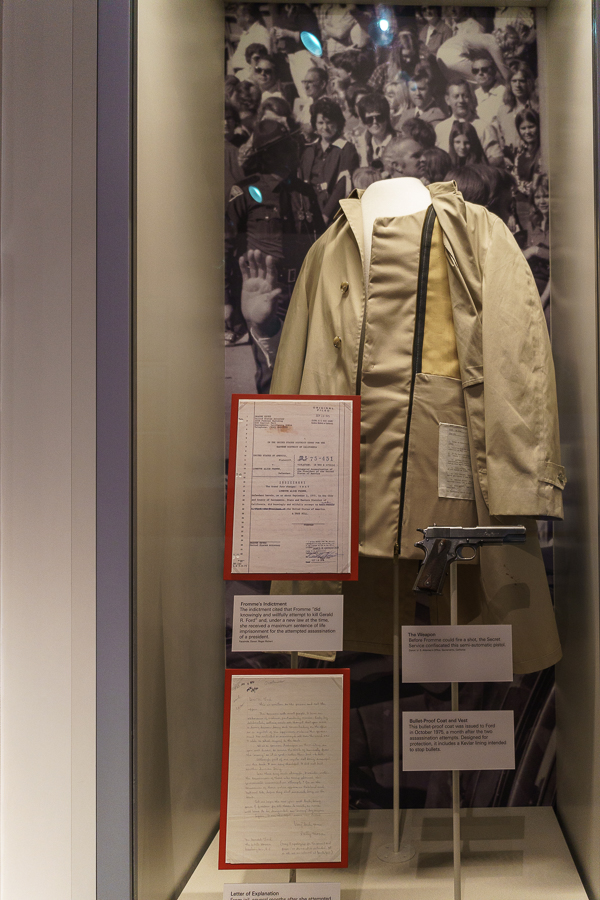
He endured two assassination attempts. Both carried out by women. Both occurred during September 1975 while Ford visited California.



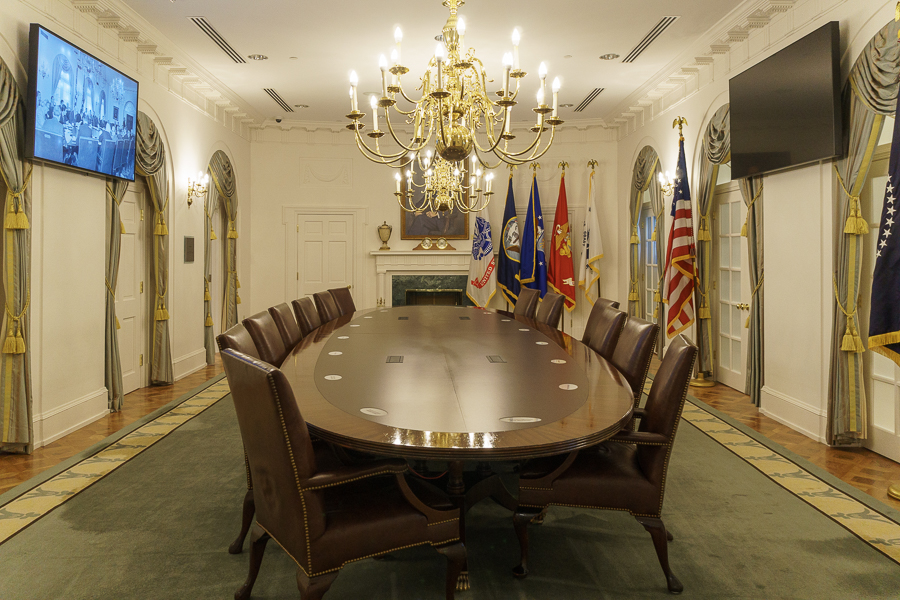
And now, a little about Betty. Elizabeth “Betty” Anne Bloomer was born April 8, 1918. Raised in Grand Rapids, her love of dance took her to Vermont’s Bennington School of Dance where she met choreographer Martha Graham.

Betty later studied with Graham in NYC and performed at Carnegie Hall. In 1941, she went back to Grand Rapids, working at Herpolsheimer’s and helping children with disabilities. Married to and then divorced from William Warren, she met Gerald Ford in 1947.
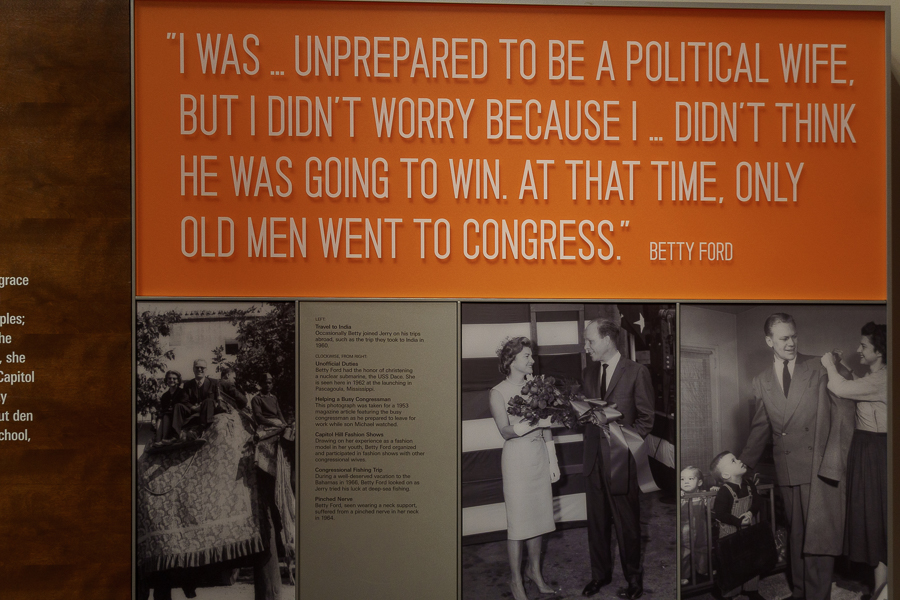
She and Ford married on October 15, 1943. She wasn’t shy about her drug and alcohol abuse and recovery or her breast cancer diagnosis and treatment. People attribute her courage to speak out while others retreated to the “Betty Ford Blip,” a 15% increase in women seeking mammograms.

And a few more artifacts.
The largest aircraft carrier in the world—the length of three and half football fields. Commissioned on July 22, 2017, and first deployed on October 4, 2022. Named for Ford to commemorate his service on the USS Monterey during WWII.

A section from the Berlin Wall. A gift from Frederik GH Meijer to the museum on its tenth anniversary. Dedicated by President Ford on September 6, 1991.


After our visit, we selected Roam by San Chez for a place to eat. We loved the atmosphere and great food.


Next up: We make a few stops on our way back to California
Safe Travels
 The Traveling Todds
Just a like. I didn’t see the icon.
LikeLiked by 1 person
Thank you for this post. I remember Ford’s presidency, but I didn’t remember much about it.
LikeLiked by 1 person
Same here. I guess I hadn’t paid much attention to the news in those days.
LikeLiked by 1 person