As we approached the Dwight David Eisenhower Presidential Library and Museum on April 29, 2023, I tried to remember what I had learned about this man. Only three tidbits popped up: 1) he was a military general, 2) had something to do with the country’s interstate system, 3) and his nickname was Ike.
Eisenhower had been my president for the first eight years of my life as I obliviously watched Romper Room, donned my cowgirl outfit—complete with pistol, holster, and boots—and later played with my Barbie. I also attended Eisenhower Junior-Senior High School in my hometown. Go Eagles! Shouldn’t I have learned more about the man, at some point? Maybe I did and don’t remember, or maybe I didn’t because my dislike of World War II history never held my interest.

Here are the highlights of what I learned about the president that polls rank in the top 10 of all presidents. As with all the presidential museums we’ve visited, we walked through Ike’s life, starting with his boyhood.
Dwight David Eisenhower (nicknamed Ike) was born on October 14, 1890, in Denison, Texas. His family moved to Abilene, Kansas, in 1892, where Dwight lived with his parents and five brothers.
Ike entered West Point on June 14, 1911, and graduated on June 12, 1915, as a Second Lieutenant. Although he didn’t make the baseball team, he played varsity football as a halfback until a knee injury ended his sports career.

In October 1915 while stationed at Fort Sam Houston, Texas, Eisenhower met Mamie Geneva Doud while visiting friends in San Antonio. Was it fate she and her Denver, Colorado, family had rented a house in San Antonio for the winter? Dwight’s and Mamie’s romance was a whirlwind, announcing their engagement on February 14, 1916, and married by July 1, 1916. They had two boys, the first of which died of scarlet fever within four months. The military family moved extensively from post to post until World War II broke out and Mamie settled in at the Wardman Park Hotel in Washington, DC.
Fun Fact: Dwight David Eisenhower II, Ike’s and Mammie’s grandson, is married to Julie Nixon, Richard and Pat Nixon’s daughter. Richard Nixon was Eisenhower’s vice president.

Between 1915 and 1922, Eisenhower served in the Infantry and Tank Corps, earning promotions along the way. In 1919, he volunteered to participate as a Tank Corps observer in the First Transcontinental Motor Convoy. The lack of roads that could accommodate the heavy equipment the Army moved across the country made the task difficult.
During the 1920s and 1930s, Eisenhower racked up promotion after promotion while serving in various posts under the command of several generals. Then, on December 7, 1941, the attack on Pearl Harbor dragged the US into World War II.

In May 1942, Eisenhower was designated Commanding General, European Theater, London England. By November 1942, he was named Commander-in-Chief, Allied Forces, North Africa. In December 1943, he was appointed Supreme Commander, Allied Expeditionary Forces and commanded forces of the Normandy Invasion on June 6, 1944.
On December 20, 1944, promoted to General of the Army with 5 stars and after the German surrender on May 8, 1945, he was appointed Military Governor, US Occupied Zone, Frankfurt, Germany.
He held the position of Supreme Allied Commander of NATO in Europe and had operational command of US forces in Europe from December 1950 to July 1952.
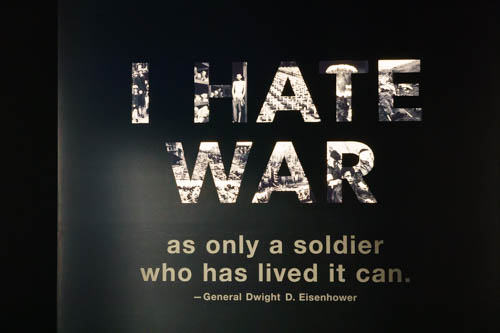
In Abilene, Kansas, on June 4, 1952, Eisenhower announced his candidacy for the Republican party nomination for president. He won the nomination and the presidency against Adlai Stevenson II and beat Stevenson again for a second term.

During Eisenhower’s presidency, the economy boomed. I suspect the pent up demand after the bans, restrictions, and rationing during the war had as much of a hand in the bounce back as the president in office did.

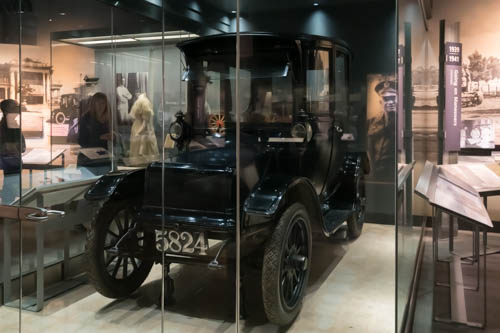
Eisenhower occasionally drove the car below. It belonged to Mamie’s mother, Elivera Doud. It cost $4,300 when new and the driver could use either the front or rear seat controls.
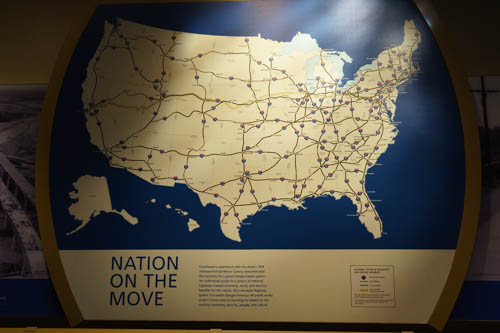
The National Interstate and Defence Highways Act (1956) was one of Eisenhower’s notable achievements as president. This display claims, “No public works project comes close to equaling its impact on the country’s economy, security, people, and culture.”
Eisenhower’s foreign policy focused on reducing military aid and preventing the spread of communism. These policies ended the fighting in Korea with the Korean Armistice Agreement signed in July 1953. They also increased the country’s nuclear weapons and delivery systems and prevented other countries from acquiring or using them against the US.

Eisenhower relied on secret CIA missions to fight communism in Southern Asia, South America, and the Caribbean instead of using the military. Some critics argue these actions have left the US with unresolved foreign policy issues that continue to cause havoc to this day.
Desegregation was another contentious issue his administration dealt with. Eisenhower continued President Truman’s orders to desegregate the federal workforce and armed forces. The Supreme Court decision in Brown vs the Board of Education, came down in 1954, which led to the Civil Rights bill.

The bill established a bipartisan congressional commission to investigate civil rights violations, created a civil rights division in the Department of Justice, and gave the Attorney General authority to pursue contempt proceedings against violators of civil and voting rights.
After exploring the museum, we took a break outside and discovered a statue of Eisenhower in the “Champion of Peace” circle. In the background are memorial pylons. Phrases on the pylons commemorate Eisenhower’s life from birth through presidency.

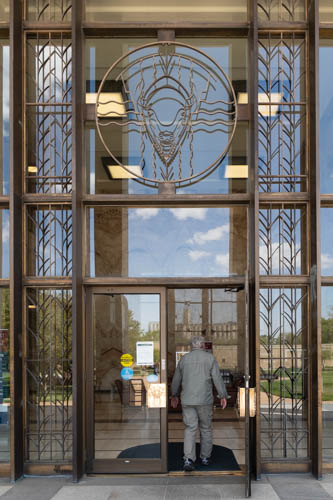
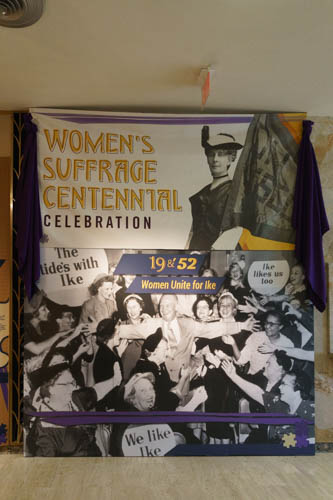
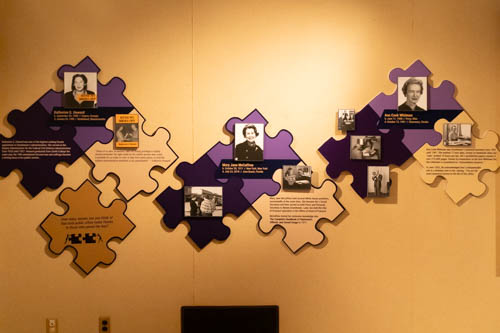
Across from the museum is the library building. During our visit, we found the Women’s Suffrage Centennial exhibit upstairs. It celebrated the women who campaigned for Eisenhower and those who served in his administration. His was the first presidential campaign to focus on the vote of women.

Below is the chapel, or mausoleum, where Dwight and Mamie are buried.

Inside are quotes from Eisenhower’s speeches. The one on the back wall is from his Guildhall Address, London, June 12, 1945. It says, “Humility must always be the portion of any man who receives acclaim earned in blood of his followers and sacrifices of his friends.”

Also outside is Eisenhower’s boyhood home, which we toured with a guide. Under the National Archives website, is a video tour of the house and historical detail for those who are interested.
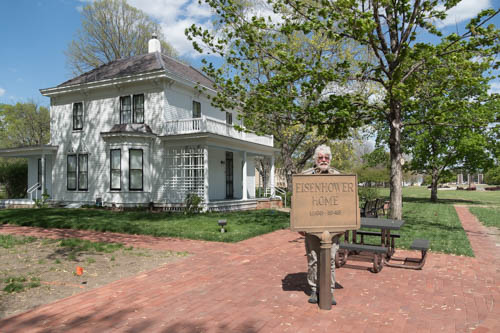


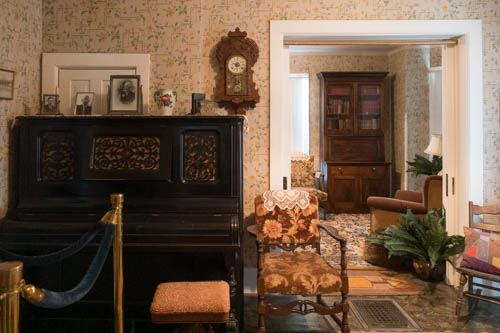


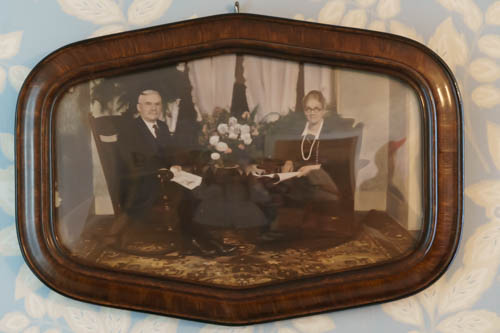

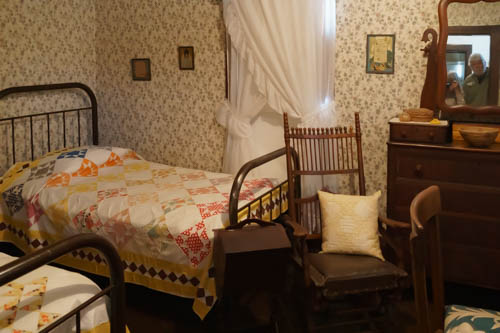


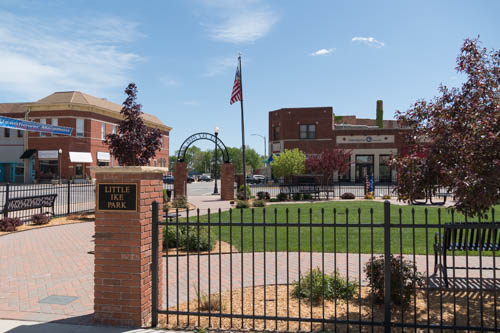
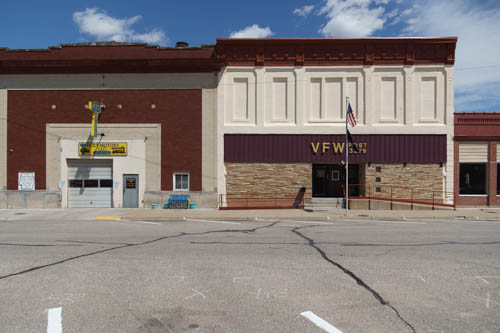
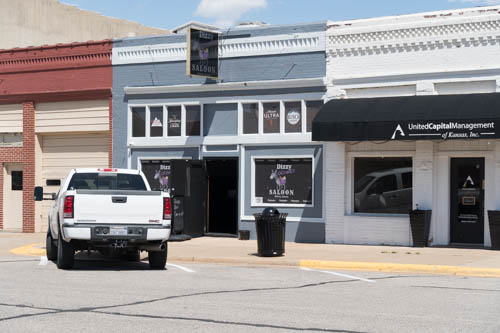
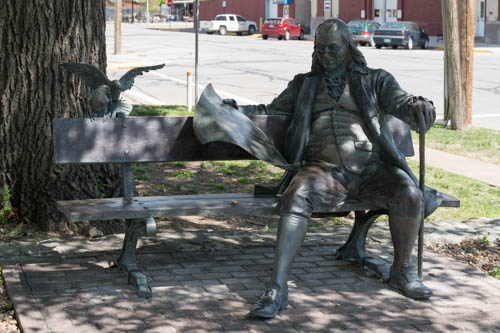
A few photos of the surrounding area in Abilene, Kansas.


Well, I finally learned about my first president and I’m not sure what to think. He impacted the country in positive ways when you consider he ended the Korean War, authorized the construction of the Interstates and signed the Civil Rights act, among other good deeds. Yet the use of the CIA for covert operations has left lasting damage to relationships with other countries.
Analyzing all of his actions to determine if Eisenhower deserves a top ten rating would require more research than I wanted to do. So I read the Farewell Speech he gave before leaving the White House. He made several points I found interesting and relatable to current affairs around the world and in today’s political climate:
1) He talked about how the President and Congress need to work together to find the best solutions to shape the nation’s future.
2) He said, “America’s leadership and prestige” does not rely only on our “unmatched material progress, richs and military strength, but on how we use our power in the interests of world peace and human betterment.”
3) He spoke at length about the buildup of the country’s military-industrial complex during the previous years and the importance to “guard against the acquisition of unwarranted influence, whether sought or unsought, by the military-industrial complex.” And he recognized that “the potential for the disastrous rise of misplaced power exists, and will persist.”
4) On conservation, he said we must, “Avoid the impulse to live for today, plundering … the precious resources of tomorrow. We cannot mortgage the material assets of our grandchildren without risking the loss also of their political and spiritual heritage. We want democracy to survive for all generations to come, not to become the insolvent phantom of tomorrow.”
And his parting prayer at the end of his speech asked for a utopia for the world I fear will never exist. However, that doesn’t mean we should stop striving for the dream.
“We pray that peoples of all faiths, all races, all nations, may have their great human needs satisfied; that those now denied opportunity shall come to enjoy it to the full; that all who yearn for freedom may experience its spiritual blessings; that those who have freedom will understand, also, its heavy responsibilities; that all who are insensitive to the needs of others will learn charity; that the scourges of poverty, disease and ignorance will be made to diappear from the earth, and that, in the goodness of time, all peoples will come to live together in a peace guaranteed by the binding force of mutual respect and love.”
Reading the speech brought me closer to agreeing with Eisenhower’s ranking in the top ten of all presidents. I like how he laid out the threats to the country that existed then and gave warnings or advice about the future. And I’m sad more people didn’t pay attention.
Up Next: We stop in Goodland, Kansas, for a few days
 The Traveling Todds