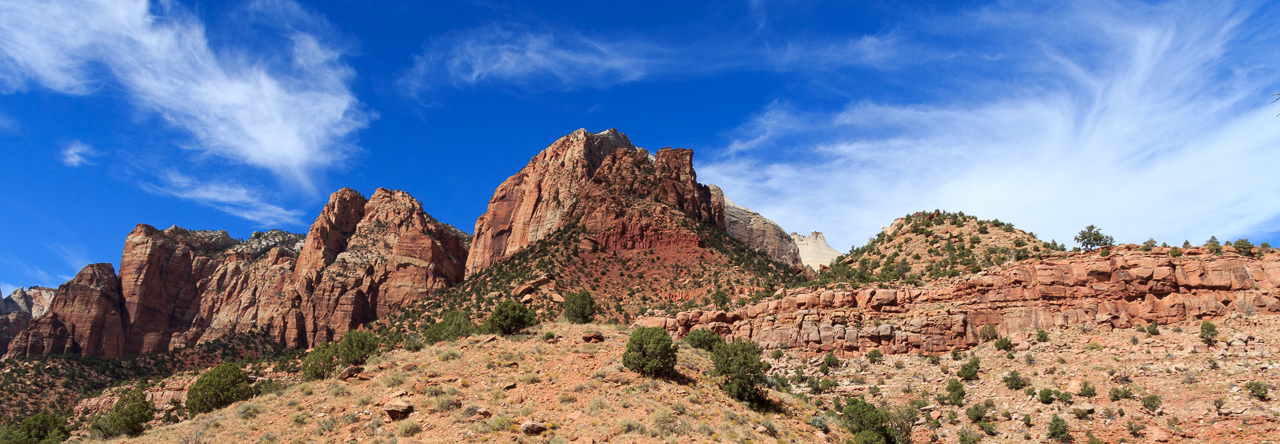
June 2026, New York City, Episode 3
On day five of our trip to New York City, we boarded a Circle Line Harbor Cruise. The narrated two-and-a-half-hour cruise circled Manhattan Island and passed under 20 bridges. Along the way, a guide provided historical context to different sites on the shorelines we passed.
Circle Line Harbor Cruise

In Jersey City, New Jersey, the fifty-foot diameter Colgate Clock, built in 1924, stood at the top of the Colgate-Palmolive headquarters building until 1985. It was relocated to its present home before the building was demolished.

The Central Railroad of New Jersey Terminal, also known as the Communipaw Terminal, is part of Liberty State Park.

The Ellis Island National Museum of Immigration, although still open for tours, was under renovation and some exhibits were closed, so we didn’t go there. Another item to add to the list for when we visit again.

Visitors lined the base of the Statue of Liberty. For an immersive experience, take a round-trip ferry to visit both the Statue of Liberty and the Ellis Island National Museum of Immigration. Offered by Statue City Cruises, it also includes audio-tours.

The mural on the ferry below caught my attention. Ann Valdez is the creator of the mural titled Spring Migration, and presented by the Trust of Governors Island under the Governors Island Arts program. The Harbor Charger Hybrid Ferry services Governors Island which is closed to vehicles. So why is there a semi-truck on it? Apparently delivery vehicles are allowed.

The white structure on the right of the photo below is the Governors Island Ventilation Building for the Hugh L. Carey Tunnel (AKA Brooklyn-Battery Tunnel). It serves as a ventilation and exhaust shaft for the twin-tube underwater tunnel beneath the East River.

In Brooklyn, a redevelopment project repurposed the former Domino Sugar factory into a Class A office building. I don’t know what the building looked like before, but I like the looks of it now.

It’s hard to escape the Empire State Building. It kept peeking out at me while taking photos from different locations.
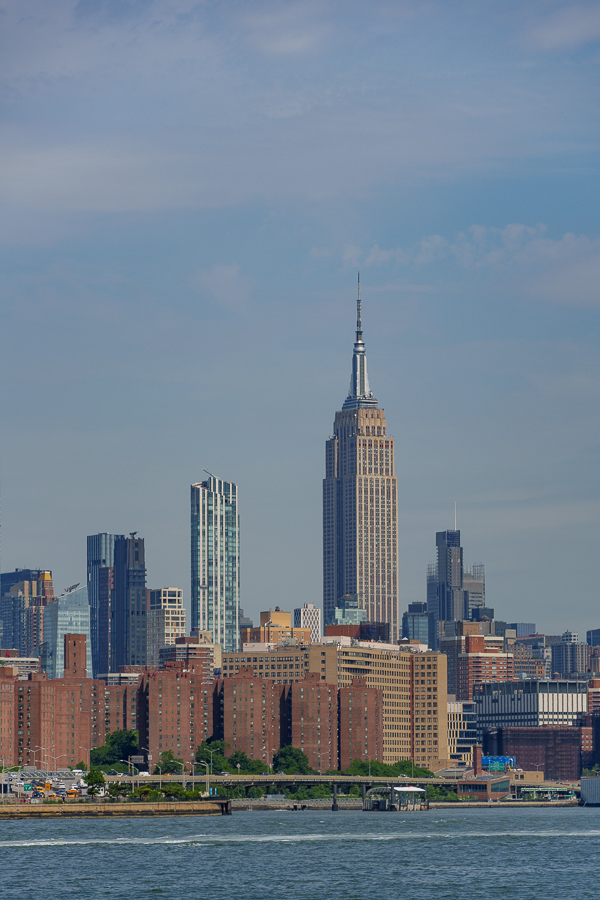
East River Generating Station (East River Power Plant) in Manhattan

Waterside Plaza is a residential and business complex along the East River in the Kips Bay of Manhattan.

The two copper-clad towers that bend toward each other and linked by a three-story skybridge were built between 2014 and 2017.
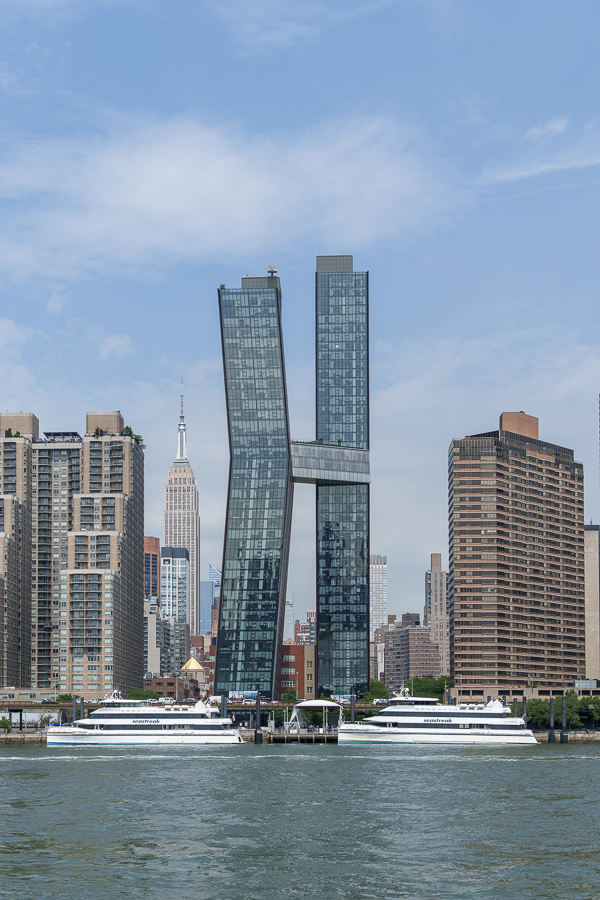
or 626 First Avenue
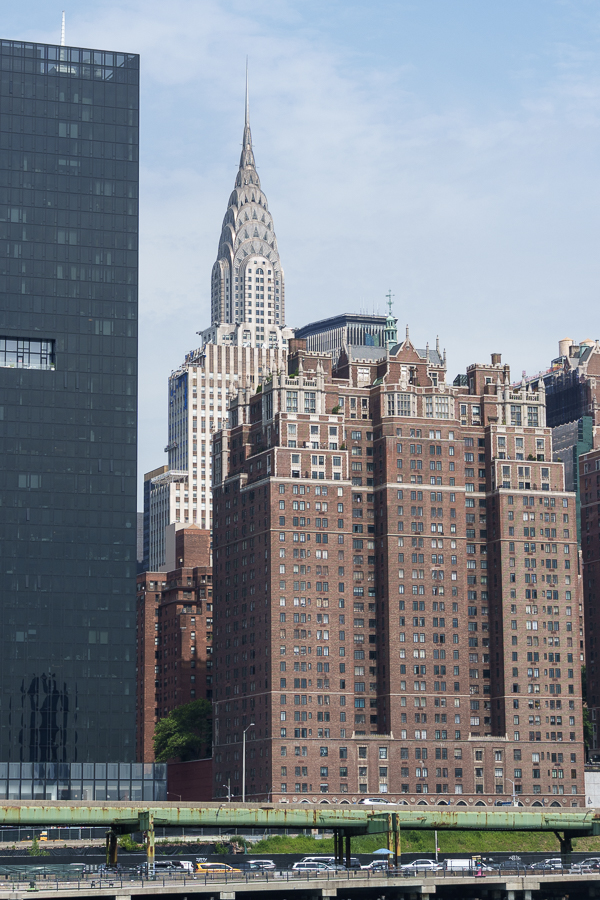
Tudor City Place is a historic skyscraper complex built in late 1920s and developed by Fred F. French. Red brick and terracotta detailing depict stone gargoyles and mythical beasts. Coats of arms are carved near the entrances and upper levels.
I opted to include a detail of the Ed Koch Queensboro Bridge rather than its span across the East River.

Another site we missed was Roosevelt Island. Visitors can access the island on the Sky Tram.

Historic railroad swing bridge Spuyten Duyvil Bridge carries Amtrak trains on the Empire Connection.

I liked how the city skyline fit under this bridge.

On our way back to the hotel, we spotted kids playing in the water spouts during a hot afternoon.

USS Intrepid (CV-11) aircraft carrier is docked at Pier 86 on the Hudson River. The ship houses the Intrepid Sea, Air & Space Museum. We didn’t relish standing in line in the heat, so we skipped it.

This was the only street where the seedier side of living in Manhattan was apparent. Most of the streets where we walked were free of debris of any kind.

Elevators for cars are a clever way to increase parking revenue in Manhattan.

Central Park
With one more day before we hopped on the plane for home, Jon relaxed at the hotel while I trekked across Central Park to the Metropolitan Museum of Art. Although I passed areas we had already seen in the park, I encountered a few new spots as well. The canopies of the trees provided enough shade for multiple groups of families and friends to stake out their section for a delightful picnic on a Saturday afternoon.

I can’t remember seeing croquet portrayed in a movie set in Central Park, so I had to stop and watch the players striking their balls through hoops. With everyone dressed in white, I assumed the players must adhere to a dress code.

The ever-present skyline loomed beyond the tree line, and those who hadn’t staked out a spot in the shade braved the sun shining down on them.

The Bethesda Fountain with the Angel of Waters sculpture was dry. The fountain and sculpture join other icons used in movies. Emma Stebbins designed the sculpture in 1873. It celebrated the Croton Aqueduct, which fed the fountain and supplied fresh water to the city. Central Park Conservancy (CPC) turned the fountain off pending restoration that began in September 2026.

A week after our visit, the Model Sailboat and Paddleboat Basin closed for restoration to rebuild mechanical systems and to replace aging vegetation and native shrubs and trees. The CPC estimates $37 million to complete the restoration scheduled to begin in August 2026 with a completion in late spring or early summer in 2028. I’ll have these photos to compare to the renovation results.


The eleven-foot-high Alice in Wonderland bronze statue by Jose de Creeft, stands nearby. George Delacorte commissioned the Margarita Delacorte Memorial, which was created in 1959 and dedicated to his wife.

I thought I went back in time when I approached these picnickers dressed in early to mid-1900s attire. Was it a period tableau? The sleeve tattoos on one woman and the child with a Mickey Mouse T-shirt yanked me back to 2026.

Activities abound in Central Park. Ride a bike, a pedicab, or take a horse carriage ride, walk, jog, lawn bowl, croquet, take a tour. There’s even a section of the street that’s blocked off for roller skaters. Rent a boat, fly a kite, sail a model sailboat, watch a film festival and in the winter lace up a pair of skates and twirl and glide on the ice. And after all that, take a break and relax in a designated Quiet Zone.
With so much to do and see, what are you waiting for?
Metropolitan Museum of Art
Across from the Met is the Villa Albertine, the French Institute for Culture and Education, a division of the French Embassy in the US, one of ten such offices throughout the United States.

Thirsty, hot, and famished after my walk, I rushed through the museum to get to the American Wing Café for sustenance in the Charles Englehard Court of the American Wing. It was bright with natural light shining through the raised glass ceiling overhead and a water feature with benches where weary visitors can sit and rest.


The Second Branch Bank of the US (later the US Assay Office). Built between 1822 and 1824, the Greek Revival marble façade once stood on Wall Street. The museum saved the building from demolition and reconstructed it inside the museum in 1924.

Vanderbilt Mantelpiece ca. 1881-83, created by Augustus Saint-Gaudens in New York. The sculptures on each side represent Love and Peace.

After my meal and documenting the art in the court, it was time to explore the Egyptian exhibit and the American Wing.


Frank Lloyd Wright used his Prairie School architectural design for the Francis W. Little House in Minneapolis between 1912 and 1914. Saving the living room from destruction, the museum purchased it and placed it in storage in early 1970. Once restored, the exhibit opened to the public in 1982.

I would like to find such a place to sit, write, and gaze out the window toward a garden filled with flowers. Curling up on a sofa with a throw blanket and listening to rain outside wouldn’t be a bad day either.

The following photos are a sample of the exhibits on display in the American Wing.

for the Blacker House in Pasadena, California, in 1907-09


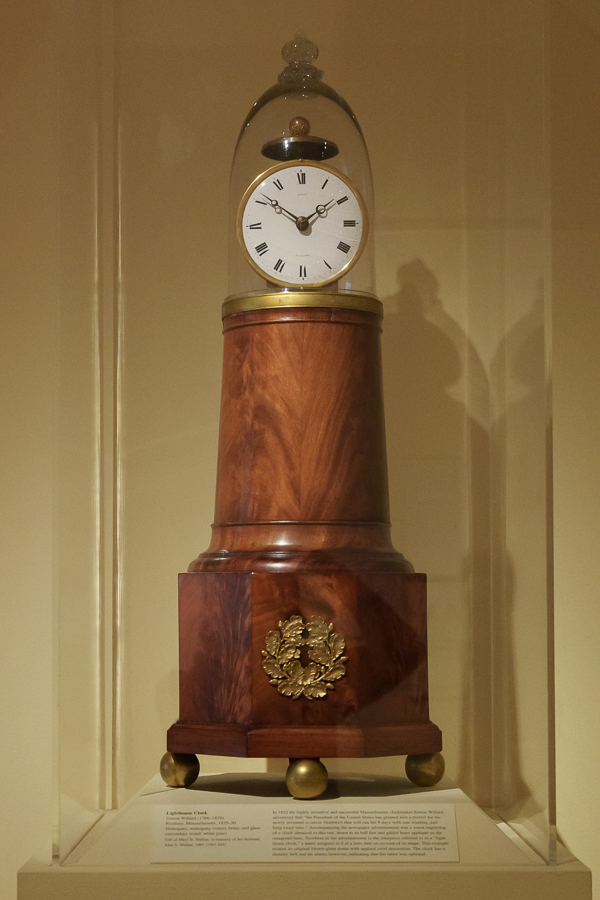


The stained glass exhibit contained an especially colorful display of Tiffany pieces. Below are but two of the many.


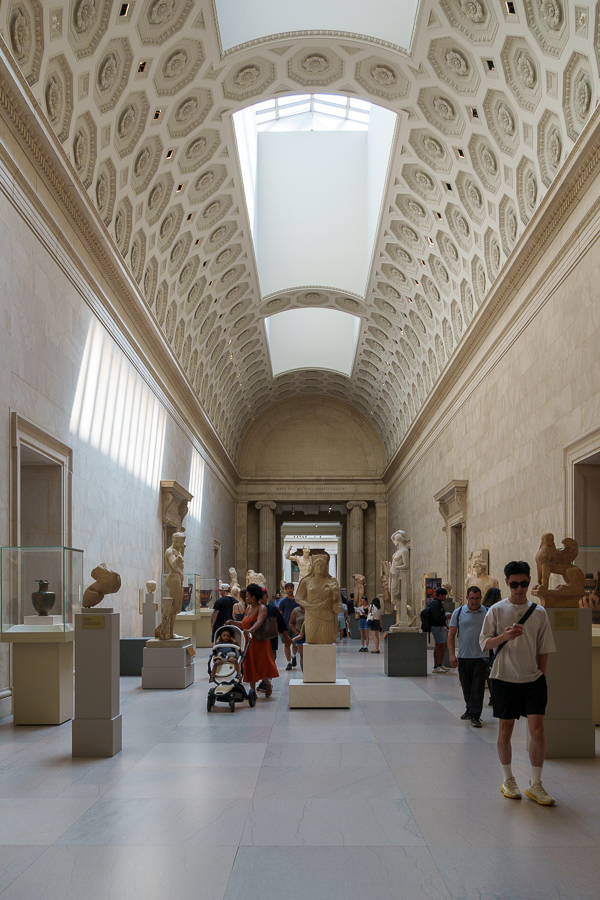
The barrel vault ceiling of the Mary and Michael Jaharis Gallery brings in natural light to the Greek and Roman art display.
Had I taken more time to see the whole museum, I’m sure instead of three blog posts on New York there’d be four or five. We have to thank Sting and his musical, The Last Ship for enticing us to visit New York. We had a wonderful time, and I’m ready to do it all over again. Until then, these posts will serve as a reminder that we didn’t see it all, and urge us to return.
Up Next: We plan to share a few jaunts we took earlier in the year in future posts.


Glad to see you traveling again. I enjoyed all the skyscrapers.
eloise
LikeLike