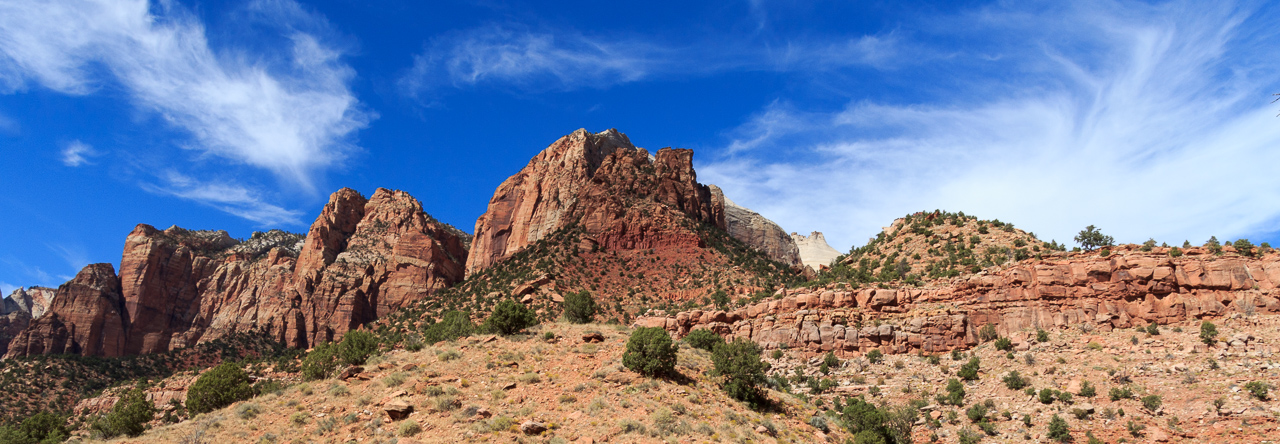
We had two goals in mind for visiting Kansas City, Missouri: Tick off another presidential library and visit my third cousin, Jill. On April 13, 2023, we pulled into the Kansas City East/Oakgrove KOA, which was a convenient location for our plans. First up is the Harry S. Truman Library and Museum.
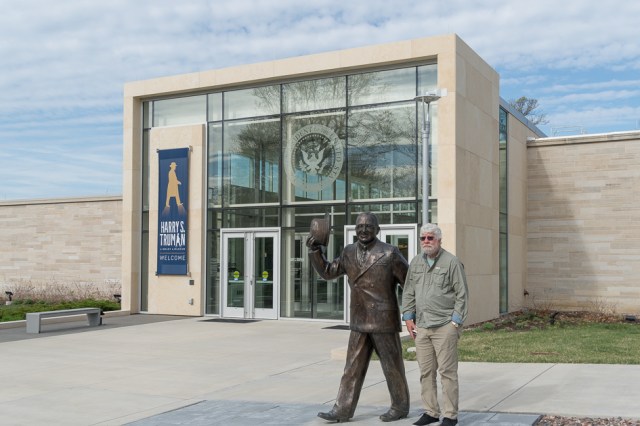
Harry S. Truman Library and Museum
I wasn’t sure what I’d learn at the Harry S. Truman Library and Museum in Independence, Missouri. During my school days, I must have learned that President Truman gave the order to bomb Japanese cities, but somehow had forgotten that fact. So I wondered what else I would learn about our 33rd president.
The museum layout was like other presidential libraries we’ve visited. With eleven exhibits inside and three outside, we were sure to spend plenty of time wandering around.
Plow to Politics, the first exhibit, tells about Truman’s youth and the professions that equipped him for being president. After graduation and with no money for college, he worked on his father’s farm, was a veteran of World War I, and lost his shirt as a haberdasher.


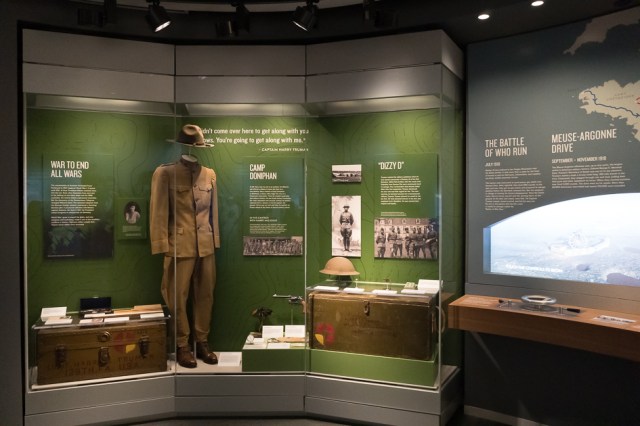

Then he turned to politics, serving as a county administrative judge followed by two terms as a US Senator. As Franklin D. Roosevelt’s running mate in the 1944 election, Truman became vice president on January 20, 1945. Truman had barely learned the ministerial and ceremonial duties as vice president when Roosevelt died on April 12, 1945, propelling Truman to the presidency.

Twelve days later, his staff informed him of a secret atomic weapon.
Detailed in the second exhibit is The First Four months of Truman’s presidency. Having only spoken to Roosevelt two times since January, the unprepared Truman embraced the challenge and got to work.
Imagine being thrust into the presidency without knowledge of the Manhattan Project—authorized by Roosevelt on December 28, 1942—and the development of the first atomic bomb.

When his cabinet disclosed the secret, did Truman’s stomach churn, did he break out in a sweat, did his chest tighten? None of the options would have resulted in a peaceful end of the war and none would have prevented significant loss of life and property in varying degrees.
Which of these four options presented to Truman would you choose?
1) Continue the conventional bombing of Japanese cities (ongoing but not effective)
2) Invasion of Japan (too costly in lives and resources)
3) Demonstrate the bomb by dropping it on an unpopulated island (not likely to persuade Japan’s leader)
4) Drop the bomb on an inhabited Japanese city (seen as the quickest way to end the war and save lives in the long run)
Diplomatic attempts to get Japan to surrender did not work. Even the Potsdam Declaration developed with Britain and China, giving Japan an ultimatum did not work. Truman chose the fourth option and authorized the bombings of Hiroshima and Nagasaki in August 1945, ending the Pacific War. I suspect if Roosevelt had lived a few more months, he would have made the same choice.
Besides dealing with ending the Pacific War, other matters around the world also fell in Turman’s lap those first four months. Some of these include ending the war in Europe, altering the presidential line of succession, and signing the United Nations Charter.
Additional displays include the Post-WWII World, Israel’s Recognition, Truman’s Civil Rights, the President’s Second Term, and the Korean War.

One of my favorite exhibits in the museum was Dear Bess. The brightly lit tower in the middle of the room was a magnet drawing me in. I kept circling around and coming back to it several times, reading a letter here and there.

As reported by The American Presidency Project at UC Santa Barbara, Truman’s approval rating was 32, one of the lowest of all the presidents. However, his presidency ranks in the top 10 by many historians and biographers. No wonder he’s become my favorite president after learning more about him.
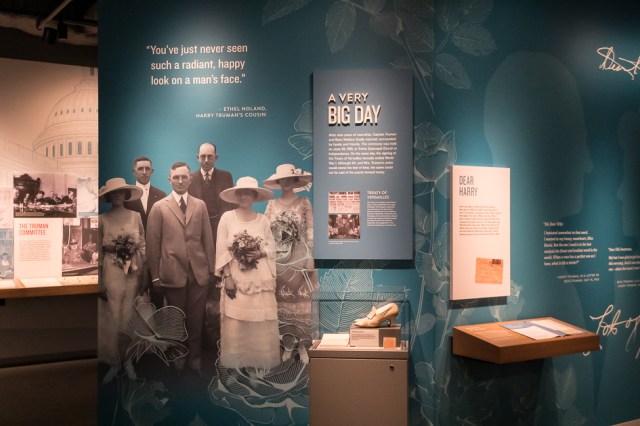
Another reason Truman is my top pick is his love story. Apparently, he was smitten with Elizabeth “Bess” Virginia Wallace when he first met her in 1890. He was only six years old. She was five. They attended the same school from fifth grade until graduation in 1901. But the closest Harry came to a relationship with Bess were the few times she allowed him to carry her books.
Bess must have remained in Harry’s heart after he moved to Kansas City and when he moved to Grandview to work on his family’s farm. Did he pine for the girl of his dreams during those nine years?
In 1910, Harry returned to Independence to visit his aunt and cousins. When an empty cake dish needed returning to Bess’ mother, Harry volunteered to return it. Bess answered the door and she and Harry developed a friendship through correspondence and Harry making several trips to see her.
Six months later, he proposed in a letter dated June 22, 1911. “Water and potatoes will soon be as much of a luxury as pineapples and diamonds. Speaking of diamonds, would you wear a solitaire one on your left hand should I get it?”
Her silence must have crushed him when she ignored him for weeks and then denied his proposal. But he persevered, and they were finally engaged in November 1913.
Unfortunately, circumstances and World War I conspired to keep them from marriage until June 28, 1919. Harry finally achieved his goal after being in love with Bess for nearly twenty years.


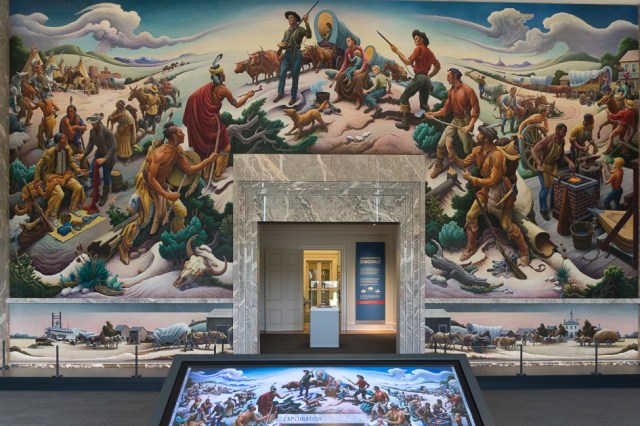
One exhibit not to be missed is the Thomas Hart Benton mural titled Independence and the Opening of the West. The mural depicts life along the Santa Fe, California, and Oregon Trails in the mid-19th century. One photo cannot capture all the images.
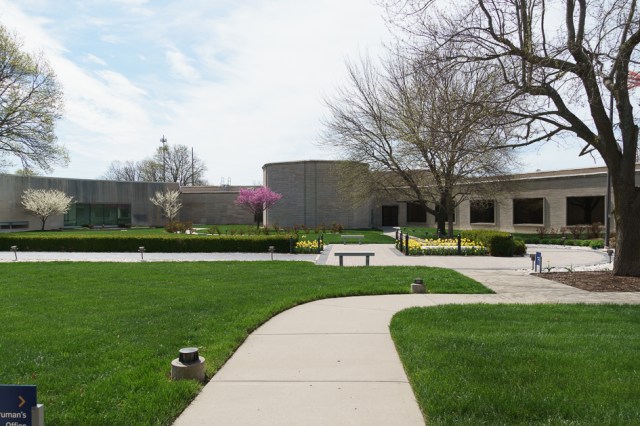
Outside are Harry’s and Bess’ gravesites, colorful gardens, Truman’s office, and the Eternal Flame of Freedom.


I’m glad I had the chance to meet Harry S. Truman. I gathered from the exhibits that he was an honorable man, with principles, morals, fairness, and kindness toward other human beings. Yes, I know he made decisive and controversial decisions that affected not only the United States but the world. To ensure the museum had not deceived me, I fell down a rabbit hole of research when I returned home and found my first impression of the man stayed intact.
Up next: We visit the Wallace/Truman home in downtown Independence and visit my cousin in Lexington, Missouri.
Save Travels
 The Traveling Todds
Something that amazes me is that Japan, despite the atomic bombs, became a close ally of the USA and has embraced a good deal of American culture.
LikeLiked by 1 person
I’m amazed as well.
LikeLiked by 1 person